
 17 min read
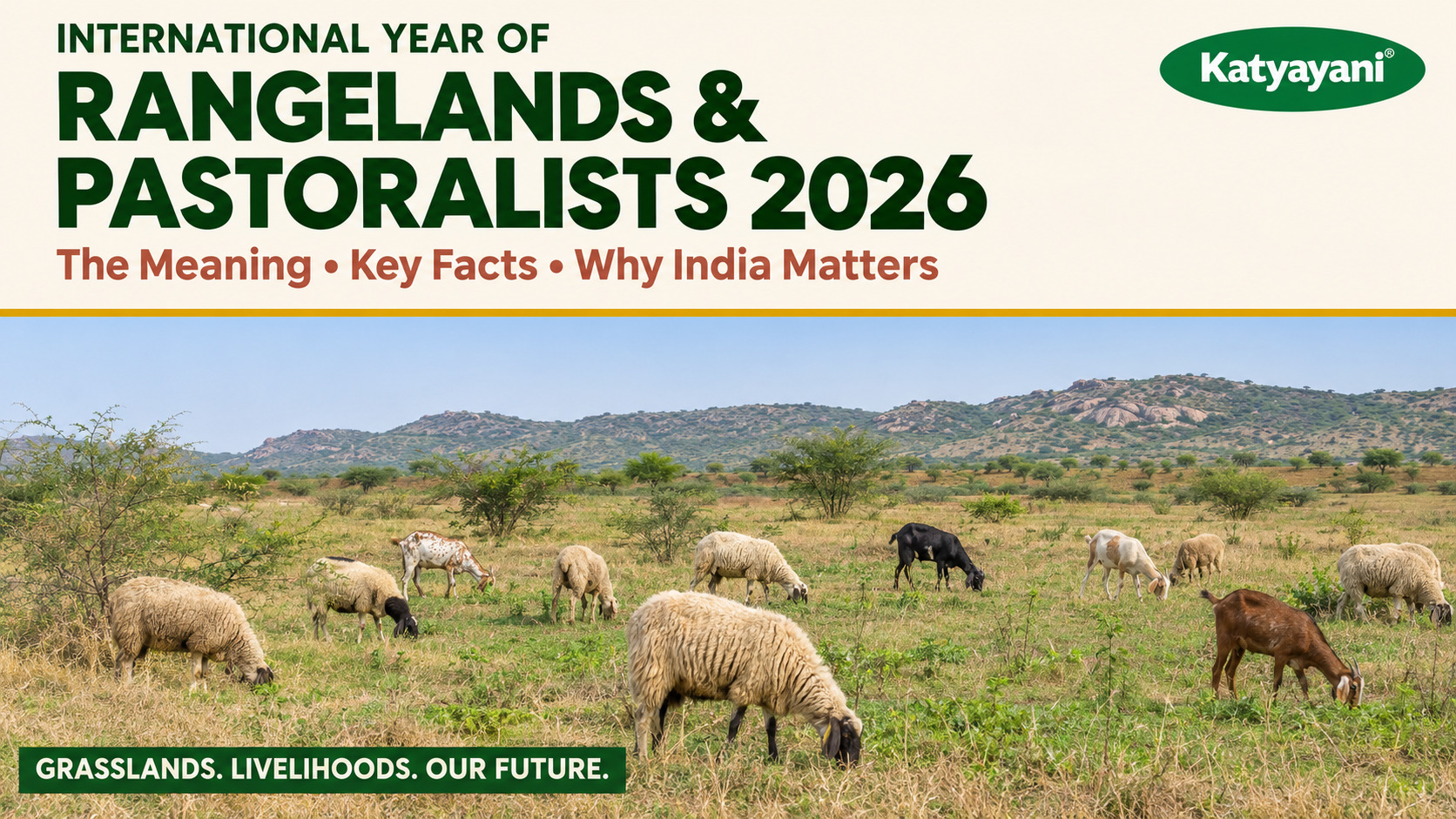
The International Year of Rangelands and Pastoralists 2026 (IYRP 2026) is a United Nations Year. The UN General Assembly declared it in resolution A/RES/76/253, adopted on 15 March 2022, and FAO leads it. Rangelands are grazing lands such as grasslands, savannas, shrublands, deserts and mountain pastures. Pastoralists are people who live mainly from animals that graze on them. FAO says rangelands cover about half of the Earth's land, and about half of them are degraded. India's land-use data (provisional, 2023-24) show 10.21 million hectares of permanent pastures and other grazing land.
What is the International Year of Rangelands and Pastoralists 2026?
It is a year-long United Nations observance in 2026, short name IYRP 2026. Its aim is to raise awareness of rangelands, which are grazing lands, and of pastoralists, the people who live from grazing animals. FAO leads it. It calls for better policy and investment for the pastoral sector.
So what is a "UN Year"? The UN page on international years says the United Nations designates days, weeks, years and decades to mark events or topics, and promotes the aims of the Organization through awareness and action. It also says that usually one or more Member States propose an observance and the General Assembly establishes it with a resolution. A Year does not pass a law for any country. It gives governments, farmers, researchers and families a reason and a shared date to talk about a neglected subject. You can see 2026 on the UN list of international years, with the resolution symbol A/RES/76/253.
The FAO page for the Year puts the idea in one line: covering about half the world's land, rangelands are home to unique biodiversity and pastoral communities whose livelihoods depend on them. It adds that pastoralists raise animals, contribute to food security and hold local and indigenous knowledge that has helped preserve ecosystems across the world.
If you are a student reading this for an exam, keep three facts ready: the name (International Year of Rangelands and Pastoralists), the year (2026) and the lead agency (FAO). If you keep animals or grow fodder, read on, because the same questions about grazing land and fodder are also asked in every Indian village.
Who declared 2026 as the International Year of Rangelands and Pastoralists?
The United Nations General Assembly declared it in resolution A/RES/76/253, which it adopted on 15 March 2022 at its 76th session. FAO says the Year was spearheaded by Mongolia and supported by 60 Member States. FAO is the lead agency and coordinates the work worldwide.
The UN resolution text is short. It was adopted at the 61st plenary meeting on 15 March 2022, without reference to a Main Committee. It decides "to declare 2026 the International Year of Rangelands and Pastoralists", invites FAO to facilitate the Year, asks FAO to report to the General Assembly at its eighty-second session, and says the costs should be met through voluntary contributions. The FAO "About" page says that FAO is the lead agency for celebrating the Year with other stakeholders. The FAO newsroom release of 2 Dec 2025 adds the Mongolia and 60 Member States detail, and records that FAO launched the Year that day in Rome. The President of Mongolia took part in the launch event.
Behind the UN decision there was a long campaign. The FAO page names the IYRP Global Alliance for Rangelands and Pastoralists, a coalition of more than 400 pastoralist and supporting organisations and more than 1,000 individuals that worked for many years to support the nomination, preparation and celebration of the Year. The Alliance runs events and works for policy change and responsible investment in 2026 and after.
The UN text does not name the countries that proposed the draft, so we rely on FAO for the Mongolia and 60 Member States detail. If an exam asks for the resolution number and date, the answer is A/RES/76/253, 15 March 2022.
What are rangelands?
FAO defines rangelands as lands dominated by grasses, grass-like plants, forbs, shrubs and sometimes trees that are grazed, or have the potential to be grazed, by livestock and wildlife. They include grasslands, savannas, shrublands, steppes, deserts, wetlands and mountain areas.
Most of us picture a rangeland as an open green meadow. The FAO pages show a much wider list: the steppes of Central Asia, the African savanna, the Alps and Pyrenees in Europe, the Andes in South America and the Great Plains of the United States are all named as examples. In India the nearest everyday word is grazing land. DES, the statistics wing of the Ministry of Agriculture, defines "permanent pasture and other grazing land" as all grazing land, whether it is permanent pasture or meadow or not, and says village common grazing land is included. In many villages this is the gauchar, a word the PIB release of 17 Aug 2026 also uses.
A rangeland does not have to be a government-owned field with a signboard. What makes it a rangeland is how it is used and what grows on it. If native grasses and shrubs feed animals that walk and graze there, it is working as a rangeland.
Who are pastoralists?
FAO describes pastoralists as people whose livelihoods rely mainly on domesticated and semi-domesticated animals that graze and browse mostly on rangelands, with varying degrees of mobility. They herd sheep, goats, cattle, camelids, yaks, horses, reindeer and buffaloes, among others. FAO says they contribute to food security while preserving ecosystems.
Mobility is the key word. Many pastoralist families move their herds with the seasons, to where grass and water are available. Others stay near a village and graze the commons every day. FAO counts both under the word as long as animals grazing on rangelands are the main source of living.
The FAO newsroom release says pastoralists manage around 1 billion animals worldwide and are key custodians of rangelands. The FAO home page adds that they are present in more than 75 percent of the countries of the world and manage at least 25 percent of the world's land. They give milk, meat, wool, fibre and manure, and they carry knowledge about plants, weather and animal health that took generations to build.
We have not named individual Indian pastoral communities in this post. The official pages we opened (FAO, PIB, DES, DAHD) do not list them, and we keep to what an official source states. PIB does say that India's grasslands and open natural ecosystems sustain pastoral, livestock-based and agricultural livelihoods, which we cover below.
What is the theme of the Year and what does it want to achieve?
The FAO page gives the theme as "Lands in Motion, Stewards of Knowledge and the Future". The Year wants to raise awareness and argue for responsible investment and adapted policies for the pastoral sector, including secure access to land and natural resources, support for mobility and inclusive governance.
The FAO page lists what the Year calls for. Policies that secure pastoralists' access to land and natural resources. Support for mobility. Customary and inclusive governance. Adequate investment in rangeland management, ecosystem restoration, animal health services and fair value chains. It also aims to build inclusive policy dialogue and joint action to improve pastoralist livelihoods and sustainable rangeland management, and says rangelands and pastoralists have strong potential to help deliver on the Sustainable Development Goals.
FAO Director-General QU Dongyu said at the launch that FAO will work under the "Four Betters": better production, better nutrition, better environment and a better life, leaving no one behind. He asked that women, youth and pastoralist organisations be heard in the decisions that shape their lands. The release lists four priorities: secure access and governance rights for pastoralist communities, scale up sustainable rangeland management, strengthen value chains and restore degraded ecosystems.
Looking for the logo? FAO says the official visual identity for the Year is available in 6 languages on its page, together with a communication handbook. We do not reproduce or describe it here.
What are the key facts and figures about rangelands and pastoralists?
FAO's own numbers are short and clear. Rangelands cover about half of the Earth's land and hold about 30 percent of global soil organic carbon, yet about half of them are degraded. Pastoralists herd about 1 billion animals, are present in over 75 percent of countries and manage at least 25 percent of land.
| Fact | Figure (FAO) | Source |
|---|---|---|
| Share of the Earth's land that is rangeland | About half | FAO IYRP home page |
| Share of global soil organic carbon held in rangelands | About 30 percent | FAO IYRP home page |
| Share of rangelands estimated to be degraded | About half | FAO newsroom, 2 Dec 2025 |
| Animals herded by pastoralists | About 1 billion | FAO IYRP home page |
| Countries with pastoralists | More than 75 percent of countries | FAO IYRP home page |
| Land managed by pastoralists | At least 25 percent of the world's land | FAO IYRP home page |
| Member States supporting the Year | 60 | FAO newsroom, 2 Dec 2025 |
| Organisations in the Global Alliance | More than 400, plus more than 1,000 individuals | FAO About page |
FAO also says that data on rangelands and pastoralists are patchy. Its "About" page states that complete, accurate data on rangeland condition, pastoralist populations and their contribution to the SDGs are often lacking, and that governments and investors struggle to plan without them. That is why you will see round words like "about" and "at least" in the figures above. Treat them as FAO's best estimates.
Why do rangelands matter for food, climate and biodiversity?
Rangelands give natural forage for livestock, store carbon, regulate water and shelter wildlife. FAO says they provide natural forage that supports global meat, dairy and fibre production, hold about 30 percent of global soil organic carbon, and sustain unique plants and animals across continents.
Think of what is on your plate. Milk, curd, ghee, meat and wool often begin as grass or shrub leaves eaten by an animal that walked to find it. FAO says pastoralists produce high quality meat, milk and other animal-source foods and so contribute to food security and nutrition. Rangelands also connect communities through local and cross-border trade networks that support rural markets.
Then there is carbon. When grass roots and soil organic matter are healthy, they hold carbon below ground. When the land is degraded, that carbon can escape. FAO's statement that about half of rangelands are degraded, set beside the 30 percent carbon figure, is why restoring them is part of the climate argument. FAO also says the pastoral practices of strategic herd mobility and adaptive grazing help regrow vegetation and maintain healthy soils, water cycles and wildlife habitat, and that maintaining these practices supports biodiversity, including indigenous livestock breeds.
What problems do rangelands and pastoralists face?
FAO lists land degradation, droughts, floods and other climate impacts, animal diseases, and competing land uses such as conversion to cropland and urban use, mining and invasive species. These pressures cause habitat loss, soil erosion, falling productivity and weaker resilience.
The FAO release says ecosystems are under increasing pressure from droughts, floods and other climate impacts, land degradation, animal diseases and competing land uses, which limit pastoralists' mobility and threaten their way of life. The "About" page names the conversion of rangelands for urban and cropland use, mining and the spread of invasive species, and says these lead to habitat loss, soil erosion, declining rangeland productivity and reduced resilience to climate impacts.
- Land conversion. Open grazing land is turned into fields, towns, roads or mines.
- Degradation. About half of rangelands are estimated to be degraded (FAO).
- Climate. More unpredictable weather, with droughts and floods, hits both grass and herds.
- Animal disease. FAO also supports prevention and control of diseases such as peste des petits ruminants (PPR), also called sheep and goat plague.
- Policy gaps. FAO says supportive laws and policies are needed to secure access to land, water and mobility routes, and to recognise indigenous and local knowledge.
- Missing data. Without good information, investment goes to the wrong places.
Why does mobility matter for rangelands?
Moving herds lets grass recover, keeps animals healthy and eases pressure on soil and water. FAO says pastoralists move herds strategically with seasonal conditions, forage and markets, and that policies that restrict movement, such as land fragmentation or privatisation, can harm both rangeland health and livelihoods.
Here is a small picture. A village herd that grazes the same patch every day will eat the best grasses first. In two or three seasons the patch has fewer of them and more weeds or bare soil. A herd that moves on gives the patch time to regrow. This is our simple explanation of the principle that FAO states: mobility allows vegetation to recover, keeps herds healthy and reduces pressure on fragile soils and water sources.
FAO also says that in the face of unpredictable weather, mobility is an essential adaptation strategy, helping communities cope with droughts, floods and shifting seasonal patterns. Mobility also supports local, regional and cross-border trade. This is one reason the Year's theme begins with the words "Lands in Motion".
What do rangelands look like in India, and how much grazing land is there?
The official land-use data count 10,210 thousand hectares, about 10.21 million hectares, as permanent pastures and other grazing land in 2023-24. That is 3.32 percent of the reporting area of 306,964 thousand hectares, per the DES publication of July 2025.
The Land Use Statistics at a Glance 2023-24 sets this beside the other categories: forests 72,021 thousand hectares, barren and unculturable land 16,589, culturable wasteland 11,586, current fallow 14,907 and net area sown 138,992. It says the area under permanent pastures, grazing lands and culturable wasteland has remained stable. The report calls pastures "contributing to livestock sustainability".
There is a second number from PIB. On 6 Apr 2025, the Union Minister for Fisheries, Animal Husbandry and Dairying said at ICAR-IGFRI, Jhansi that the country has approximately 11.5 million hectares of grasslands and nearly 100 million hectares of wastelands that can be used more efficiently, against only 8.5 million hectares under cultivated fodder (PIB release). The two numbers differ because they count different things. DES counts the land that records label as pasture and grazing land. The Minister's 11.5 million is a figure for grasslands. We print both, name the source of each, and do not try to add them up.
India's new official Guide adds the wider picture. On 17 Aug 2026, at the 17th Session of the UNCCD Conference of the Parties in Ulaanbaatar, Mongolia, India launched its first Guide to Grasslands and Other Open Natural Ecosystems. According to the PIB release, these ecosystems range from Himalayan and Terai grasslands to the Thar and Banni areas, Deccan savannas, rocky plateaus, ravines, scrublands, coastal ecosystems and desert lands, and they sustain pastoral, livestock-based and agricultural livelihoods. The Guide has thematic sections on pastoralism, fire ecology and carbon sequestration.
Is a rangeland the same as wasteland? What does India's Environment Minister say?
Not in the way India's Environment Minister describes them. In a PIB release of 17 Aug 2026 he said grasslands, scrublands and ravines have for too long been judged by the absence of trees, although they shelter species found nowhere else on earth and sustain pastoral communities.
The PIB release of 17 Aug 2026 quotes the Minister recalling the Oran and gauchar lands of Rajasthan, which villages protected, and says local communities understood that land, herds and their own lives were closely connected. He described the Guide as an important step in recognising India's open natural ecosystems and stressed their science-based conservation alongside forests. The release says restoring them has a role in India's Land Degradation Neutrality targets.
This matters for a farmer because the ICAR-IGFRI Director's presentation lists "diversion of grazing lands for other purposes", such as industry and social welfare schemes, among the issues for grasslands. We do not know the extent of this at national level, because the same presentation also lists the lack of an inventory of grassland resources as a gap. Checking how your village grazing land is recorded is a sensible first step.
How many animals depend on grazing in India?
The 20th Livestock Census (2019) counted 535.78 million livestock in India. That includes 192.49 million cattle, 109.85 million buffaloes, 74.26 million sheep and 148.88 million goats, according to the PIB release of 16 Oct 2019. The census does not say how many of them graze.
These numbers come from the 20th Livestock Census release by the Department of Animal Husbandry and Dairying. The census does not say how many of these animals graze on rangelands or common land, so we do not claim a share. What the numbers do show is the size of the demand for fodder. Sheep and goats together are over 223 million (our sum of the two census figures).
If you keep a few animals, our National Livestock Mission subsidy post explains the goat, poultry and pig unit schemes, and our livestock insurance post explains how to insure a cow or buffalo.
Why is India short of fodder, and what do grazing lands have to do with it?
PIB (6 Apr 2025) quotes a national green fodder deficit of about 11 percent. Only 8.5 million hectares are under cultivated fodder. The ICAR-IGFRI Director's presentation lists the grassland issues: overgrazing, loss of grazing land to other uses, urbanisation and social conflicts.
The IGFRI presentation gives a plain list. Under "grassland issues" it names: lack of proper policy for management and use of common property resources and degraded lands and wastelands, increasing urbanisation, overgrazing leading to denudation of grasslands, diversion of grazing lands for industry and social welfare schemes, social conflicts, lack of national-level mission mode programmes, and lack of an inventory of grassland resources. The presentation is undated and uses Livestock Census 2012 data, so read it for the list of issues and not for current numbers.
Now connect this to your own farm. Rangelands and cultivated fodder are two parts of the same feed supply. When grazing land shrinks or degrades, more pressure falls on fields and on bought fodder. When farmers grow fodder crops well, some pressure comes off the commons. Our Napier grass post and our fodder sorghum post cover two ways to grow fodder, one perennial and one annual.
What is India doing to restore grazing land and grow more fodder?
The National Livestock Mission guidelines (Jan 2025) have a component for fodder production from non-forest wasteland, rangeland, grassland and non-arable land. PIB (6 Apr 2025) reports ICAR-IGFRI work on perennial grasses, fodder machinery and drone-based seed pellets for grassland rejuvenation.
Take the NLM first. In the NLM guidelines, "Activity IV" is fodder production from non-forest wasteland, rangeland, grassland and non-arable land. Its objectives are to rehabilitate degraded land by introducing suitable grasses, legumes and fodder trees, to raise the production of palatable grasses, legumes and tree leaves, to produce biomass to reduce the gap between supply and need, and to build a reserve of forage for lean periods and crises. The guidelines say perennial grasses and legumes are chosen for the soil type, and that the component can improve saline, acidic and heavy soils.
The conditions are specific. For individual farmers, proposals are for a minimum of one hectare. For government land, community land or gaushalas, proposals are for a minimum of 2.5 hectares and in multiples of 2.5 hectares, for perennial fodder crops for at least 3 years on the same site. An individual farmer must sign an agreement or MoU with the state department and keep the land under grassland for at least 3 years, or refund the assistance. The area should be outside municipality limits. These are the rules of the guidelines, and a state may add its own. Our agriculture subsidy schemes post gives the wider picture.
Now the research side. The PIB release on the ICAR-IGFRI visit lists the technologies shown: livestock-based integrated farming systems, apomictic breeding in perennial grasses, specialised fodder farm machinery to reduce manual labour, seed standards and certification systems, and the use of drones for seed-pellet-based grassland rejuvenation at scale. The Minister stressed perennial grasses that tolerate abiotic stress and can rejuvenate degraded lands.
What does the Year mean for farmers and dairy families?
It means grazing land and fodder should be talked about openly in your village, your FPO and your gram sabha. It does not bring a new subsidy by itself. The practical gains come from existing schemes, careful use of common grazing land, and growing good fodder.
Here are three small examples. A dairy family with two buffaloes finds that the gauchar next to the village is bare by March. The Year is a good moment to ask the panchayat what the land record says about that patch and whether the NLM component above can be used to restore it. A goat keeper notices that grazing near the village is too thin to carry the flock in summer. Extra fodder from a few rows of perennial grass or a fodder crop helps. A gaushala manager asks whether the shed can be fed from its own land rather than from bought straw. The IGFRI and NLM material above is the place to start.
- Look at the record. Check how your village grazing land is recorded, and by whom it is managed.
- Match animals to feed. If grazing is thin, grow fodder. See the fodder posts linked above.
- Use what exists. The NLM fodder components in the January 2025 guidelines are written for farmers, community land and gaushalas.
- Keep animals healthy. FAO links animal health services to the Year, and PPR control is one of its named disease efforts.
- Know your credit options. Our Kisan Credit Card post says the card was extended to animal husbandry, dairy and fisheries working capital in 2019.
- Keep records of your herd. Insurance and scheme benefits need clear records; see the livestock insurance post.
Not all of this is official advice. The list above is our reading of the sources, written in farm terms. The official material is in the paragraphs before it.
How can you take part in the International Year of Rangelands and Pastoralists?
FAO says anyone can take part: pastoralists, researchers, governments, businesses, NGOs, journalists, schools and individuals. It offers a page for events, a communication handbook, a social media campaign with the tag #IYRP2026, and free material to share. FAO invites you to plan your own activities for the Year.
The FAO page invites you to plan activities for the Year, and lists events, a communications handbook, a Trello board of facts for sharing, and a video. For a farmer or a school in India the ideas are simple and cost little. Hold a village meeting on the common grazing land. Walk the land with the elders and mark what grows on it. Share the FAO facts with your FPO or SHG. Ask a Krishi Vigyan Kendra about fodder and grassland methods. PIB reports that the Union Minister asked for the quick spread of IGFRI technologies through KVKs.
FAO also says that in 2026 it leads the International Year of the Woman Farmer too, and that the two Years support each other, because women farmers and pastoralist communities both sustain land and food. We cover that Year in our post on the International Year of the Woman Farmer 2026.
What are the key dates for the Year?
The Year is 2026. The UN General Assembly adopted resolution A/RES/76/253 on 15 March 2022, with 60 Member States in support, says FAO. FAO launched the Year on 2 Dec 2025 in Rome. India launched its first Guide to Grasslands on 17 Aug 2026 at UNCCD COP17 in Ulaanbaatar.
| Date | Event | Source |
|---|---|---|
| 15 Mar 2022 | UN General Assembly adopts resolution A/RES/76/253 (76th session, 61st plenary meeting) | UN resolution |
| 6 Apr 2025 | Union Minister at ICAR-IGFRI Jhansi: 11 percent green fodder deficit, 8.5 million ha fodder | PIB |
| 2 Dec 2025 | FAO launches the Year in Rome, with the President of Mongolia at the event | FAO newsroom |
| 2026 | The International Year of Rangelands and Pastoralists | UN list |
| 17 Aug 2026 | India launches Guide to Grasslands and Other Open Natural Ecosystems at UNCCD COP17 | PIB |
We found no exam-style "important dates" list on an official page, so we do not add one. For an exam, learn the name, the year, the resolution number and date (A/RES/76/253, 15 March 2022) and the lead agency, as above.
Which words should you remember about rangelands and pastoralists?
A short glossary helps. Use the definitions below, taken from FAO, DES and PIB. They are the ones an exam, a news article or a government paper is most likely to use, so read them once before you move on.
| Word | Meaning | Source |
|---|---|---|
| Rangeland | Land dominated by grasses, grass-like plants, forbs, shrubs and sometimes trees that is grazed or can be grazed by livestock and wildlife | FAO |
| Pastoralist | A person whose livelihood relies mainly on domesticated or semi-domesticated animals grazing and browsing on rangelands, with varying mobility | FAO |
| Pastoral mobility | Moving herds with seasons, forage, water and markets | FAO |
| Permanent pasture and other grazing land | All grazing land, permanent pasture or not; village common grazing land is included | DES |
| Gauchar / Oran | Village-protected grazing lands named by the Environment Minister | PIB |
| ONEs | Open Natural Ecosystems: grasslands, savannas, deserts, scrublands and similar | PIB |
| IYRP | International Year of Rangelands and Pastoralists | UN, FAO |
The word "Oran" in the PIB release is used with gauchar for the lands protected by villages in Rajasthan. We keep to what the release says and do not define it further.
Conclusion
The International Year of Rangelands and Pastoralists 2026 was declared by the UN General Assembly in resolution A/RES/76/253 of 15 March 2022 and is led by FAO. It asks the world to value grazing lands and the people who live from them. FAO says rangelands cover about half of the Earth and about half of them are degraded. India counts 10.21 million hectares as permanent pasture and grazing land (provisional, 2023-24), faces a green fodder deficit of about 11 percent, and published its first Guide to Grasslands in August 2026. For a farmer, the Year is a prompt to look after the village grazing land and to grow good fodder.

Leave a Comment