
 13 min read
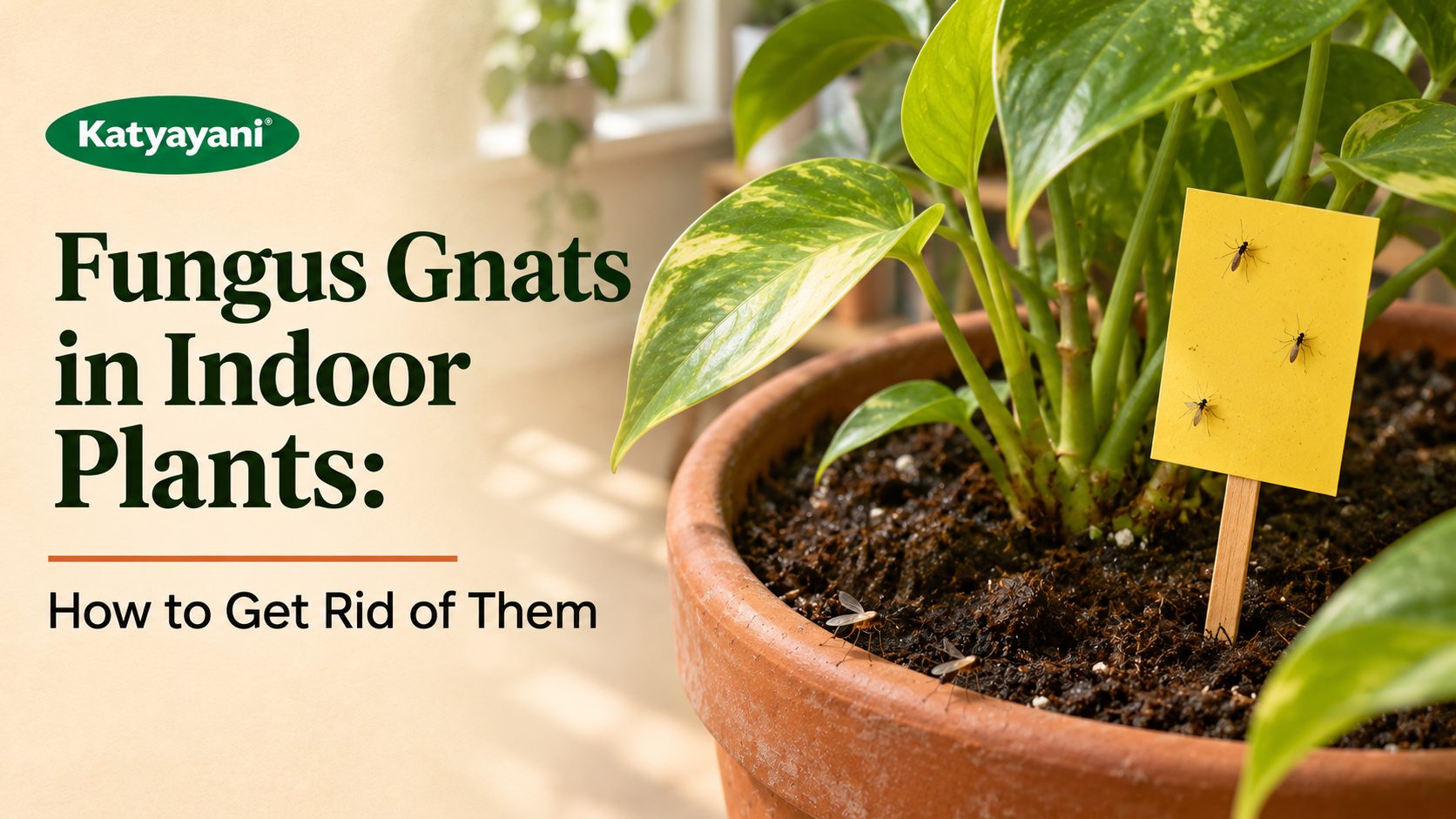
Fungus gnats are small, dark, mosquito-like flies that do not bite. Their larvae live in wet potting soil and eat fungi, rotting matter and sometimes roots. To get rid of them, let the top 1 to 2 inches (2.5 to 5 cm) of soil dry between waterings, catch adults on yellow sticky traps, and kill larvae with Bti, a soil bacterium. Give it 3 to 4 weeks, the time one full life cycle takes.
What are fungus gnats and how do I know I have them?
Fungus gnats are small, dark, mosquito-like flies that breed in damp potting soil. UC IPM describes the adults as dark, delicate flies with long legs and long antennae. Most are about 1/16 to 1/8 inch long, which is 1.6 to 3.2 mm. Arizona Extension calls them grey or black, and the common species have a Y-shaped vein on the wing.
You will see them walking on the soil or flying slowly around the pot, a lamp or a window. They are weak fliers and stay near plants, soil and walls. The larvae stay out of sight. They are whitish or clear, legless, and have a shiny black head.
Fruit flies are the usual mix-up. The NC State Extension note says fungus gnats are drawn to moist soil, not ripe fruit. UC IPM adds that shore flies live in the same places but have short, bristle-like antennae. So if the flies sit on the soil and not on the fruit bowl, you likely have fungus gnats. Still not sure? Put a yellow sticky trap in the pot and look closely at what it catches. You want a slender body, long legs and the Y-shaped vein on the wing.
Are fungus gnats harmful to my plants or to people?
The adults do not bite and do not damage plants. The larvae can harm roots, mainly in seedlings and young plants. UC IPM says larvae in large numbers can damage roots and stunt growth, but adults are mostly a nuisance.
For an older houseplant, the harm is usually small. NC State says established plants suffer little, but a severe infestation can lead to root rot because larval wounds let disease in. A wilting houseplant is more often a watering problem, root-rot fungi or poor drainage than gnat larvae, says UC IPM.
The Arizona Extension sheet (2010) adds that both adults and larvae can carry plant disease. So do not ignore a bad outbreak, and do not blame the gnats alone when a plant looks sick. If your plant is yellowing or drooping, read about yellow leaves on houseplants before you decide.
Serious damage is most common in greenhouses, nurseries and sod farms, says UC IPM, and larvae outdoors rarely cause serious harm. A few flies in a home pot are rarely a crisis. Wisconsin Extension calls most cases a cosmetic problem.
What is the life cycle of a fungus gnat?
A fungus gnat passes through four stages: egg, larva, pupa and adult. At room temperature the full cycle takes about 3 to 4 weeks. Colorado State says egg to adult takes 3 to 4 weeks at 65 to 75 F (18 to 24 C). UC IPM says one generation takes about 17 days at 75 F (24 C).
| Stage | UC IPM (at 75 F) | Wisconsin and Colorado State | Arizona (70 to 75 F) |
|---|---|---|---|
| Eggs | Hatch in about 3 days | Hatch in 3 to 6 days. A female lays up to 200 eggs in cracks on moist soil | Hatch in 4 to 7 days. A female lays 50 to 300 eggs |
| Larvae | About 10 days to reach the pupa | Four stages over 1 to 2 weeks (Wisconsin). Fully grown in 2 to 3 weeks (Colorado State) | Feed for two weeks |
| Pupae | Adults emerge about 4 days after | Adults emerge 4 to 5 days after pupation (Wisconsin). About one week (Colorado State) | Pupation takes 5 to 6 days |
| Adults | Full generation about 17 days | Live about a week (Wisconsin). 7 to 10 days (Colorado State) | Live about a week |
| Egg to adult | - | 3 to 4 weeks | 3 to 4 weeks |
The numbers differ a little, but the pattern is the same. Generations overlap, so eggs, larvae, pupae and adults sit in the pot together. One spray or one trap cannot reach them all, so run your steps for at least one full cycle.
The larvae live in the top 2 to 3 inches (5 to 8 cm) of the potting medium, says Colorado State. That is the layer to dry out and to treat.
Why do fungus gnats come to indoor plants?
They come because the soil stays wet and holds rotting matter. UC IPM says they thrive in moist conditions and decaying organic matter. Breeding sites include overwatered pots, standing water, compost, organic fertilisers, mulch and half-composted material in the potting mix. The usual causes are these.
- Overwatering. Moist soil is where females lay eggs (Wisconsin), and it feeds the fungi the larvae eat (UMD).
- Old or broken-down potting mix. It holds more water and attracts egg-laying females (Colorado State, Ask Extension).
- Peat-rich mix. Adults are strongly attracted to moist media high in peat moss (Colorado State).
- Organic fertiliser and compost. Too much manure or blood meal can encourage them (UC IPM).
- New plants and fresh soil. Contaminated potting soil and new plants can bring gnats in (NC State).
- Plants moved in from outdoors. Plants kept outside in summer can carry gnats indoors in the fall (Wisconsin, Colorado State).
- Shorter, cooler days. Plants use less water, so the same watering keeps the mix wet (Colorado State).
- Wet saucers and poor drainage. Standing water is a breeding site (UC IPM, NC State).
The shorter-days cause is why trouble peaks in winter. Colorado State says the nuisance is most noticeable in late fall and winter. The guide to indoor plant care in winter shows how to adjust watering in the cold months.
How do I find which pot is the source?
Put yellow sticky traps in the pots and use a potato slice as bait. The flies you see may come from one or two pots, not all of them. A trap tells you adults are there, and a potato slice tells you larvae are in the soil. Treat the worst pots first.
- Yellow sticky traps: place them to catch adults. Colorado State says put them under the plant canopy or at the container edge. Arizona says check them every 2 to 3 days.
- Potato slice: Colorado State says push a 1/4 inch (6 mm) slice into the medium and check the underside in a few days for larvae. Arizona gives 1 inch (2.5 cm) pieces set about 3/8 inch (1 cm) deep, checked a couple of times a week. UC IPM says place raw potato chunks cut side down.
- Screen test: University of Maryland says cover the suspect plant or drain with screen or cheesecloth and watch for flies over several days.
- Drains: Maryland says a drain with wet debris can also breed gnats, so clean it or set a clean trap there.
With many plants, Wisconsin says the potato slice helps you spot the main source. Put one slice in each suspect pot, check after three or four days, and treat the pots where larvae show up first.
How should I water to get rid of fungus gnats?
Let the top of the soil dry between waterings. This is the most important step. Colorado State says to let the top 1 to 2 inches (2.5 to 5 cm) dry. Wisconsin calls reducing moisture the single most important step and says to let the top inch (2.5 cm) dry before watering.
Dry soil kills larvae and makes the pot less inviting to egg-laying females. Arizona says drying the surface kills larvae and removes the next generation. Wisconsin says changed watering takes 3 to 4 weeks to bring the gnats under control.
- Check the soil with a finger. Water only when the top inch or two is dry.
- Water from the bottom when you can, so the surface stays dry while the roots drink. Wisconsin, NC State, Oregon State and Arizona all give this tip.
- Empty the saucer after watering. UC IPM and Oregon State both say not to leave standing water.
- Use pots with drainage holes, as NC State advises, and a mix that drains fast.
- Do not let water puddle for long. Arizona warns it can lead to root rot.
Some plants like more moisture, so do not dry one out until it wilts. NC State says most houseplants, except moisture-loving ones, do well when the top inch dries between waterings. For a money plant, follow its own watering advice and use the other steps here alongside.
Do yellow sticky traps work?
Yes, they catch adults, and that cuts the next batch of eggs. Colorado State says adults are drawn to yellow and mass trapping can reduce the next generation of larvae. Traps alone do not remove larvae from the soil, so use them with drier watering and Bti.
Oregon State suggests 2 x 2 inch (5 x 5 cm) traps, replaced every few days, kept where children and pets cannot reach them. UC IPM suggests cutting a trap into smaller squares and mounting them on skewers or sticks in the pot. Wisconsin also mentions small insect light traps that use UV LEDs to draw adults onto a sticky card, but plain yellow cards are the simple place to start.
One tip from the Wisconsin page: vinegar traps and other fruit fly methods do not work for monitoring fungus gnats, so skip them.
What is Bti and how do I use it on fungus gnats?
Bti is Bacillus thuringiensis subspecies israelensis, a soil bacterium that kills fly larvae. You apply it as a drench so it reaches the larvae in the soil. Wisconsin says it does not affect eggs, pupae or adults, so it must be repeated.
Only the israelensis strain works on fungus gnats. The Arizona sheet says there are several Bt strains for different insects, but only israelensis is effective against fungus gnats. A general Bt product sold for caterpillars is a different strain, so read the label for the word israelensis or Bti before you buy.
| Source | How to apply Bti | How often |
|---|---|---|
| Oregon State | Mix with water, let it soak for 30 minutes, then pour on the soil as a drench | Follow the label |
| UC IPM | Soil drench with products sold for the purpose. It does not last long indoors | About every 5 days may be needed |
| Arizona AZ1531 | Soil drench. It slowly kills larvae | Every other week if needed. Full control expected in 2 to 4 applications |
| University of Maryland | Soil drench products labeled for indoor plants | Follow the product label |
| Ask Extension answer | Add a piece of a mosquito dunk to the watering can | Follow the product label |
Oregon State says these bacteria-based products are also labelled for mosquito control in standing water. On the label, look for the words Bti, Bacillus thuringiensis israelensis or H-14.
The repeat times differ between sources, so follow the label on the product you buy. This post gives no dose, because the amount is on the label. Use enough water so the Bti filters through the soil to the larvae, as Wisconsin advises.
How easy Bti is to buy depends on where you live. UC IPM says Bti products such as Gnatrol and Mosquito Bits are sold in retail nurseries and garden centres in the US. Colorado State says the Bti formulations sold for fungus gnat control are generally not available through retail outlets. If you find a product, check that the label names Bti and covers your use. Bti is a biopesticide, so follow the label for use and storage.
Do sand, gravel or diatomaceous earth help?
Sand or gravel helps. Several extension pages advise a thin top layer of coarse sand or fine gravel, because it dries fast and makes egg-laying harder. Wisconsin gives a layer of 1/2 to 1 inch (1.3 to 2.5 cm) and says to expect 3 to 4 weeks of changed watering and the sand layer to bring gnats under control.
The advice on diatomaceous earth is mixed. NC State and an Ask Extension answer list it as a top dressing. The Arizona sheet says diatomaceous earth on or in the soil does not control fungus gnat adults or larvae. So treat sand or gravel as a help, not a cure. NC State says top dressing works best combined with other methods.
Seedlings are the plants most at risk from larvae, says UC IPM. If you grow seedlings at home, see the microgreens guide.
Can nematodes or mites control fungus gnats?
Yes, they can. UC IPM says the nematode Steinernema feltiae is more effective against fungus gnats than other commercial nematodes. It works between 60 and 90 F (16 to 32 C) in moist conditions, applied as a soil drench or spray, and repeat applications can give long-term control.
Colorado State says larvae die within 3 to 4 days after a nematode drench. Arizona says the nematodes are not dangerous to people or pets. UC IPM also lists predatory Hypoaspis mites, but says they are not generally recommended for individual houseplants. Both nematodes and mites are live, perishable products that must be mail-ordered and applied at once. Check that the label names Steinernema feltiae.
Should I use an insecticide?
Usually not. UC IPM says insecticides are rarely needed in homes. Most extension pages say to fix watering and use traps and Bti first. A spray should be the last step, and it should be labelled for your use, such as for house plants.
If you do spray, know what it can do. Colorado State says adult-targeted sprays do not affect the larvae in the soil. UC IPM says pyrethrins act fast but only for a short time, and that you should spray the soil surface and the plant parts where adults rest, not the air. It also says not to fog a room, and Wisconsin makes the same point about spraying the air.
Colorado State lists neem and oil sprays among short-acting contact products that need repeat use every couple of days and give little long-term control. If you plan to use neem oil on a houseplant, read neem oil in the home garden for dilution and the cases where it does not suit. For the wider approach, see organic pest control for home gardens.
When should I repot and what mix should I use?
Repot when the pot stays wet for a long time or the mix has broken down. Use fresh, well-draining soil. Colorado State says to repot when the medium breaks down and holds too much water. NC State says to discard heavily infested soil and sterilise the pot before you reuse it.
Start with clean mix. UC IPM says to buy pasteurised potting or container mix, store it off the ground in closed containers, and avoid half-composted organic matter unless it has been pasteurised. Compost and some organic fertilisers are favourite breeding spots. Oregon State agrees that heat-pasteurised mix is best and says most commercial mixes already are. To help drainage, UC IPM suggests adding perlite or sand. For a home mix, see the terrace garden soil mix recipe.
UC IPM also gives a way to clean old soil at home. Moisten it, put it in clear or black plastic bags in a pile no deeper than about 8 inches (20 cm), and set the bags on a raised surface in a sunny spot for 4 to 6 weeks. This takes time, so use it for soil you plan to reuse later.
If a plant is badly infested and other steps fail, UC IPM says not to move it to other areas, and to discard severely infested plants. Oregon State also lists discarding as a last step.
How do I stop fungus gnats from coming back?
Keep the soil on the dry side, start with clean mix, and check new plants before they join the rest. Oregon State advises quarantining new plants for a few weeks with a sticky trap and inspecting them daily. UC IPM says to screen windows and doors to keep adults out, and Oregon State says to remove dead leaves and flowers.
- Quarantine every new plant for a few weeks, with a yellow sticky trap.
- Check plants that spent the summer outdoors before you bring them in. Colorado State and Wisconsin say they often bring gnats in the fall.
- Keep clean potting mix in a closed container, off the ground (UC IPM).
- Do not over-feed with manure or blood meal, which UC IPM says can encourage gnats.
- Remove fallen leaves, dead flowers and decaying roots from the pot. Colorado State says containers with rotting bulbs, roots or plant matter feed larvae.
- Keep a sticky trap in a few pots all year as an early warning. Check it every 2 to 3 days at first, as Arizona says.
Plants that rest in winter need less water. Snake plant care shows how a dry-leaning plant is watered, and why plants grow slowly lists wet soil as one cause. Both help you judge when a pot really needs water.
What mistakes keep fungus gnats alive?
The usual mistakes are watering by the calendar, spraying only the adults, stopping too early and bringing in more wet soil. Each lets the larvae in the soil carry on, and they start the next round of flies.
- Watering on a fixed day. The top soil never gets a chance to dry, so larvae live (Colorado State, Wisconsin).
- Spraying the air or flying adults. The larvae in the soil carry on (UC IPM, Wisconsin).
- Leaving water in the saucer. It is a breeding site (UC IPM, Oregon State).
- Using a general Bt for caterpillars. Only the israelensis strain works on fungus gnats (Arizona AZ1531).
- Using vinegar traps. They do not work for monitoring fungus gnats (Wisconsin).
- Relying on diatomaceous earth alone. Arizona says it does not control gnats, and NC State says top dressing works best with other methods.
- Stopping after one week. Eggs and pupae survive, and a full cycle takes 3 to 4 weeks (Colorado State, Wisconsin).
- Reusing infested soil and pots. The larvae stay in the old mix (NC State).
If you fix only one thing, fix the watering. Arizona calls it the most important control method.
Seedlings and cuttings need extra care, since larval damage is most common in seedlings and young plants (UC IPM). Check seed trays and rooting pots first, and do not let their surface stay wet all day.
What is a three-week plan to clear fungus gnats?
Plan for at least three weeks, because the life cycle runs 3 to 4 weeks. Fix watering on day one, add traps and Bti in the first week, and keep going until the sticky traps stay clean. Stopping early leaves eggs and pupae to carry on.
| When | What to do |
|---|---|
| Day 1 | Find the worst pots with sticky traps and a potato slice. Stop watering by habit. Empty saucers. Leave infested pots where they are and do not carry them to other rooms (UC IPM) |
| Day 1 to 3 | Let the top 1 to 2 inches dry. Water from the bottom. Add a 1/2 to 1 inch layer of coarse sand or fine gravel if the plant allows it |
| Week 1 | Apply Bti as a drench by the label. Replace sticky traps every few days |
| Week 2 | Repeat Bti as the label says (Arizona: every other week, UC IPM: about every 5 days). Check the potato slice for larvae |
| Week 3 | Keep the drier watering. Repot any pot that is still wet with fresh, well-draining mix and a cleaned pot |
| Week 4 onward | Keep the drier watering and keep checking the traps. Repeat the steps if flies return |
Conclusion
Fungus gnats are a wet-soil problem. Dry the top of the soil, catch adults on yellow traps, treat larvae with Bti, and plan for a few weeks because the life cycle is that long.


Leave a Comment