
 19 min read
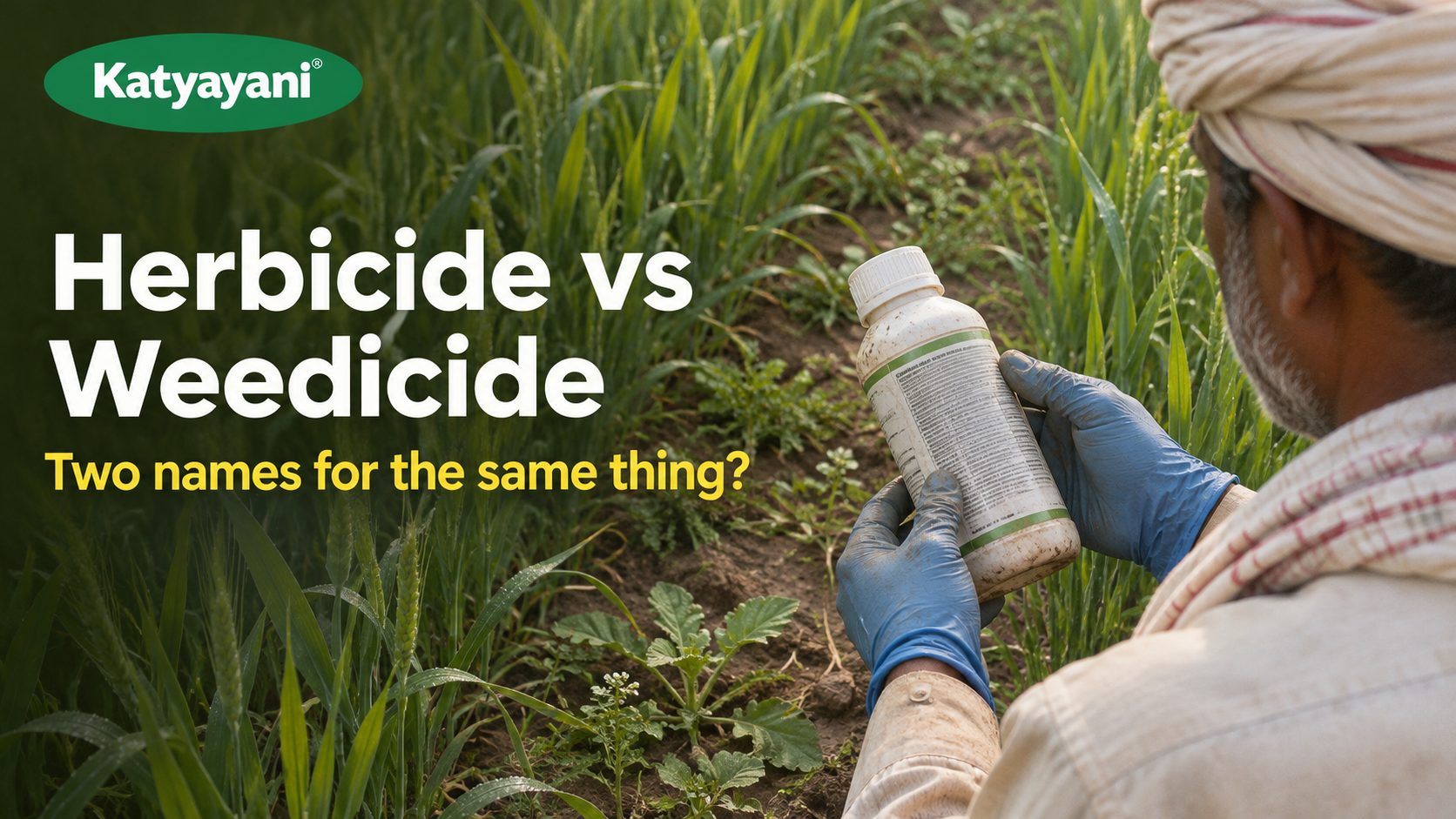
Herbicide and weedicide mean the same thing: a chemical that kills weeds. Herbicide is the textbook word, weedicide is the older everyday word, and Indian law uses both. The differences that matter are in the type. A selective herbicide kills certain weeds and spares the crop, while a non-selective one kills most green plants. A contact herbicide burns only the part it touches, while a translocated (systemic) one moves inside the plant. A pre-emergence herbicide acts before weeds come up, and a post-emergence one acts on weeds already up. Read the label colour, use only the crop and dose on the pack, and use no chemical when hand or tool weeding is enough.
Is there any difference between herbicide and weedicide?
No. In practice both words mean a chemical used to kill weeds. Herbicide is the scientific word used in textbooks and ICAR papers. Weedicide is the everyday word that Indian government texts, including the Insecticides Act and the PPQS page, also use.
You can see this in official documents. The Insecticides Act, 1968, section 3(e), defines "insecticide" as any substance in its Schedule or "such other substances (including fungicides and weedicides)" that the Central Government adds. So under Indian law a weedicide is registered and sold under the same Act as an insecticide. The PPQS safe-use page gives a rule in the same language: "Use separate sprayer for insecticides and weedicides."
ICAR writers use the other word. Scientists of the Indian Agricultural Research Institute wrote in Indian Farming (Nov 2018): "Herbicides are chemicals which are used to kill unwanted (weeds) under cropped or non-cropped situations." TNAU says the same in simpler words: a herbicide is "a chemical used to kill some targeted plants".
| Word | Where you meet it | What it means |
|---|---|---|
| Herbicide | TNAU lectures, ICAR-DWR articles, the CIB&RC list titled "Herbicides" | A chemical that kills weeds |
| Weedicide | Insecticides Act 1968, PPQS safe-use page | The same thing |
| Weed killer | Product names and shop talk | The same thing, in everyday words |
| Pesticide | Government texts and labels | A wider word. It covers insecticides, fungicides and herbicides together |
So do not pay more, or less, because one pack says weedicide and another says herbicide. The useful questions are different. Is it selective or non-selective? Does it work before or after weeds come up? Is it registered for my crop? The next sections answer these one by one.
What is a herbicide and how does it kill a weed?
A herbicide is a chemical that kills plants you do not want. It works because plants differ in shape, in how much chemical they absorb, in how it moves inside them and in how fast they break it down. TNAU lists these four differences as the base of chemical weed control. The crop survives and the weed does not.
Think of a maize field in the first month. Grass and broad-leaf weeds come up with the crop. A farmer sprays a product that is safe on maize but not on those weeds. The TNAU lecture explains that this kind of safety comes from "differences in the morphology, differential absorption, differential translocation, differential deactivation". In simple words, the crop either does not take the chemical in, does not move it around, or breaks it down quickly.
The safety is not fixed. The IARI authors in Indian Farming (Nov 2018) point out that "the selectivity is dose-dependent". A higher dose can damage the crop, and at very high rates most soil-applied herbicides may act as soil sterilants. They also say that herbicides are recommended on an active-ingredient basis, so the farmer has to work out how much of the commercial product the field needs. This is why a dose written on the pack is a limit, not a suggestion.
What are the two types of herbicides?
The two types most people mean are selective and non-selective herbicides. A selective herbicide kills some plant species in a mixed stand without seriously hurting others, so it can be used on a standing crop. A non-selective herbicide destroys most of the vegetation it touches, so it is used where no crop is growing, or sprayed with care.
TNAU gives atrazine as its example of a selective herbicide. The ICAR-DWR article of Dec 2025 names glyphosate and glufosinate as non-selective herbicides. A selective herbicide is like a key that fits only some locks. A non-selective one fits almost all of them.
Non-selective does not always mean "never near a crop". TNAU describes spray methods that give a non-selective product a safe path. In a directed spray, the nozzle is aimed at weeds between rows, often with a hood, and care is taken to keep the spray off the crop. TNAU also lists the protected spray, where the crop is covered, and spot treatment for small patches. The TNAU chemical method page gives an example: late weeds in cotton can be sprayed with a non-selective herbicide as a directed spray.
| Point | Selective herbicide | Non-selective herbicide |
|---|---|---|
| What it does | Kills some species, spares others (TNAU) | Destroys most treated vegetation (TNAU) |
| Used on | A standing crop, as the label allows | Non-crop area or tea (CIB&RC glyphosate rows), or before sowing; directed or protected spray only if the label permits (TNAU) |
| Examples named in the sources | Atrazine (TNAU) | Glyphosate and glufosinate (ICAR-DWR, Dec 2025) |
| Main risk | Crop injury if the dose, timing or crop is wrong | Kills the crop if the spray touches it |
| Spray method | Blanket spray is possible (TNAU) | Directed, protected or spot spray (TNAU) |
What is the difference between contact and systemic (translocated) herbicides?
A contact herbicide kills only the plant parts it touches. A systemic herbicide, which TNAU calls translocated, is taken into the plant and moves from the sprayed part to untreated parts through the xylem or phloem. The difference shows in perennial weeds, where roots can grow back after a contact spray.
TNAU names glyphosate as its example of a translocated herbicide. It also shows a use that fits the idea well: glyphosate can be sprayed on the leaves of perennial weeds like Cyperus rotundus (purple nutsedge, listed as Moth in the CIB&RC list) before any crop is planted. The leaf takes it in, and it travels down to the underground parts.
The TNAU Agritech page on problem weeds says the same thing in another way. For perennial grasses and sedges such as Cynodon dactylon (Bermuda grass, called Dhoob grass in the CIB&RC list) and Cyperus rotundus, TNAU lists glyphosate as a post-emergence, translocated herbicide, applied at the active-growth, pre-flowering stage.
| Point | Contact herbicide | Translocated (systemic) herbicide |
|---|---|---|
| How it works | Kills the part it touches (TNAU) | Moves inside the plant through xylem or phloem (TNAU) |
| Example in TNAU lecture | Paraquat (TNAU) | Glyphosate (TNAU: on perennial weeds, apply at active growth, before flowering) |
What is the difference between pre-emergence and post-emergence herbicides?
A pre-emergence herbicide is sprayed after sowing but before the weeds come up. A post-emergence herbicide is sprayed after the weeds have come up. TNAU defines pre-emergence as application "before a crop or weed has emerged" and post-emergence as application "after the emergence of crop or weed".
Timing is the whole point. A pre-emergence product is sprayed on the soil and acts on weeds as they sprout. TNAU lists atrazine, pendimethalin, butachlor, thiobencarb and pretilachlor as pre-emergence examples. A post-emergence product works on weeds that are already up. TNAU lists glyphosate and 2,4-D sodium salt as post-emergence examples.
TNAU adds two more timing words. Pre-plant means applied before the crop is planted or sown. Early post-emergence is used in slow-growing crops such as potato and sugarcane, about two to three weeks after sowing. TNAU also gives a sugarcane example: atrazine sprayed on the third day after planting is "pre-emergence" to the cane crop, but the same spray after a rain on an orchard floor is "pre-emergence" to the weeds.
| Stage | When you spray | Weeds at that time | Examples named by TNAU |
|---|---|---|---|
| Pre-plant | Before the crop is sown or planted | May or may not be up | Fluchloralin on soil before sowing; glyphosate on leaves of perennial weeds |
| Pre-emergence | After sowing, before weeds or crop emerge | Seeds only, not yet up | Atrazine, pendimethalin, butachlor, thiobencarb, pretilachlor |
| Early post-emergence | Two to three weeks after sowing in slow crops like potato and sugarcane | Small, just up | As the label allows |
| Post-emergence | After weeds are up | Growing | Glyphosate, 2,4-D sodium salt |
TNAU gives a rice example from its Agritech pages: pendimethalin on day 5 after sowing, or pretilachlor with a safener on the day of a soaking rain, then one hand weeding at 30 to 35 days after sowing. This shows that even the chemical plan is built around a later hand weeding.
Is atrazine the same type of herbicide as glyphosate?
Every herbicide sits in several groups at once. One product can be soil-applied, pre-emergence and selective all together. Reading a label means placing the product on each line: how it is applied, how selective it is, whether it moves inside the plant, and when it is used.
TNAU sorts herbicides in five ways: by method of application (soil-applied or foliage-applied), by mode of action (selective or non-selective), by mobility (contact or translocated), by time of application, and by molecular structure (inorganic or organic). Here is how two products from the sources sit on these lines.
| Line | Atrazine | Glyphosate |
|---|---|---|
| Applied to | Soil (surface application), per TNAU | Foliage, per TNAU |
| Selective or not | Selective (TNAU) | Non-selective (ICAR-DWR, Dec 2025) |
| Time of use | Pre-emergence (TNAU) | Translocated; post-emergence and pre-plant on perennial weeds (TNAU) |
| Where the CIB&RC list shows it | Maize and sugarcane rows, among others | Non-crop area and tea only, in all seven single-active rows |
What are herbicide mode-of-action groups, and why do they matter?
A mode of action is the exact part of the weed that the chemical blocks, such as an enzyme. Herbicides with the same mode of action attack the same spot. If you keep using one group, resistant weeds multiply. ICAR-DWR advises rotating herbicides with different modes of action, along with crop rotation and mechanical weeding.
ICAR-DWR wrote in the Sept 2019 Indian Farming article that Phalaris minor has resisted three modes of action: photosystem II site A, acetyl-CoA carboxylase (ACCase) and acetolactate synthase (ALS). The Dec 2025 article adds the others with the herbicides that use them.
| Mode of action | Herbicides named in the sources | Source |
|---|---|---|
| EPSPS enzyme inhibitor | Glyphosate | ICAR-DWR, Dec 2025 |
| Glutamine synthetase inhibitor | Glufosinate | ICAR-DWR, Dec 2025 |
| ALS (AHAS) enzyme inhibitor | Imidazolinones such as imazethapyr; metsulfuron; mesosulfuron; iodosulfuron | ICAR-DWR, Dec 2025 and Sept 2019 |
| Synthetic auxin | 2,4-D and dicamba | ICAR-DWR, Dec 2025 |
| ACCase inhibitor | Diclofop | ICAR-DWR, Sept 2019 |
| Photosystem II inhibitor | Isoproturon | ICAR-DWR, Sept 2019 |
Why does this matter at the shop? Two products with different names can belong to the same group, and then the weeds feel the same pressure again. Note the active ingredient printed on the label in your diary each season.
Why do herbicides stop working? What is herbicide resistance?
Herbicide resistance means a weed survives a dose that used to kill it. ICAR-DWR defines it as the inherited ability of a plant to survive an application that would kill a normal population of the same species. It builds up when the same herbicide, or the same group, is used year after year.
India has real cases. The ICAR-DWR article of Sept 2019 reports five cases in two weed species, Phalaris minor and Rumex dentatus. The first case was Phalaris minor against isoproturon in wheat, reported in 1991. Phalaris minor later became resistant across three modes of action. A recent case then was Rumex dentatus against an ALS inhibitor, metsulfuron.
The same article describes jungle rice (Echinochloa colona) in soybean. Scientists collected 93 biotypes from 20 districts of Madhya Pradesh. After two years of tests, 36 biotypes stayed resistant even at four times the dose of imazethapyr. Farmers who found imazethapyr weak had tried double and triple doses and other herbicides, but the resistant plants survived. The authors say relying on a single mode of action raises the chance of resistance.
The Dec 2025 ICAR-DWR article repeats the lesson for wheat: Phalaris minor, which looks almost the same as wheat when young, has developed resistance due to repeated use of the same herbicides, which forced costlier, more complex mixes. It also reports a global pattern, where over-use of glyphosate bred resistant weeds in the USA.
| Weed | Crop | Resistance reported | Source |
|---|---|---|---|
| Phalaris minor | Wheat | First case against isoproturon (1991); later across three modes of action: photosystem II, ACCase and ALS | ICAR-DWR, Sept 2019 |
| Rumex dentatus | - | Against an ALS inhibitor, metsulfuron | ICAR-DWR, Sept 2019 |
| Echinochloa colona (jungle rice) | Soybean in Madhya Pradesh | 36 of 93 biotypes still resistant at four times the dose of imazethapyr | ICAR-DWR, Sept 2019 |
What do the scientists advise? The 2019 article says to use the herbicide "at right dose, at right time, right source and at right place", and it calls herbicides "only a temporary solution". It adds that integrated weed management should be adopted, using crop rotation, curbing the spread of weed seeds and mechanical weeding. Globally, the article said weeds had evolved resistance to 23 of 26 known herbicide sites of action.
Where do farmers check the CIB&RC herbicide list before buying?
The CIB&RC list shows which crops each registered herbicide may be used on, the weeds it controls, the dose per hectare, the water to mix it in and the waiting period before harvest. Find your crop and your weed in it. If the herbicide is not listed for your crop, do not use it, even if a shop owner says it is fine.
The latest list is titled "List of Major Uses of Pesticides (Herbicides) as on 30.09.2026". It sits on the PPQS CIB&RC page and the PDF has 79 pages. It carries the heading "Registered under the Insecticides Act, 1968" and a disclaimer that it is compiled for guidance and not for legal purposes. The label on the pack is the final word.
| Column in the list | What it tells you | Why you care |
|---|---|---|
| Herbicide name and approved crops | The active ingredient, its strength and formulation, then the crops allowed | If your crop is not there, the use is not approved |
| Weed species | Weeds named in the registration, such as Phalaris minor or Echinochloa colona | Check your weed is on the list |
| Dosage per hectare | Active ingredient and formulation amount per hectare | Convert it for your land only with the label in hand |
| Dilution in water | Litres of water per hectare | Too little water means poor cover |
| Waiting period (PHI) | Days between last spray and harvest | Harvest before this period is a food-safety risk |
Here is one useful example of what you can learn. All seven single-active glyphosate rows in the list show only "non-crop area" and/or tea as the approved use. That tells a farmer that glyphosate is not approved on the standing field crop and should not be sprayed over it. The Dec 2025 ICAR-DWR article reports that an October 2022 order restricted glyphosate use to licensed Pest Control Operators. Trade reports say the Delhi High Court stayed it, so check with your state agriculture office whether it applies now.
To keep a dose right when you do mix, use the live guide on how much herbicide per litre of water and then compare the number with the pack label. Doses differ for each crop, soil and weed, so always follow the label of your product.
Before you buy, keep to this order: name your crop, weed and crop stage, find a listed product on the CIB&RC list, check the active ingredient against what you used last season, and buy from a licensed dealer with the bill and the pack batch number. The Katyayani herbicides collection shows the herbicides on offer here, and each product page and pack label tells you the crop it is meant for.
What do the label colours on a weedicide pack mean?
The coloured band at the bottom of a diamond on the pack shows how toxic the product is. Bright red means extremely toxic, bright yellow highly toxic, bright blue moderately toxic and bright green slightly toxic. The top half of the diamond carries a signal word. Rule 19 of the Insecticides Rules, 1971 sets this.
The Insecticides Rules, 1971 say the label must carry, in a prominent place and covering at least one-sixteenth of the label face, a square set at 45 degrees (a diamond). It is split into two triangles. The upper triangle holds the symbol and signal word. The lower triangle holds the colour band. The colour depends on the oral LD50, the dose that kills half the test animals, in mg per kg of body weight.
| Category | Oral LD50 (mg/kg) | Dermal LD50 (mg/kg) | Colour | Signal on the label |
|---|---|---|---|---|
| 1. Extremely toxic | 1 to 50 | 1 to 200 | Bright red | Skull and cross-bones, the word POISON in red, plus "Keep out of the reach of children" and a call-the-physician line |
| 2. Highly toxic | 51 to 500 | 201 to 2000 | Bright yellow | The word POISON in red, plus "Keep out of the reach of children" |
| 3. Moderately toxic | 501 to 5000 | 2001 to 20000 | Bright blue | The word DANGER, plus "Keep out of the reach of children" |
| 4. Slightly toxic | More than 5000 | More than 20000 | Bright green | The word CAUTION |
The same rule says the label must be printed in Hindi, English and one or two regional languages of the area where the pack will be sold. It must also carry the registration number, batch number, expiry date, the name and strength of the active ingredient and an antidote statement. A label may not claim the product is "safe", "non-poisonous", "non-injurious" or "harmless". If a pack lacks these, it is a warning sign. The guide to pesticide toxicity triangle goes through each line, and the guide on fake pesticides and fertilisers shows how to spot a false pack.
A green label does not mean "no gloves". IARI scientists note in the Nov 2018 article that herbicides as a group are relatively safer than other pesticides. The WHO classes they quote, for products registered in India, show about 44 per cent of herbicides under "unlikely to present acute hazard", against about 20 per cent of insecticides. But "relatively safer" is not the same as safe.
Is weedicide harmful to people?
Yes, it can be, if it is misused. Herbicides are generally less toxic than insecticides, but they are still chemicals. People are harmed by breathing the spray, by skin contact and by swallowing. ICAR-DWR says self-poisoning with several herbicides is a serious problem in parts of Asia. Use gloves, a mask and full clothing, and follow the label.
The ICAR-DWR article of Nov 2018 says humans can take in herbicide by inhaling dust and vapour, by eating food or drinking water with residues, or through skin. It notes that acute self-poisoning with butachlor, fluchloralin, 2,4-D, pendimethalin, glyphosate and others is a significant problem in parts of Asia. It also says only a small share of any spray reaches the target: "only less than 20 per cent of applied pesticides actually reach the target", and the rest goes into the surroundings.
The PPQS safe-use page gives the daily habits that cut this risk. Use clean water. Wear gloves, face mask, cap, apron and full trouser. Never prepare the spray without protective clothing. Do not eat, drink, smoke or chew during the work. Do not smell the spray tank. Do not blow clogged nozzles with the mouth. Wash hands and face with soap before eating. Keep animals and workers out of the field right after spraying. If symptoms of poisoning appear, give first aid, take the patient to a doctor and show the empty container.
Storage matters too. PPQS says to keep pesticides in their original containers, away from the house, children and animals, and out of sun and rain, and to store weedicides apart from insecticides. Never use the same sprayer for both.
Is herbicide harmful to soil, water and the next crop?
It can be, depending on how long the chemical lasts and how much is used. ICAR-DWR says most herbicides at recommended rates break down within days or weeks and set no limit on next year crops. Some persist for weeks, months or years. Heavy or repeated use can leave residues in soil and water and hurt a sensitive next crop.
ICAR-DWR measures persistence as half-life, the time for half of the chemical to break down. The Nov 2018 article adds that half-life is not fixed. It depends on soil, temperature, dose, application method and weather. Some facts it gives from Indian studies are useful to a farmer.
- Pendimethalin applied to wheat at 1 to 4 kg per hectare in one study persisted up to 200 days in sandy loam soil and caused damage to the next crop, sorghum, at the higher dose.
- No atrazine residue remained at harvest in a maize crop, but residue showed in post-harvest soil when the double dose was used.
- The breakdown of butachlor was driven mainly by soil organic matter and moisture. It was fastest at field capacity.
- Chlorsulfuron broke down faster in low pH soil than in high pH soil, while metsulfuron-methyl dissipated faster in acidic silty loam soil.
- Sorghum and cucumber plants proved to be sensitive indicators of metribuzin residue in soil.
Water is the other worry. The article says herbicide residues reach water by direct application, runoff from land and drift. It reports atrazine found in water from the Singoor reservoir in Hyderabad. It also says that reports of herbicide monitoring in water are limited in India compared with developed countries. So the true picture is less known, and care is the safe choice.
What can a farmer do? The ICAR-DWR authors list simple steps. Use the lowest dose that works, as excess use leads to accumulation, leaching and drift. Early weed removal reduces competition and also reduces carry-over, since the longer the herbicide is exposed to moisture and temperature, the lower the carry-over risk. Disc ploughing or inter-cultivation mixes the herbicide into a larger volume of soil and dilutes it. Farmyard manure at 10 tonnes per hectare, or green manuring with Sesbania, reduces the residual toxicity of atrazine, sulfosulfuron and dinitroaniline herbicides such as pendimethalin in sandy loam soil. Your soil health card helps you know if your soil is sandy or has low organic matter.
The summary of the article is balanced. It says that herbicides at recommended doses, in most cases, leave no residues in the food chain or soil at a level of concern. But it also says that surface water and groundwater samples still show herbicides in some places, sometimes at harmful levels, and that best practice and training are needed.
Which herbicide is best for soil, and which chemical is best for killing weeds?
No single herbicide is the best for soil or for all weeds. The right choice depends on the crop, the weed, its stage, your soil and the next crop. For soil, pick a product that is approved for your crop, use the lowest working dose and avoid repeating the same group each season.
The IARI authors list how herbicides differ from other pesticides: they are crop-specific, the rate is very specific, uniform application is critical, and selectivity depends on dose. A product approved in rice may not be approved on wheat. So treat "best weedicide" questions as "best for which crop and which weed".
| Question to ask | Why it matters | Where to find the answer |
|---|---|---|
| Which crop and which stage? | Herbicides are crop-specific; the same weed is treated differently in maize and rice (IARI) | CIB&RC list, column "approved crops" |
| Which weed? | Grass, broad-leaf and sedge weeds need different products | CIB&RC list, column "weed species" |
| Are weeds up yet? | Pre-emergence before, post-emergence after (TNAU) | Pack label |
| Which soil? | Persistence depends on soil, temperature, dose and weather (ICAR-DWR); pendimethalin lasted up to 200 days in one sandy loam study | Soil health card; label |
| What is the next crop? | Residue can hurt a sensitive next crop (sorghum, cucumber in ICAR-DWR studies) | Label gives the crop-gap if any |
| Which group did I use last year? | Same group again speeds up resistance (ICAR-DWR) | Active ingredient on the old pack or your diary |
If a seller names a "best" product without asking your crop and weed, step back. Use the questions in the table as a short talk with your agriculture extension officer, KVK or a licensed dealer.
How do I spray a weedicide safely and avoid drift and crop injury?
Spray on a cool, calm day with clean water, the recommended dose only and the right nozzle. Do not spray in strong wind, on a hot sunny day, or just before or after rain. Use a sprayer that has never held an insecticide. Keep animals out of the field and wash all gear after the work.
This list is drawn from the PPQS safe-use page and the ICAR articles.
- Check the pack. See the registration number, batch number and expiry date, and buy only from a registered dealer with a valid licence.
- Buy only the quantity needed for one spray in your field. PPQS says not to buy in bulk for the whole season.
- Choose the right sprayer and the right nozzle. PPQS says to use a separate sprayer for weedicides, and not to use leaky or non-recommended nozzles. The guide on agriculture sprayer explains the options.
- Work out the amount for your tank only after reading the label. Herbicide doses are per hectare on an active-ingredient basis (IARI), so convert carefully with the dose calculator guide.
- Mix in clean water. PPQS says never use muddy or stagnant water and never keep a mixed solution longer than 24 hours. Before you mix two products, read the guide on tank mix compatibility.
- Wear gloves, mask, cap, apron and full trousers while mixing and spraying.
- Spray on a cool, calm day, in the direction of the wind and not against it. Do not spray before rain or just after rain (PPQS).
- Spray evenly. IARI says uniform application is "very critical" with herbicides, since a thin or double patch changes the result.
- After the work, wash the sprayer and buckets with clean water and soap. Do not use mixing buckets for home use.
- Dispose of leftover solution in a safe barren spot, away from ponds and water lines. Crush empty containers and bury them deep, away from water.
Drift is a quiet cause of crop loss. IARI says fine spray with very small droplets is prone to drift, and that drift can be reduced by picking the right sprayer and nozzle and by spraying in the right weather, especially wind. Drift from a weed killer can scorch a neighbour's vegetable bed or cotton row, even when your own field is fine.
When should I not use a herbicide at all?
Skip the herbicide when weeds are few and small, when labour or a hand weeder can do the job in time, when the product is not approved for your crop, when rain is expected, or when your next crop is sensitive to the residue. A herbicide is a tool for the right moment, not a default.
The weeds are most costly early. The ICAR-DWR article of Dec 2025 says that if weeds are not managed in the first 30 to 40 days after sowing, they can cause permanent yield losses of 20 to 40 per cent in crops like rice, wheat, maize, soybean and cotton. It also says weeding can cost up to 25 per cent of the total cultivation cost, which is why many farmers turn to chemicals. The answer is to weed early, by hand, by tool or by a correct spray at the right stage.
The ICAR-DWR residue article lists non-chemical practices that work alongside or in place of a spray: crop rotation, competitive hybrids, rotary hoeing and altered planting dates. The 2025 article adds stale seedbeds, mulching and mechanical weeding. For hand and push tools, see the guide to hand weeder. For soil cover, see benefits of mulching. For rotation, see crop rotation examples.
| Situation | Better choice than a spray |
|---|---|
| A few weed patches in a small plot | Hand pulling or a hand weeder |
| Weeds between crop rows early in the season | A wheel hoe or push weeder |
| The herbicide is not listed for your crop in the CIB&RC list | Do not use it; pick a listed product or a non-chemical method |
| Rain or strong wind is forecast | Wait for a calm, dry spell |
| A sensitive crop follows (such as sorghum after a long-lasting herbicide) | Choose a short-life product or a non-chemical method |
| The same weed returns every year after the same spray | Change the group, rotate crops and add tool weeding (ICAR-DWR) |
What should farmers check before the 2026-27 season?
Three dated sources are worth knowing for 2026-27. The CIB&RC herbicide list is valid up to 30 September 2026. ICAR-DWR reported in Dec 2025 that only non-GM herbicide-tolerant rice is approved for farmers. And ICAR-IIRR with IRRI published a June 2026 drone-spraying procedure for direct-seeded rice.
| Item | What is new or current | Date and source |
|---|---|---|
| CIB&RC herbicide list | Latest list titled "as on 30.09.2026", 79 pages | 30 Sept 2026, CIB&RC |
| Glyphosate | ICAR-DWR cites a 2022 order for licensed Pest Control Operators only; a court stay was reported, so check with your state agriculture office whether it applies now; CIB&RC rows show non-crop area and tea | Dec 2025, ICAR-DWR; 30 Sept 2026, CIB&RC list |
| Herbicide-tolerant crops | Non-GM imidazolinone-tolerant rice (Pusa Basmati 1979, Pusa Basmati 1985, CR Dhan 807) and hybrids SAVA 127 and SAVA 134 are released; HT mustard (DMH-11) faces legal challenges; unapproved HT cotton is grown illegally | Dec 2025, as of July 2025 per ICAR-DWR |
| Drone spraying of herbicide in direct-seeded rice | Spray volume 30 to 45 litres per hectare, height 1.5 to 2.0 m above the canopy for a drone of about 20 kg payload (2.0 to 2.5 m for heavier ones), speed 3 to 6 m per second, wind below 3 m per second | June 2026, ICAR-IIRR and IRRI |
The drone article is about rice, but its weather advice suits any spray. It says the best time is early morning (before 8 am) or late afternoon (after 4 pm), and that spraying must stop if wind passes 3 m per second. Drones also need a registered aircraft and a certified remote pilot. If you plan to hire a drone service, see Namo Drone Didi scheme.
What has not changed: the basic types of herbicides, the colour label, and the advice to rotate groups and weed early.
For crop-wise advice, the package of practices of your state agriculture university and the CIB&RC list are the two sources to trust. Doses and timings differ by crop, soil and weed, so use the dose on your own pack label.
Conclusion
Herbicide and weedicide are two words for the same thing. What really differs is the type. A selective herbicide spares the crop, a non-selective one does not. A contact herbicide burns what it touches, a translocated one moves inside the plant. A pre-emergence product acts before weeds come up, a post-emergence one after. Read the CIB&RC list for your crop, read the colour label, spray only on a calm day with clean water, rotate groups, and weed early with tools where you can. ICAR-DWR calls herbicides only a temporary solution, so use them with care.


Leave a Comment