
 18 min read
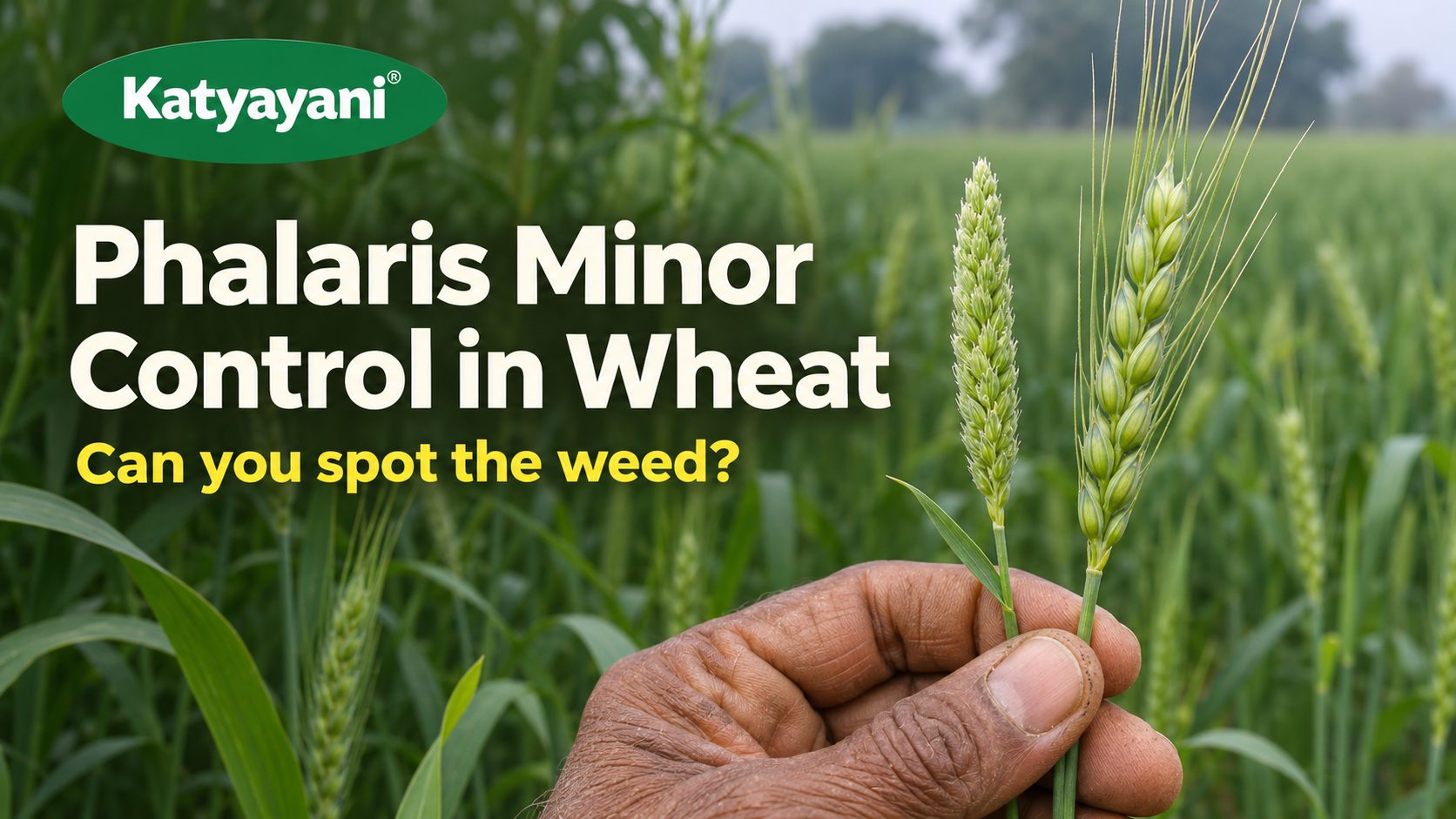
Phalaris minor (gulli danda) looks like wheat until it flowers, so spray on time, not on guesswork. PAU (Rabi 2025-26) lists pendimethalin 30 EC at 1.5 litre per acre or pyroxasulfone at 60 g per acre, sprayed within two days of sowing in 200 litres of water, as the pre-emergence start. After that comes a post-emergence spray at 30 to 35 days after sowing in 150 litres of water. Resistance to clodinafop, fenoxaprop, sulfosulfuron and isoproturon is confirmed, so change the herbicide group every year and add cultural control: sow from the last week of October, use 15 cm rows, rotate out of wheat in a bad field and pull escapes before seed set. Read the pack label first.
What is Phalaris minor and why is it the main grass weed of wheat in the rice-wheat belt?
Phalaris minor is an annual grass weed, also called little seed canary grass and gulli danda. It grows with wheat, matures early and makes a lot of seed. Indian Farming (September 2026, PAU authors) calls it the most troublesome and dominant grass weed of wheat in Punjab's rice-wheat system.
The Indian Farming article of March 2021 gives local names as guli danda, mandusi and kanaki, and says the weed became a problem in the early 1970s. Dwarf, high-yielding wheat needs assured irrigation and heavy fertiliser. Those conditions favoured Phalaris minor and wild oat and pushed out the broadleaf weeds that were common before.
Rice-wheat farming adds to the problem. The September 2026 article says seed collects in the top 10 cm of soil during puddling in transplanted rice, which can mean a heavier weed crop in the next wheat. Weed seed, wheat seed and the same field year after year: this is the rice-wheat trap.
Picture a grower in Karnal district who sows wheat after paddy on the same date every year and sprays the same product every year. The first three years go well. In the fourth year, patches of grass stand above the crop after the spray. That is how most resistant fields begin.
How do I tell Phalaris minor from wheat seedlings before the ear head comes?
You mostly cannot, and that is the problem. The September 2026 article says Phalaris minor is morphologically like wheat until flowering, so it is very difficult to identify early and hard to remove by hand inside the rows. The Journal of Wheat Research review says the same about both wild oat and Phalaris minor in the vegetative phase.
There is no simple leaf rule that separates Phalaris minor seedlings from wheat in every field. What helps is a set of clues from timing and behaviour.
- It comes up with the crop. The March 2021 article says it germinates along with the wheat and looks like wheat seedlings in the early stage.
- It comes in waves. The September 2026 article says emergence starts in November and later waves come up after each irrigation in winter.
- It grows taller than dwarf wheat later. The Journal of Wheat Research review says it grows much taller, shades the wheat, lodges easily and smothers the plants around it.
- It matures earlier than wheat and drops seed. The March 2021 article gives early maturity and heavy seed production as reasons for its spread.
The practical answer is to treat the field by its history, not by what you see in December. If last year's crop had grass patches above the wheat at grain filling, spray as if the weed is there this year. Also tell resistant grass apart from a bad spray. The September 2026 article advises checking carefully whether a failure is resistance or poor spray technique before changing the product.
How much wheat yield can Phalaris minor take away?
Sources give wide ranges because losses depend on density, sowing date, variety and soil. The Journal of Wheat Research review says Phalaris minor and wild oat can cause yield losses of 10 to 80%. The September 2026 article says a season-long infestation can reduce wheat yield by up to 80%.
| Figure | What it says | Source |
|---|---|---|
| Season-long Phalaris minor infestation | Wheat yield can fall by up to 80%, depending on density, crop management and soil and weather | Indian Farming, Sept 2026 |
| Phalaris minor and wild oat together | Yield loss between 10 and 80%; in the worst case complete crop failure | Journal of Wheat Research review |
| All weeds in wheat, by zone | Average yield loss of 20 to 32% in the wheat zones | Journal of Wheat Research review |
| All weeds in wheat, India average | Around 25 to 30% | Indian Farming, March 2021 |
| Critical weed-free period | 30 to 45 days after sowing | Journal of Wheat Research review, Indian Farming, March 2021 |
| Very heavy infestation seen in the 1990s | 2,000 to 3,000 plants per square metre in some areas | Indian Farming, March 2021 |
The review adds that complete crop failure was common in the late 1970s, before effective herbicides, and again in the mid-1990s when resistance to isoproturon spread. Some farmers cut their immature wheat as fodder. Most farmers delay the spray, and the review says many do not respect the 30 to 45 day period.
Why do some herbicides stop working on Phalaris minor?
Because the weed has evolved resistance. Isoproturon was used for 10 to 15 years from the mid-1970s, and resistance showed up in the early 1990s in Haryana, then Punjab. Clodinafop, fenoxaprop and sulfosulfuron then worked for years, but resistance to them followed, as the September 2026 and March 2021 articles describe.
The March 2021 article says Haryana's isoproturon case was the first case of herbicide resistance in India. Table 1 of the September 2026 article lists India 1991 as the first confirmed Phalaris minor case. Resistant plants needed 3 to 15 times the normal dose, which was neither economical nor safe for wheat. It names the main causes: rice-wheat monocropping, the same herbicide or same mode of action every year, and under-dosing.
| Herbicide group (HRAC) | Examples used on wheat | Resistance status in Phalaris minor | Source |
|---|---|---|---|
| 5 (photosystem II, substituted ureas) | Isoproturon | Confirmed; first case in 1991 | Indian Farming, Sept 2026 |
| 1 (ACCase inhibitors) | Clodinafop, fenoxaprop, diclofop, pinoxaden | Confirmed for clodinafop and fenoxaprop; pinoxaden alone also listed among products with resistance | Indian Farming, Sept 2026 |
| 2 (ALS inhibitors) | Sulfosulfuron, mesosulfuron + iodosulfuron | Confirmed for sulfosulfuron; mesosulfuron + iodosulfuron alone also listed | Indian Farming, Sept 2026 |
| 5 (triazine) | Metribuzin | Stand-alone metribuzin and clodinafop + metribuzin also listed among products where resistance has evolved | Indian Farming, Sept 2026 |
| 3, 12, 14, 15, 34 and others | Pendimethalin, diflufenican, flumioxazin, pyroxasulfone, aclonifen | Used pre-emergence; the September 2026 article calls pre-emergence use the best strategy against resistant populations | Indian Farming, Sept 2026 |
Note the wording. The September 2026 article lists confirmed multiple resistance (to two or three modes of action) against clodinafop, fenoxaprop, sulfosulfuron and isoproturon. It also says Phalaris minor has evolved resistance to several classes, including stand-alone clodinafop, sulfosulfuron, mesosulfuron plus iodosulfuron, pinoxaden, clodinafop plus metribuzin and metribuzin. Resistance is not an on-off switch. It depends on your field's history.
Which herbicide is best for Phalaris minor in wheat?
No one product is best for every field. PAU (Rabi 2025-26) lists pre-emergence and post-emergence options by dose per acre. The September 2026 PAU article says pre-emergence use is the best strategy for resistant populations. The right choice depends on soil, field history and what you plan to sow next.
The table below is the PAU list for gulli danda, written by active ingredient. Doses are per acre as PAU prints them. Water volume and timing are in the last column.
| Stage | Active ingredient | PAU dose per acre | Timing and water (PAU) |
|---|---|---|---|
| Pre-emergence | Pendimethalin 30 EC | 1.5 litre | Within two days of sowing, 200 litres of water |
| Pre-emergence | Pyroxasulfone 85 WG | 60 g | Within two days of sowing, 200 litres of water |
| Pre-emergence | Pendimethalin + metribuzin (385 SE mix) | 1.0 litre | Within two days of sowing, 200 litres of water; also controls broadleaf weeds |
| Pre-emergence | Pendimethalin + metribuzin (48 EC mix) | 900 mL | Within two days of sowing, 200 litres of water; also controls broadleaf weeds |
| Post-emergence, before first irrigation | Sulfosulfuron 75 WG | 13 g | Listed under post-emergence before first irrigation; also listed after first irrigation |
| Post-emergence, after first irrigation | Clodinafop 15 WP | 160 g | 30 to 35 days after sowing, 150 litres of water |
| Post-emergence, after first irrigation | Pinoxaden 5 EC | 400 mL | 30 to 35 days after sowing, 150 litres of water |
| Post-emergence, after first irrigation | Sulfosulfuron 75 WG | 13 g | 30 to 35 days after sowing, 150 litres of water |
| Post-emergence, grass and broadleaf | Sulfosulfuron + metsulfuron 75 WG | 16 g | 30 to 35 days after sowing, 150 litres of water |
| Post-emergence, grass and broadleaf | Mesosulfuron + iodosulfuron 3.6 WDG | 160 g | 30 to 35 days after sowing, 150 litres of water |
| Post-emergence, grass and broadleaf | Metribuzin + clodinafop (first mix; CIB&RC lists a 42% + 12% WG product at 500 g per hectare) | 200 g | 30 to 35 days after sowing, 150 litres of water; preferred where multiple resistance is a problem |
| Post-emergence, grass and broadleaf | Metribuzin + clodinafop (second mix; CIB&RC lists a clodinafop 9% + metribuzin 20% WP at 600 g per hectare) | 240 g | 30 to 35 days after sowing, 150 litres of water; preferred where multiple resistance is a problem |
PAU adds cautions you should not skip. Do not use the metribuzin plus clodinafop mixes on light-textured soils or on the wheat varieties PBW RS1 and Unnat PBW 550. Do not use sulfosulfuron or its ready-mix with metsulfuron where sorghum or maize is to be sown after wheat. Do not use sulfosulfuron alone where a broadleaf crop is sown in the wheat. For the grass and broadleaf ready-mixes, do not use them where raya, gobhi sarson or gram is sown in the wheat. Do not use the isoproturon group where resistance is a problem. The post-emergence mixes in the last four rows are not for durum wheat.
Broadleaf weeds need a separate decision. PAU lists metsulfuron methyl herbicide, carfentrazone and 2,4-D for them. None of these controls gulli danda, so a broadleaf-only spray will not fix a grass problem.
What does the CIB&RC list print for wheat and Phalaris minor?
The CIB&RC Major Uses of Pesticides list for herbicides (upto 30.09.2026) shows the registered products, dose per hectare, water volume and the waiting period before harvest. The table below copies the rows where wheat and Phalaris minor appear together. Per hectare is not per acre, so do not copy it into an acre calculation.
| Active ingredient and formulation | Active per hectare | Product per hectare, as in the CIB&RC list | Water, litres per hectare | Waiting period, days |
|---|---|---|---|---|
| Pendimethalin 30% EC | 1.0 kg light soil, 1.25 kg medium soil, 1.5 kg heavy soil | 3.3, 4.2 and 5.0 litre | 500 to 700 | - |
| Pyroxasulfone 85% WG | 127.5 g | 150 (the list prints ml; 127.5 g active from an 85% product works out to about 150 g) | 500 | 131 |
| Flumioxazin 50% SC | 125 g | 250 mL | 500 | 137 |
| Clodinafop-propargyl 15% WP | 60 g | 400 g | 375 to 400 | 110 |
| Fenoxaprop-p-ethyl 10% EC | 100 to 120 g | 1.0 to 1.20 (printed as kg) | 250 to 300 | 110 |
| Pinoxaden 5.1% EC | 40 to 45 g | 800 to 900 mL, 30 to 35 days after sowing | 225 to 300 | 90 |
| Sulfosulfuron 75% WG | 25 g | 33.3 g plus cationic surfactant 1,250 mL | 200 to 250 | 110 |
| Diclofop-methyl 28% EC | 0.7 to 1.0 kg | 2.5 to 3.5 litre | 500 | 90 |
| Metribuzin 70% WP | 0.175 kg medium soil, 0.21 kg heavy soil | 0.25 kg and 0.30 kg | 500 to 750 | 120 |
Ready-mix products are also listed for wheat with Phalaris minor. A few examples from the same list are below.
| Ready-mix | Active per hectare | Product per hectare, as in the CIB&RC list | Water, litres per hectare | Waiting period, days |
|---|---|---|---|---|
| Clodinafop 15% + metsulfuron 1% WP | 60 + 4 g | 400 g, with 1,250 mL surfactant | 375 | 100 |
| Metribuzin 42% + clodinafop 12% WG | 210 + 60 g | 500 | 375 | 92 |
| Clodinafop 9% + metribuzin 20% WP | 54 + 120 g | 600 | 300 | 120 |
| Aclonifen 40.65% + diflufenican 8.13% SC | 875 + 175 g | 1,750 | 500 | 82 |
Three points on reading this list. First, the PDF says it is compiled for guidance and not for legal purposes, so the pack label is the legal document. Second, the list also shows isoproturon for wheat and Phalaris minor, but PAU says not to use it where resistance is a problem, so no isoproturon dose is given here. Third, flufenacet appears in the list only for transplanted paddy, not for wheat, so it is not suggested for wheat here even though it features in research papers. See the PPQS page for the full list.
What is pendimethalin 30% EC used for in wheat, and how do I apply it?
Pendimethalin 30% EC is a pre-emergence herbicide. It is sprayed on moist soil just after sowing to stop Phalaris minor and some broadleaf weeds from coming up. PAU gives 1.5 litre per acre within two days of sowing, in 200 litres of water. CIB&RC gives 3.3 to 5.0 litre per hectare by soil type.
It belongs to HRAC group 3 (microtubule assembly inhibitor), which is a different group from clodinafop, sulfosulfuron and isoproturon. That is why it is useful in fields where those fail. The CIB&RC list names Phalaris minor, Chenopodium album, Melilotus alba, Portulaca oleracea, Anagallis arvensis, Fumaria parviflora and Poa annua for pendimethalin in wheat.
- Sow the crop and spray within two days, as PAU says. In a conventional-till field, use 200 litres of water per acre.
- Check soil moisture first. The September 2026 article says a pre-emergence herbicide needs good soil moisture to work, and it is not recommended on a dry soil-mulch surface.
- Use a field with fine tilth, free from clods. The September 2026 article says this gives excellent control and keeps the field free of Phalaris minor for the first 25 to 30 days.
- For Happy Seeder sowing, PAU says to mix the herbicide with the basal urea and broadcast the mixture just before sowing.
- If you sow with a seed drill that can spray at the same time, the PAU book and the September 2026 article both name the Lucky Seed Drill for this.
- Do not give a heavy irrigation after the spray. PAU says heavy irrigation reduces herbicide performance; keep it light.
Pendimethalin alone does not give the whole season of control. The 25 to 30 days it gives is the early flush. Plan a post-emergence spray from a different group for later flushes, especially in a field that has had resistance problems.
When should I spray: how many days after sowing is right?
There are three windows. Pre-emergence is within two days of sowing. Early post-emergence is before the first irrigation, when weeds are small. Post-emergence is 30 to 35 days after sowing, after the first irrigation. The 30 to 45 day period is when wheat must be kept weed free.
| Window | Days after sowing | What is sprayed (as per PAU and CIB&RC) | Source |
|---|---|---|---|
| Pre-emergence | 0 to 2 | Pendimethalin, pyroxasulfone or pendimethalin + metribuzin mixes | PAU Rabi 2025-26 |
| Early post-emergence | About 20, weeds at 2 to 3 leaves, 2 to 3 days before first irrigation | Isoproturon (not in resistant fields) and sulfosulfuron are listed in this window | PAU Rabi 2025-26 |
| Post-emergence | 30 to 35 | Clodinafop, pinoxaden, sulfosulfuron and the ready-mixes | PAU Rabi 2025-26, CIB&RC list |
| Critical weed-free period | 30 to 45 | Wheat must stay free of weeds in this period | Journal of Wheat Research review |
Does late spraying matter? The review reports a trial by Chhokar and co-workers (2006). Sulfosulfuron at 25 g per hectare with surfactant gave 97.8% Phalaris minor control and 99.0% of weed-free yield when sprayed early post-emergence at 19 to 21 days after sowing. Sprayed post-emergence at 31 to 33 days after sowing, it gave 94.8% control and 97.8% of weed-free yield. A flufenacet plus metribuzin mix fell from 75.5% control to 60.9% with the same delay. Late spray costs you.
The September 2026 article adds that the post-emergence spray must go on at the right weed stage, on a sunny day after the dew has dried, and that the first and second irrigations should be lighter for the best result. The wheat CRI stage in wheat and the herbicide spray should be planned together, not one after the other by chance.
Can I mix a grass herbicide with a broadleaf herbicide in one tank?
Avoid mixing two separate products on your own. PAU lists a tank mix of clodinafop with 2,4-D or metsulfuron. ICAR-IIWBR authors (Indian Farming, 2018) report antagonism and advise a gap of 3 to 5 days. Use a registered ready-mix, or follow the label.
The IIWBR authors name clodinafop, fenoxaprop and pinoxaden as the grass herbicides that lose strength when mixed with 2,4-D or metsulfuron, and say they should be applied one after the other. They list sulfosulfuron plus metsulfuron, mesosulfuron plus iodosulfuron, clodinafop plus metribuzin and sulfosulfuron plus carfentrazone as ready-mixes that control mixed grass and broadleaf weeds. You can read the full article for the two tables of products.
For any mixing you do on your own, a jar test and the right order matter. The live pesticide tank mix compatibility post shows how. A ready-mix has already been checked by the maker and registered, so it removes the guesswork.
What should I do in a field where Phalaris minor already survives my usual spray?
Change the herbicide group, move to a pre-emergence start, and use a mixture or a different post-emergence group in sequence. The September 2026 article says rotation, mixture and sequence all lower the selection pressure. The March 2021 article advises rotating herbicides with a different mode of action about once every 3 years.
- Rule out spray error first. The September 2026 article says to tell resistance apart from faulty spray technology by careful visual rating of control.
- Start with a pre-emergence product in group 3, group 15 or the pendimethalin plus metribuzin mixes, as PAU lists. The September 2026 article says pre-emergence use is the best strategy against resistant populations.
- Follow with a different post-emergence group at 30 to 35 days. PAU says to prefer the metribuzin plus clodinafop mixes where multiple resistance is a problem, but not on light soils or on the two named varieties.
- Do not repeat the product that failed. The March 2021 article says continuous use of one herbicide for 8 to 10 years led to resistance to clodinafop, sulfosulfuron, fenoxaprop and diclofop-methyl.
- Add cultural control (next sections). The September 2026 article says the key is a mix: herbicide, crop rotation, competitive varieties, higher seed rate, narrower rows, stale seedbed, early sowing, conservation tillage and weed-free seed.
The IIWBR authors (Indian Farming, November 2018) name pendimethalin, flumioxazine, pyroxasulfone, flufenacet and metribuzin as effective against multiple-resistant populations in research, and note that registration status was still pending for some at that time. The CIB&RC list of 30.09.2026 now shows pendimethalin, pyroxasulfone, flumioxazin and metribuzin for wheat Phalaris minor, as the table above shows. Flufenacet is not listed for wheat.
What spray volume and nozzle should I use?
Use enough water to cover the field evenly and the right nozzle. PAU gives 200 litres of water per acre for pre-emergence sprays and 150 litres per acre for post-emergence sprays. It also says to use a flat fan or flood jet nozzle for pre-emergence and a flat fan nozzle for post-emergence.
The Journal of Wheat Research review says most farmers spray with cut nozzles, which spread the herbicide unevenly. It adds that this can also raise the selection pressure for resistance to the alternative herbicides, and it recommends boom sprayers with multiple flat-fan nozzles. The review also reports that mixing isoproturon with soil or urea worked a little worse than spraying it, so spraying is better where it is practical.
- Spray on a clear day (PAU).
- Spray as evenly as you can (PAU). Gaps in the spray are where resistant plants get their start.
- After spraying, flush the pump with water and then with 0.5% washing soda solution (PAU). A contaminated pump can harm the next crop.
- Keep the first irrigation after the spray light (PAU).
To work out how many tanks go on an acre with your own knapsack sprayer, use the live pesticide dose per litre calculator. For choosing and calibrating the sprayer itself, see agriculture sprayer.
How do sowing date, seed rate and row spacing change the Phalaris minor problem?
They change it a lot. Phalaris minor germinates best at 15 to 20 degrees Celsius, so sowing from the last week of October escapes the first flush. PAU recommends quick-growing varieties sown from the last week of October to the first week of November, in rows 15 cm apart.
| Habit | What the sources say | Source |
|---|---|---|
| Early sowing | Phalaris minor emergence at 60 days after sowing was 65% and 57% lower (3-year mean) in wheat sown on 25 October than in wheat sown on 15 and 25 November | Indian Farming, May 2022 (ICAR-CSSRI) |
| Sowing window for infested fields | Last week of October to first week of November | PAU Rabi 2025-26, Indian Farming, Sept 2026 |
| Row spacing | 15 to 18 cm instead of 20 to 22.5 cm leaves less room for weeds; PAU says 15 cm | Indian Farming, Sept 2026, PAU Rabi 2025-26 |
| Seed rate | A seed rate of 150 kg per hectare cut Phalaris minor biomass by more than 40% compared with 100 kg per hectare | Indian Farming, March 2021 |
| Competitive varieties | Early vigour and high tillering help; the article names HD 3086, PBW 677 and HD 2967 as vigorous, spreading types | Indian Farming, March 2021 |
| Certified seed | PAU seed standards allow at most 2 gulli danda and wild morning glory seeds per kg in foundation seed and 5 in certified seed | PAU Rabi 2025-26 |
A word on timing against yield. Very early sowing is not right for every variety or district, so check your zone. The live wheat sowing time post lists best dates by state and seed rates. The point here is only that a field with a gulli danda history gains by sowing at the early end of the window you are allowed.
Do stale seedbed, zero tillage and rice straw mulch help against Phalaris minor?
Yes. Zero tillage, a stale seedbed and rice residue all reduce Phalaris minor in the sources. The March 2021 article says zero tillage which needs a higher herbicide dose can speed up resistance, so combine it with a clean sowing plan. Rice residue of 8 to 10 tonnes per hectare cut Phalaris minor emergence by 69 to 75% in ICAR-CSSRI data.
| Method | What it does | Source |
|---|---|---|
| Stale seedbed | Give a pre-sowing irrigation, wait about a fortnight, then kill the weeds that came up with a non-selective herbicide or harrow; two or three flushes can be cleared | Indian Farming, March 2021 |
| Soil or dust mulch | Let the surface dry so weed seed near the top does not get the moisture to germinate; do not spray a pre-emergence herbicide on a dry surface | Indian Farming, Sept 2026 |
| Zero tillage | Fewer weeds because the soil is less disturbed; IIWBR authors also say it lets you use a non-selective pre-sowing spray on emerged weeds | Indian Farming, Nov 2018 |
| Rice residue as mulch | Cut Phalaris minor emergence by 16 to 75% depending on load; 6 to 8 t per hectare gave 57 to 64% lower, 8 to 10 t gave 69 to 75% lower | Indian Farming, May 2022 |
| Straw layer thickness | A uniform layer of 3 to 4 inches acts as a mulch that stops germination and emergence | Indian Farming, Sept 2026 |
| Do not burn straw | Burning stimulates more Phalaris minor seed to grow; ash can also lower soil-applied herbicide activity | Indian Farming, March 2021, Indian Farming, Nov 2018 |
PAU also says zero tillage and Happy Seeder sowing in standing rice stubble lower weed pressure and the weed seed bank, especially gulli danda. The September 2026 article says early sowing in residue-retained fields is the best integrated approach and cut Phalaris minor density by more than 80%. Where mulch is thin, you still need a herbicide. Where the topsoil is dry, a pre-emergence spray will not activate. The live mulching guide covers the general rules for mulch depth.
Which crops can I rotate with to clean up a heavily infested field?
PAU says to replace wheat for 2 to 3 years with berseem, potato, raya or gobhi sarson in a field with severe infestation. The September 2026 article says rotating wheat with berseem, sugarcane or potato for 1 to 2 years significantly reduces infestation. The March 2021 article says berseem cuts the seed bank within three years.
| Rotation crop | Why it helps against Phalaris minor | Source |
|---|---|---|
| Berseem | Repeated cuttings do not let the weed make seed, so the seed bank falls | Indian Farming, Sept 2026, Indian Farming, March 2021 |
| Sugarcane | Herbicides and repeated interculture limit weed seed production | Indian Farming, Sept 2026 |
| Mustard | Early sowing, a smothering canopy and early maturity reduce establishment | Indian Farming, Sept 2026 |
| Potato | Different herbicides, digging and early maturity do not let the weed set seed | Indian Farming, Sept 2026 |
A different crop means a different calendar, different herbicide groups and different cultivation, and each of those breaks the weed's yearly cycle. If a full rotation is not possible, a short fodder or vegetable crop inside the rice-wheat year helps. The IIWBR authors note that adding short-duration vegetable pea before late wheat controlled weeds. The live crop rotation examples post helps you plan the replacement crop.
What if I sprayed late or Phalaris minor escaped the spray?
Remove the escapes by hand before they set seed, and do not spray the same group again to chase them. PAU says some plants may escape after any herbicide, and that these should be uprooted before they produce seed. The September 2026 article says Phalaris minor holds 74% of its seed until wheat harvest.
That 74% figure is a chance as well as a warning. Most seed stays on the plant until harvest, so there is time to walk the field and pull the tall grass heads out of the crop. The September 2026 article names this idea harvest weed control and says to uproot weeds before they set seed to stop seed rain. PAU lists hand hoeing with a wheel hand hoe, kasola or khurpa before and after the first irrigation as a non-chemical option. The live hand weeder shows which tool suits which row spacing.
- Do not spray a second time with the same group because the first one seemed weak. That keeps the selection pressure on.
- Mark the patch. Next season, start that part of the field with a pre-emergence herbicide and a different post-emergence group.
- Keep the combine and the seed clean. The review says resistant plants spread when contaminated wheat seed and farmyard manure move between farms.
- Do not guess if a product is legal at this stage. Check the waiting period on the label and in the CIB&RC list before any late spray.
In past crop failures some farmers harvested their immature wheat as fodder, as the review notes. That is a heavy loss, which is why early control matters more than late rescue.
What mistakes make Phalaris minor control fail?
Most failures come from using the same product every year, spraying late, using a worn nozzle, spraying a pre-emergence herbicide on dry soil, or giving a heavy irrigation soon after. Under-dosing is another cause named by ICAR authors. Each mistake is on the list below with the source.
| Mistake | What goes wrong | Source |
|---|---|---|
| Same herbicide or group every year | Resistant plants survive, multiply and take over; rotate herbicide groups | PAU Rabi 2025-26, Indian Farming, March 2021 |
| Under-dosing | Named as a main cause of fast resistance evolution | Indian Farming, March 2021 |
| Late post-emergence spray | Control and yield fall (94.8% against 97.8% for sulfosulfuron in the review trial) | Journal of Wheat Research review |
| Cut nozzles | Uneven spray; can raise selection pressure on alternative herbicides | Journal of Wheat Research review |
| Pre-emergence spray on dry soil | The herbicide does not activate without soil moisture | Indian Farming, Sept 2026 |
| Too much moisture at spray time | Crop injury risk with some products such as iodosulfuron, metribuzin, bixlozone, aclonifen and diflufenican | Indian Farming, Sept 2026 |
| Heavy irrigation after spray | Lower herbicide performance | PAU Rabi 2025-26 |
| Metribuzin mixes on light soil or on PBW RS1 and Unnat PBW 550 | Not recommended by PAU | PAU Rabi 2025-26 |
| Burning rice straw | Triggers more Phalaris minor seed to grow | Indian Farming, March 2021 |
If your wheat turns yellow soon after a spray and you cannot tell if it is the herbicide or a nutrient problem, the live wheat yellowing guide helps you sort the patterns. Do not treat yellowing with another spray before you know the cause.
What are the safety and waiting-period rules for wheat herbicides?
Read the label before every spray. The CIB&RC list gives a waiting period between the last spray and harvest for each wheat herbicide, and the figures in the table above run from 82 to 137 days for the products shown. A late spray needs this check most.
The list calls itself guidance based on certificates issued, not a legal document, so always match the figure to the printed label of the pack you hold. The live pesticide toxicity triangle explains the colour triangle, registration number and waiting period lines, and the pre-harvest interval post explains how to count the days.
- Use only products registered for wheat. The CIB&RC list is the check.
- Do not use sulfosulfuron where sorghum or maize is to be sown after wheat (PAU).
- Keep spray off any broadleaf crop sown in the wheat, such as raya, gobhi sarson or gram, when you use the herbicides PAU flags (PAU).
- In a wheat field with raya, sarson or gobhi sarson sown in it, PAU says to use clodinafop or fenoxaprop at the recommended doses (PAU also lists isoproturon here, but not where gulli danda is resistant to it).
- Clean the sprayer with washing soda solution before the next crop (PAU).
What do the latest official papers (to September 2026) add?
Three dated items stand out. The CIB&RC herbicide list is current upto 30.09.2026. The PAU Rabi 2025-26 book (August 2025) is the latest PAU package. The Indian Farming article of September 2026 from PAU is the latest ICAR-published guidance on resistant Phalaris minor. Look for the Rabi 2026-27 PAU book when it is released.
The September 2026 article names newer pre-emergence options that are not in older guidance: a premix of aclonifen, diflufenican and pyroxasulfone, and bixlozone as an early post-emergence herbicide. The CIB&RC list of 30.09.2026 prints bixlozone plus metribuzin and aclonifen plus diflufenican plus pyroxasulfone premixes for wheat Phalaris minor. For those two premixes, follow the dose and water volume on the pack label.
Before the 2026-27 season, check the ICAR-IIWBR Karnal and your state agriculture university pages for any new advisory, and use PAU, CCSHAU or your state's own package if you are outside Punjab.
How do I fit all this into one simple plan for the season?
Start clean, spray a pre-emergence herbicide in the first two days, follow with a different post-emergence group at 30 to 35 days, and walk the field before ear emergence to pull escapes. Use a different group next year. The table below puts the calendar in one place for a conventional-till field.
| When | What to do | Source |
|---|---|---|
| Before sowing | Plan the rotation, clean seed, stale seedbed if time allows; do not burn rice straw | PAU, Indian Farming, March 2021 |
| Sowing, last week of October to first week of November | Quick-growing variety, 15 cm rows, certified seed | PAU Rabi 2025-26 |
| Day 0 to 2 | Pre-emergence spray on moist soil, 200 litres of water per acre | PAU Rabi 2025-26 |
| About 20 to 35 days | Post-emergence spray from a different group, 150 litres of water per acre; keep the first irrigation light | PAU Rabi 2025-26 |
| 30 to 45 days | Keep the field weed free (critical period) | Journal of Wheat Research review |
| Before ear emergence to harvest | Walk the rows and pull escapes before seed set | Indian Farming, Sept 2026 |
| After harvest | Note the patches; change herbicide group next year; do not burn straw | Indian Farming, March 2021 |
For a field with termite trouble as well, read the live termite control in wheat post, so the seed treatment and the herbicide plan do not clash.
Conclusion
Phalaris minor looks like wheat until it flowers, so plan the control before you see it. PAU (Rabi 2025-26) lists pendimethalin 30 EC at 1.5 litre per acre or pyroxasulfone at 60 g per acre within two days of sowing in 200 litres of water, then a post-emergence spray from another group at 30 to 35 days in 150 litres. Resistance to isoproturon, clodinafop, fenoxaprop and sulfosulfuron is confirmed, so change the group each year, sow from the last week of October in 15 cm rows, keep rice straw on the field, rotate out of wheat in a bad field and pull escapes before seed set. Match every dose to the pack label and the CIB&RC list.



Leave a Comment