
 17 min read
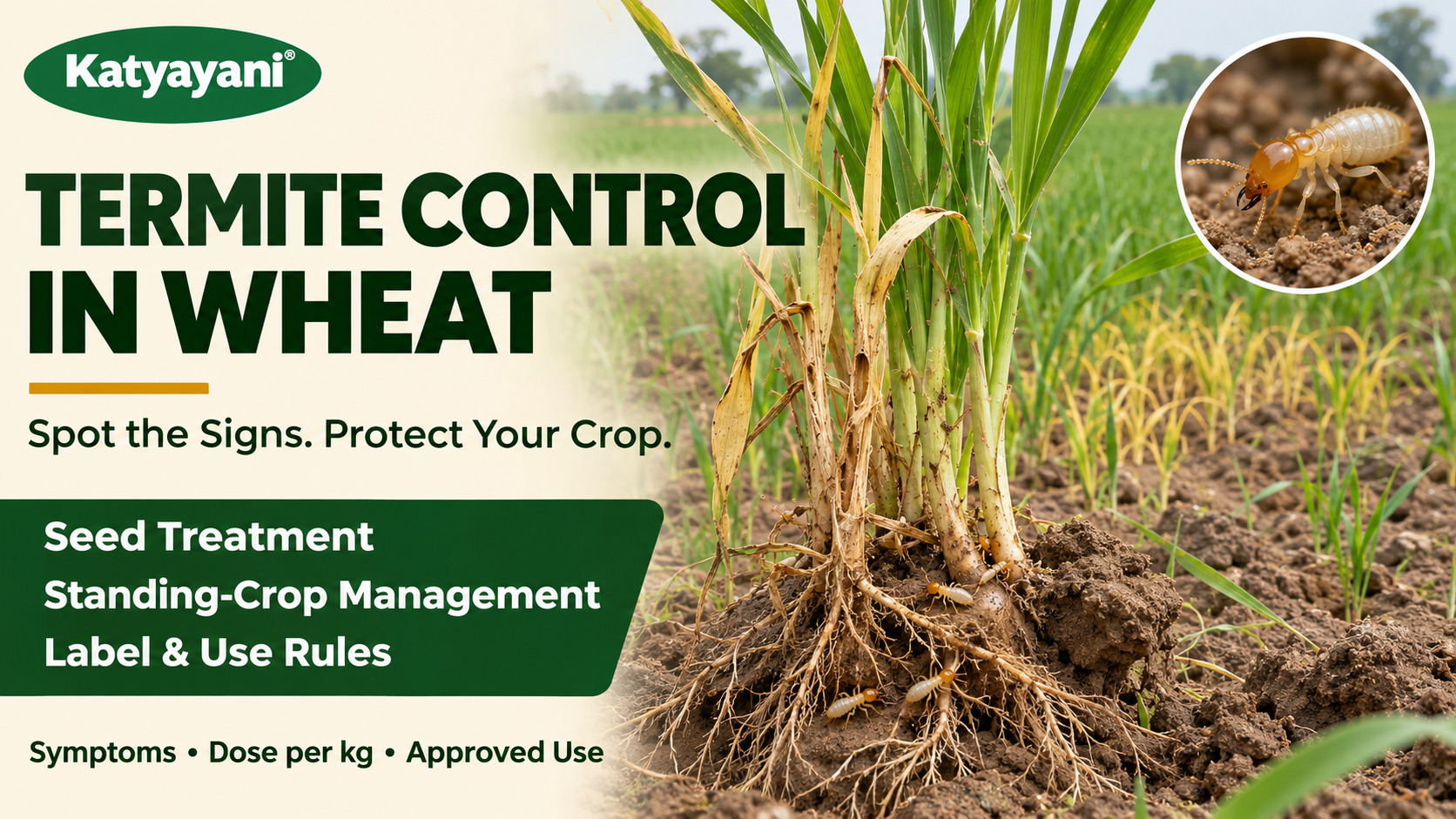
Termites eat wheat roots and the base of the stem, so plants dry up and come out of the soil with a light pull. They strike soon after sowing and again near maturity, and more in sandy and rainfed land (PAU, Rabi 2025-26). The cheapest fix is seed treatment before sowing. PAU gives, per kg of seed, 1 g thiamethoxam 70 WS, 2 mL imidacloprid + hexaconazole 20 FS or 4 mL chlorpyrifos 20 EC, which is 160 mL chlorpyrifos for 40 kg of seed. For a standing crop with severe attack, PAU says to broadcast 7 kg fipronil 0.3 G or 1.2 litre chlorpyrifos 20 EC per acre, mixed with 20 kg moist sand, before the first irrigation. No chemical stops termites for good, because the colony lives in the soil. Read the pack label first.
What is termite damage in wheat and which termites cause it?
Termites are small, pale insects that live in the soil in big colonies. In wheat they eat the roots and the base of the stem, so the plant dries up. An Indian Farming article of July 2024 names two species as the main troublemakers in Indian field crops: Odontotermes obesus and Microtermes obesi.
People call them white ants, but they are not ants. The Indian Farming article says they normally feed on dead plant material such as leaf litter and humus. When that food runs short and a crop is nearby, they travel through a web of mud galleries into the field and start eating living plants, roots first. They also burrow into stems, and the plants grow stunted. Plants hit like this come out of the soil easily.
Wheat is only one of the crops they attack. The same article lists maize, barley, pulses, oilseeds, vegetables, fruit trees, sugarcane and cotton.
When do termites attack wheat, and why are sandy and rainfed fields at more risk?
Termites hit wheat twice: soon after sowing and again near maturity. PAU, in its Rabi 2025-26 package, says they cause more damage in sandy soil. The PAU farm operations sheet for November calls termite a serious wheat pest particularly in rainfed areas. Irrigating an affected field gives some control.
Picture a farmer with two acres of light sandy land who sows in the third week of November without treating the seed. The seedlings come up thin in patches. A month later he pulls a dry plant and the root comes out with almost no soil on it. That is the early attack. If the crop survives, the second wave arrives near grain filling, and the ear heads turn white.
| Stage of the crop | What termites do | What you see in the field | Source |
|---|---|---|---|
| Soon after sowing (seedling) | Cut or eat roots and the base of the young plant | Plants dry up completely and are easily pulled out; thin patches | PAU Rabi 2025-26 |
| Tillering and growth | Keep feeding on roots if the soil is dry and the colony is close | Stunted growth, scattered dry plants | Indian Farming, Jul 2024 |
| Near maturity | Feed on stems and roots of the grown plant | Plants damaged at this stage give white ears | PAU Rabi 2025-26 |
What raises the risk? Four things show up in the official pages.
- Sandy and light soil. PAU and Indian Farming both say damage is higher in sandy soil. The TNAU page on chickpea termites says the same pest is worse in light soils.
- Rainfed fields. PAU names rainfed land as the place where termite is a serious wheat pest. The TNAU page adds that attack may continue in a standing crop during drought.
- Raw organic matter. TNAU says not to use undecomposed FYM or compost, and to clear crop stubble and undecomposed plant parts, because termites feed on dead material first.
- A colony already in or near the field. Indian Farming describes colonies of a few hundred to several million insects, so a field next to old mounds starts with a risk.
If you are not sure about your soil type, your soil health card helps you place your field.
How do I recognise termite damage in my wheat field?
Look for dry or dying plants in patches, then pull one. If it comes out with a light tug and the roots look chewed or empty, termites are likely. Later in the season, white ear heads on scattered plants point the same way. PAU describes exactly these signs.
- Walk the field at seedling stage and note patches where plants are dry while the plants around them are green.
- Pull a few dry plants. PAU says termite-damaged plants dry up completely and are easily pulled out.
- Look at the roots and the base of the stem. TNAU describes termites boring into the roots and stem, so the plant soon dries.
- Dig a little soil near the dry patch. Indian Farming says termites travel through mud galleries, so look for thin earth tunnels near the base.
- Near maturity, look for white ear heads on single plants. PAU says plants damaged at a later stage give white ears.
A simple count helps you decide. Pick 10 random spots, count total and damaged plants in a small square at each, add them up and divide. This is our own simple method, not an official action threshold, but it tells you whether the problem is a few plants or a fifth of the field.
Yellow leaves alone do not mean termites. If the plants are firmly rooted and the leaf colour is the issue, read our guide on wheat leaves turning yellow and, if the youngest leaves show the pattern, zinc deficiency in wheat.
How much damage do termites do to wheat? What does the survey data say?
The latest wheat survey available is from Jaipur district, Rajasthan, for rabi 2021-22 and 2022-23 (Annals of Arid Zone, 2024). Average plant damage was 2.82 to 5.56 percent at seedling stage and 18.40 to 28.63 percent near maturity, depending on the tehsil and year. No newer official wheat survey is available.
| Measure (Jaipur district survey, five tehsils) | Rabi 2021-22 | Rabi 2022-23 |
|---|---|---|
| Plant damage at seedling stage, range by tehsil | 2.82 to 4.88 % | 3.32 to 5.56 % |
| Plant damage near maturity, range by tehsil | 18.40 to 27.36 % | 19.80 to 28.63 % |
| Highest tehsil near maturity | Chomu, 27.36 % | Chomu, 28.63 % |
| Lowest tehsil near maturity | Dudu, 18.40 % | Dudu, 19.80 % |
Source: Annals of Arid Zone 63(2), 2024, abstract. These are percentages of damaged plants. They are not yield loss figures, so do not read 24 percent damaged plants as 24 percent less grain.
The Indian Farming article (July 2024) adds a general warning for field and fruit crops: when damage happens in the early growth phase, losses can be up to 100 percent. It is not a wheat trial number. The seedling stage looks mild in a survey, but a dead seedling is a lost plant, and near maturity there is no time left to make up the loss.
What does the CIB&RC list say about termite control in wheat?
The CIB&RC list "Major Uses of Pesticides (Insecticides)" upto 30.09.2026 shows wheat termite rows for chlorpyrifos 20% EC, fipronil 0.3% GR and fipronil 0.6% GR, plus some seed-dresser products. The list says it is for guidance, not legal use. The pack label is the legal document.
CIB&RC is the Central Insecticides Board and Registration Committee under the Government of India. It registers each pesticide product and publishes the approved crops, pests and doses. The PPQS page carries six lists dated 30.09.2026, one of them for insecticides. Rows below are read from the PDF page images. The last column is our reading.
| Product line in the list | What is printed for wheat termites | How to read it |
|---|---|---|
| Chlorpyrifos 20% EC, "Termite control", cropped area | Wheat: 3 to 4 mL per kg seed. Barley: 4 to 6 mL per kg seed. Gram: 15 to 30 mL per kg seed | Seed treatment, mL of product per kg of seed |
| Chlorpyrifos 20% EC, "Termite control", soil treatment | Wheat: 2 to 3 litre per ha. Sugarcane: 6.25 litre per ha | About 0.8 to 1.2 litre per acre for wheat (our division by 2.47) |
| Fipronil 0.3% GR | Wheat, termites: 0.06 active, 20 kg product, waiting period 91 days | 20 kg of 0.3% granules holds 60 g fipronil, so the active is 60 g per ha; about 8 kg per acre (our arithmetic) |
| Fipronil 0.6% GR | Wheat, termite: 60 active, 10 kg product, waiting period 117 days | About 4 kg per acre (our arithmetic) |
Source for all rows: CIB&RC Major Uses of Pesticides (Insecticides), upto 30.09.2026. The list also has seed-dresser rows (thiamethoxam, imidacloprid mixes) for wheat termites. They are not copied because the PDF does not print the seed weight or clear units, so read the pack label for those. Chlorpyrifos 50% EC is listed for rice and cotton, not for wheat termite control.
One more point. The 5% SC form of fipronil does not have a wheat row in this list; its rows are for rice, cabbage, chilli, sugarcane and cotton, as explained in our fipronil 5% SC dose guide. If your dealer offers fipronil 5 SC for wheat seed, ask which pack and which label supports it.
What does PAU recommend for termite control in wheat in 2025-26?
PAU Ludhiana, in its Package of Practices for Rabi 2025-26 (August 2025), advises seed treatment in termite-infested soil with 1 g thiamethoxam 70 WS, or 2 mL imidacloprid + hexaconazole 20 FS, or 4 mL chlorpyrifos 20 EC per kg of seed, then drying the seed in shade. Severe attack gets a granule or liquid broadcast.
| Situation | PAU recommendation (Rabi 2025-26) | Per what |
|---|---|---|
| Seed treatment, termite-infested soil | 1 g thiamethoxam 70 WS, or 2 mL imidacloprid + hexaconazole 20 FS, or 4 mL chlorpyrifos 20 EC. Dry the seed in shade | per kg of seed |
| Seed treatment, method given by PAU | Dilute 40 g thiamethoxam 70 WS, or 160 mL chlorpyrifos 20 EC, or 80 mL imidacloprid + hexaconazole 20 FS in 1 litre of water and spray on seed spread in a thin layer on a pucca floor, tarpaulin or polythene | per 40 kg of seed (one acre) |
| Severe attack in the standing crop | Broadcast 7 kg fipronil 0.3 G, or 1.2 litre chlorpyrifos 20 EC, mixed with 20 kg moist sand, before the first irrigation | per acre |
| Seed rate used for the arithmetic | 40 kg per acre for most varieties; 45 kg for PBW 869 and Unnat PBW 550 in conventional sowing; 50 and 45 kg with a Happy Seeder | per acre |
Sources: PAU Package of Practices for Crops of Punjab, Rabi 2025-26, wheat seed treatment and plant protection pages, and the PAU farm operations sheet for November. PAU adds that insecticide-treated seed is less attacked by birds, and that the imidacloprid + hexaconazole mix also controls smuts of wheat. The package names pack brands; this post uses the active names only.
Remember that this is the Punjab package. Soils, rainfall and registered products differ in other states. If you farm elsewhere, ask your state agriculture university or KVK for the local advice, and use PAU as a good worked example.
How do I treat wheat seed for termites step by step?
Spread the seed thin on a clean floor or sheet, mix the measured dose of product in a little water, spray or sprinkle it evenly over the seed, turn the seed until it is coated, then dry it in shade before sowing. PAU gives the dose and the thin-layer method; the steps below follow it.
- Fix your seed weight first. Weigh the seed for the plot you will sow. PAU assumes 40 kg per acre for most varieties.
- Pick one product from the CIB&RC or PAU table and read its label. Do not mix two insecticides on the same seed unless the label says so. For mixing rules see pesticide tank mix compatibility.
- Measure the dose with a clean cup or syringe kept only for chemicals. PAU gives one litre of water for 40 kg of seed.
- Spread the seed in a thin layer on a pucca floor, tarpaulin or polythene sheet. Do not use the same floor where grain is dried for the kitchen.
- Sprinkle the diluted mix evenly and turn the seed until every grain is wet and coated.
- Dry the treated seed in shade, as PAU advises. Do not dry it in strong sun.
- Sow soon after drying. PAU says treatment should not be done earlier than one month before sowing, because it can hurt germination. Note the date, product and dose in a notebook, so you can compare fields next year.
Where does seed treatment sit among other wheat jobs? It comes before sowing, together with any smut treatment, and before the timing and seed rate choices in our guide to wheat sowing time and seed rate per acre. Later, the first irrigation at the CRI stage is also the moment PAU names for the standing-crop broadcast.
How much insecticide do I need for 40, 45 or 50 kg of wheat seed?
Multiply the per-kg dose by the seed weight. For PAU rates: 40 kg of seed needs 40 g thiamethoxam 70 WS, 80 mL imidacloprid + hexaconazole 20 FS or 160 mL chlorpyrifos 20 EC. With 45 kg of seed, add one eighth to each figure; with 50 kg, add a quarter.
| Seed weight | Thiamethoxam 70 WS at 1 g per kg | Imidacloprid + hexaconazole 20 FS at 2 mL per kg | Chlorpyrifos 20 EC at 4 mL per kg |
|---|---|---|---|
| 40 kg (one acre, most varieties) | 40 g | 80 mL | 160 mL |
| 45 kg (PBW 869 and Unnat PBW 550, conventional) | 45 g | 90 mL | 180 mL |
| 50 kg (Unnat PBW 550, Happy Seeder) | 50 g | 100 mL | 200 mL |
| 100 kg (one quintal) | 100 g | 200 mL | 400 mL |
The per-kg rates and the seed rates are from PAU Rabi 2025-26. The multiplication is our arithmetic. Where the two sources differ, the CIB&RC list prints 3 to 4 mL of chlorpyrifos 20 EC per kg of wheat seed, while PAU uses 4 mL. Both are in the same range, and the pack label decides.
PAU uses one litre of water for the coat on 40 kg of seed. For 45 kg, about 1.1 litre keeps the same ratio (our scaling). For help with mL, g and litre arithmetic, see pesticide dose per litre of water. The code 20 EC means an emulsifiable concentrate with 20 percent active; our guide to EC, FS, GR and WS formulation codes explains the other letters.
What can I do if termites attack the standing wheat crop?
PAU says that in severe infestation you broadcast 7 kg fipronil 0.3 G, or 1.2 litre chlorpyrifos 20 EC, per acre, mixed with 20 kg moist sand, before the first irrigation. Irrigating an affected field also gives some control. Spot treatment of patches is not described by PAU, so follow the package and the label.
- Confirm the problem first: pull plants, look at roots, and count damaged plants in 10 squares.
- Pick the product that suits you from the PAU line: fipronil 0.3 G granules (7 kg per acre) or chlorpyrifos 20 EC (1.2 litre per acre).
- Mix the measured product with 20 kg of moist sand for each acre. Mix well so the product spreads through the sand.
- Broadcast the mixture evenly over the field before the first irrigation.
- Irrigate. PAU notes that irrigating the affected fields gives some control of termite damage.
- Write down the date, so you can count days to harvest and compare with the waiting period on the pack. The CIB&RC list prints 91 days for fipronil 0.3% GR and 117 days for the 0.6% GR in wheat.
The sources differ slightly on the granule rate: CIB&RC prints 20 kg of the 0.3% granule per hectare (about 8 kg per acre) and PAU says 7 kg per acre. If your pack says another figure, follow the pack.
The product page for fipronil 0.3 GR granules lists wheat termites in its crop table. The insecticide for wheat termite collection page groups related products. Neither page gives a wheat dose we rely on here, so use the label for the dose.
Note what this fix cannot do. A dead plant does not come back. Treating the standing crop protects the plants that are left. That is why seed treatment before sowing is the cheaper and safer choice.
Which chemical is best for termite control in wheat?
No single chemical is best for every field. The official sources list several options and do not rank them. Seed treatment with chlorpyrifos, thiamethoxam or the imidacloprid + hexaconazole mix is the first line. Fipronil granules or chlorpyrifos mixed with sand are the rescue steps for severe attack.
| Option | Where it is listed for wheat termites | Used when | Note from the source |
|---|---|---|---|
| Chlorpyrifos 20 EC, seed treatment | CIB&RC list (3 to 4 mL per kg); PAU (4 mL per kg) | Before sowing in termite-infested soil | Also listed for soil treatment, 2 to 3 litre per ha |
| Thiamethoxam 70 WS or 30 FS, seed dresser | CIB&RC list; PAU (1 g of 70 WS per kg) | Before sowing | The CIB&RC rows for these do not print clear units here, so use the PAU rate or the label |
| Imidacloprid + hexaconazole 20 FS | CIB&RC list; PAU (2 mL per kg) | Before sowing, when smut is also a worry | PAU says it also controls smuts of wheat |
| Fipronil 0.3 G or 0.3% GR | CIB&RC list (20 kg per ha); PAU (7 kg per acre) | Standing crop, severe attack, before first irrigation | Waiting period printed in the list: 91 days |
| Fipronil 0.6% GR | CIB&RC list (10 kg per ha) | As the label allows | Waiting period printed in the list: 117 days |
| Chlorpyrifos 20 EC, soil broadcast with sand | PAU (1.2 litre per acre); CIB&RC soil treatment 2 to 3 litre per ha | Standing crop, severe attack, before first irrigation | Mixed with 20 kg moist sand (PAU) |
How to choose, in plain words. If you are sowing now, treat the seed. If your field has a smut history too, the imidacloprid + hexaconazole mix covers both. If termites are already in the standing crop, use the sand broadcast. Switch the product you use from year to year only if the label and your local KVK say it is fine; the official sources do not discuss resistance in termites, so nothing is said about it here.
It is also not possible to say which product gives the best yield. The one field trial used here (next sections) used chlorpyrifos and fipronil with a farm manure and found both worked well in one place for two years. That is one site, so treat it as a clue, not a ranking.
Can I stop termites permanently? What field habits help?
No official page says termites can be stopped for good. The colony lives in the soil and can come back each season. What the sources do show is that you can cut the damage: treat seed every year, use well-rotted manure, clear crop stubble, plough deep and destroy mounds near the field.
| Habit | What the source says | Source |
|---|---|---|
| Seed treatment every year | Treat seed before sowing in termite-infested soil | PAU Rabi 2025-26 |
| Irrigate affected fields | Irrigating affected fields gives some control of termite damage | PAU Rabi 2025-26 |
| Well-rotted manure only | Undecomposed FYM or compost should not be used | TNAU, chickpea termite page |
| Clean the field | Field sanitation; timely disposal of crop stubble and undecomposed plant parts | TNAU, chickpea termite page |
| Deep ploughing | Two or three deep ploughings could help control the pest | TNAU, chickpea termite page |
| Destroy mounds and the queen | Destroy termite mounds in and around the field and kill the queen and the complementary forms | TNAU, chickpea termite page |
| Intercultural operations and pre-sowing irrigation | Frequent intercultural operations and irrigation before sowing | TNAU, chickpea termite page |
The TNAU page is written for chickpea, a rabi crop that suffers from the same soil pest. We use it only for habits that do not depend on the crop, and that is stated. It also gives chlorpyrifos at 4 mL per kg of seed, which matches PAU for wheat.
Think of it like weeds on a bund. You cannot weed once and be done for life. You keep the field clean, you do the cheap job on time every season, and you act fast when you see the first sign. Termites work the same way.
Sugarcane growers who rotate with wheat can read about termites in that crop too in our guide on termites in sugarcane. The CIB&RC chlorpyrifos termite line gives 6.25 litre per hectare as soil treatment for sugarcane, which is a different crop-specific rate and should not be used for wheat.
Do neem cake, castor cake or bio-agents work against termites in wheat?
One two-year field trial at Anand Agricultural University found that castor cake or neem cake at 1 tonne per hectare, together with seed treatment, gave good termite control in wheat. No ICAR or state university page recommends Metarhizium, Beauveria or another bio-agent for wheat termites, so none is recommended here.
| Treatment in the Anand trial | Seed treatment used | Result stated in the abstract |
|---|---|---|
| Castor cake at 1 tonne per ha | Fipronil 5 SC at 5 mL per kg of seed (cost-benefit ratio 1:7.36) | Highly effective and economical |
| Castor cake at 1 tonne per ha | Chlorpyrifos 20 EC at 4 mL per kg of seed (cost-benefit ratio 1:7.51) | Highly effective and economical |
| Neem cake at 1 tonne per ha | Fipronil 5 SC at 5 mL per kg of seed (cost-benefit ratio 1:3.50) | Highly effective |
Source: Bhatt and Borad, Indian Journal of Plant Protection, 2020, nine treatments, three replications, two years, at the college farm in Anand. The abstract says the treatments had no bad effect on seed germination or on the number of tillers per plant. It was a research trial. The fipronil 5 SC seed treatment in it is not a wheat row in the CIB&RC list, so for your own field use only a product whose label names wheat.
What this means for a farmer: the abstract reports only the combined treatments, so no claim is made that cake alone controls termites. If you already apply cake as a soil input, it is a sensible add-on to seed treatment. This post gives no biopesticide dose for wheat termites; see our guide on biopesticides for the wider picture.
What is the biggest enemy of termites?
None of the official pages for wheat names one natural enemy as the answer. Indian Farming says that after a rainstorm, most of the winged reproductives that leave the nest become food for lizards, frogs, snakes and other predators. In the field, the working enemies are your own habits: treated seed and a clean, irrigated field.
Many websites say ants are the biggest enemy of termites. No ICAR, PAU or TNAU page for wheat carries that line, so it is not repeated as a control method. What the Indian Farming article supports is this. Termites have enemies in nature, but the article lists them as animals that eat the swarming adults, not as a way to protect a wheat crop.
So the honest answer to a farmer who asks "who will finish off my termites?" is that no animal will do it for you in time to save a seedling. The same article describes a different, trap-based method for orchards: earthen pots with holes filled with grain-free maize cobs, buried 14 per acre and checked after three days. PAU entomologists devised it for pear, ber, peach, grape and amla, not for wheat, so it is outside the scope of this post.
Are chlorpyrifos, fipronil and thiamethoxam banned or restricted in India?
Chlorpyrifos is not banned for wheat in India. It is banned for use on ber, citrus and tobacco (S.O. 4294(E), 3 October 2023). The ICAR-IISR page and the PAU list of restricted and banned pesticides do not name fipronil or thiamethoxam. International rules on chlorpyrifos changed in 2025.
India. The ICAR-Indian Institute of Spices Research page, which gives CIB&RC, Faridabad as its source, lists chlorpyriphos with one line: "banned for use in Ber, Citrus and Tobacco", citing S.O. 4294(E) dated 3 October 2023. The PAU Rabi 2025-26 book carries its own "List of Pesticides Restricted or Banned in the Country". Chlorpyrifos is not on that list, and neither is fipronil, thiamethoxam or imidacloprid. Both lists are only guides; the Gazette notification is the law.
World. The UN depositary notification C.N.672.2025 of 16 December 2025 says that the Conference of the Parties to the Stockholm Convention, meeting in Geneva from 28 April to 9 May 2025, adopted decision SC-12/9, which lists chlorpyrifos in Annex A with specific exemptions. The notification adds that, in general, an amendment enters into force for all Parties one year after the depositary communicates it, except for Parties that have notified they cannot accept it. The exemptions include crop-pest uses listed in a new part XV of the annex, and some uses such as the control of locusts and of leaf-cutting ants.
What does that mean for your wheat field in 2026-27? No Indian notification changes the chlorpyrifos label for wheat, so the CIB&RC and PAU rows above still apply as written. But rules can change. Check the CIB&RC list each October and ask your state agriculture department before you stock for the next season. If you sell to exporters, check the buyer rules too.
| Question | What the opened sources show | Date and source |
|---|---|---|
| Is chlorpyrifos banned on wheat in India? | No. The one India line cited here bans it on ber, citrus and tobacco | S.O. 4294(E), 3 Oct 2023, as shown by the ICAR-IISR page (CIB&RC source) |
| Is chlorpyrifos on the PAU restricted or banned list? | No | PAU Rabi 2025-26, August 2025 |
| Are fipronil, thiamethoxam, imidacloprid on those lists? | Not named on either list | ICAR-IISR page; PAU Rabi 2025-26 |
| Did the world agree on a listing for chlorpyrifos? | Yes, Stockholm Convention Annex A with specific exemptions (SC-12/9) | COP-12, 28 Apr to 9 May 2025; notification 16 Dec 2025 |
| Is the CIB&RC list a legal document? | The list says it is compiled for guidance and not for legal purposes | CIB&RC list upto 30.09.2026 |
What mistakes should I avoid when treating wheat for termites?
The common mistakes are treating too late, using the wrong unit, guessing the seed weight, copying an old guide, mixing products without the label, and thinking one treatment ends the problem. Each has a simple fix, shown in the table below with the source behind it.
| Mistake | Why it hurts | What to do instead |
|---|---|---|
| Waiting for plants to die before acting | PAU says early-damaged plants dry up completely, so those plants are gone | Treat the seed before sowing in termite-infested soil |
| Guessing the seed weight | The dose is per kg of seed; a wrong weight gives a wrong dose | Weigh the seed; PAU uses 40 kg per acre for most varieties |
| Mixing the wrong units (mL for g) | Thiamethoxam 70 WS is grams, chlorpyrifos and the FS mix are mL | Read the unit on the label; use the table in this post as a check |
| Using old advice | Old guides name products that new lists do not | Use the CIB&RC list (upto 30.09.2026) and the latest state package |
| Drying treated seed in strong sun | PAU says dry the seed in shade | Dry in shade on a clean sheet |
| Using raw FYM or leaving stubble | TNAU says to avoid undecomposed FYM and to clear stubble | Use well-rotted manure and clean the field |
| Mixing two products on the seed without the label | The label and our tank-mix guide say what can be mixed | Follow the label; see how to read a pesticide label |
| Thinking one season fixes it for life | The colony stays in the soil | Treat seed every year and keep the field clean |
Safety is part of the job. No label text for the products above was available, so this guide does not give a protective-gear list. Read the pack for the gear, the colour triangle, first aid and the waiting period. PAU also carries a general caution that chemicals used to control insects, diseases and weeds are poisons for human beings and must be used carefully.
Fake or expired packs are a real risk when you buy seed-treatment chemicals just before sowing. Check the pack, batch and expiry. Read the label and buy only from a licensed dealer.
Does the advice change for barley, gram, late sowing or other special cases?
Yes, a little. The CIB&RC chlorpyrifos 20 EC termite line gives a different seed rate for each crop: wheat 3 to 4 mL per kg, barley 4 to 6 mL per kg and gram 15 to 30 mL per kg. Do not carry a wheat dose to another crop. Late-sown wheat is not covered by any sourced dose change.
| Case | What the sources say | What to do |
|---|---|---|
| Barley | CIB&RC chlorpyrifos 20 EC: 4 to 6 mL per kg of seed | Use the barley figure, not the wheat one |
| Gram (chickpea) | CIB&RC chlorpyrifos 20 EC: 15 to 30 mL per kg of seed; TNAU gives 4 mL per kg for bengal gram | The two sources differ; read the pack and your state advice |
| Sugarcane | CIB&RC chlorpyrifos 20 EC soil treatment: 6.25 litre per ha; fipronil 0.6% GR also lists termite in sugarcane | Do not use a wheat dose in cane |
| Late-sown wheat | PAU lists sowing windows by variety, but gives no separate termite dose for late sowing | Use the same seed treatment; see wheat sowing time |
| Field with smut history | PAU: imidacloprid + hexaconazole also controls smuts of wheat | Ask the dealer if one product can cover both |
| Sandy or rainfed field | PAU: more damage in sandy soil; serious in rainfed areas | Treat the seed every year; keep a watch from the seedling stage |
Do the same rules apply in every state? The numbers above come from CIB&RC (a national list) and PAU (Punjab). Soils and rainfall differ elsewhere, and a state agriculture university may print a different rate. Show your KVK the table and ask which line fits your district.
What is new in 2025-26 for wheat termite control, and what has not changed?
There are three dated items and no change in the wheat termite doses. The PAU Rabi 2025-26 book is dated August 2025. The CIB&RC list is current to 30.09.2026. Chlorpyrifos was listed under the Stockholm Convention in May 2025.
| Item | What is new or current | Date and source |
|---|---|---|
| State package for wheat | PAU Rabi 2025-26 wheat seed treatment and standing-crop lines as given in this post | August 2025, PAU Package of Practices |
| CIB&RC list | Wheat termite rows as shown above; list says it is upto 30.09.2026 | 30.09.2026, CIB&RC |
| International rule | Chlorpyrifos listed in Annex A of the Stockholm Convention with specific exemptions | Adopted May 2025; notification 16 Dec 2025 |
| Latest wheat termite survey in the sources | Jaipur survey for rabi 2021-22 and 2022-23 | 2024, Annals of Arid Zone |
What has not changed: nothing in these sources raises, lowers or replaces the seed-treatment doses compared with the standard advice. No earlier PAU book was available to compare line by line, so no change by PAU is claimed. The latest wheat termite survey available is the Jaipur work for 2021-22 and 2022-23.
If you are reading this in the sowing season, the practical steps are the same as always. Pick your seed lot, weigh it, choose one product from the tables, treat the seed, dry it in shade, sow, and check the first patches after emergence. Keep the receipt and pack label, because the label is what you will show if you need to ask a KVK or dealer for help.
Conclusion
Termites eat wheat roots and the base of the stem, soon after sowing and again near maturity, and more in sandy and rainfed land. Treat the seed before sowing. PAU (Rabi 2025-26) gives 1 g thiamethoxam 70 WS, 2 mL imidacloprid + hexaconazole 20 FS or 4 mL chlorpyrifos 20 EC per kg of seed, which is 160 mL chlorpyrifos for 40 kg. For a severe standing-crop attack, broadcast 7 kg fipronil 0.3 G or 1.2 litre chlorpyrifos 20 EC per acre with 20 kg moist sand before the first irrigation. Keep the field clean, use well-rotted manure and read the label. No source opened promises permanent control, so repeat the seed treatment every year.



Leave a Comment