
 17 min read
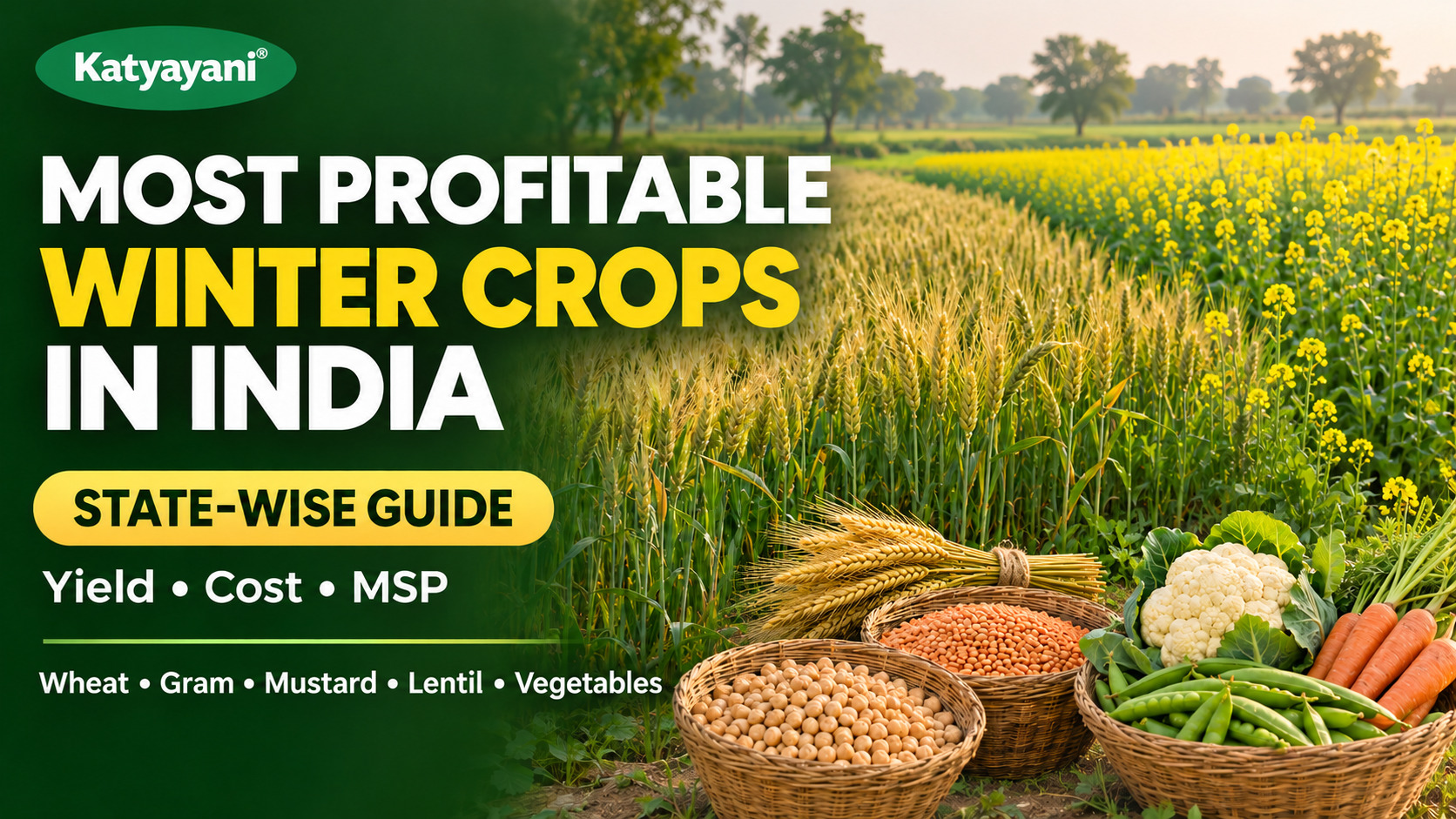
The most profitable winter crop depends on your state. Official data (DA&FW, 2023-24 and 2024-25) shows wheat leaves the most room in Punjab and Haryana, mustard in Madhya Pradesh and Haryana, and gram in Madhya Pradesh and Rajasthan. The new MSP for 2027-28 (PIB, 30 Sep 2026) leaves Rs 3,536 a quintal over cost for lentil and Rs 3,246 for mustard. Potato, onion and tomato have no MSP, so no official profit exists. Rs 1 lakh a month from one acre is not supported by any official number.
What are the most profitable winter crops in India, and what does "profit" mean here?
No official list ranks winter crops by profit. The government publishes yield, cost of production and minimum support price (MSP) instead. From those numbers, lentil, mustard, gram and wheat leave a clear margin over cost in the big producing states. Potato, onion and tomato depend on the market. No single crop wins in every state.
Winter crops are called rabi crops. Wheat, barley, gram (chana), lentil (masur), rapeseed and mustard, and safflower are the six rabi crops with an MSP. Potato, onion, tomato, peas, cumin, garlic and fenugreek are also grown in the cool season, but they have no MSP.
This post uses only official numbers: Press Information Bureau (PIB) releases, the Department of Agriculture and Farmers Welfare (DA&FW), the ICAR wheat institute at Karnal, TNAU and the Spices Board. Each figure carries its year. Market prices change every week, so none are written here.
Margin over cost in this post means MSP minus cost of production, per quintal. It is not the money in your pocket. It shows how much room a crop leaves at the support price. The cost figure is the government's projected cost, which includes the value of family labour. Rabi MSP crop-wise rates keeps the full MSP list.
Which winter crops leave the best margin over cost at the support price?
On the newest MSP list, lentil (masur) leaves the most room per quintal, Rs 3,536 over the all-India cost. Rapeseed and mustard follow at Rs 3,246, then safflower at Rs 2,405, gram at Rs 2,207, wheat at Rs 1,346 and barley at Rs 839. These are all-India averages, not your state.
The Cabinet Committee on Economic Affairs approved the MSP for marketing season 2027-28 on 30 Sep 2026 (PIB, 30 Sep 2026). The cost column is the all-India weighted average cost of production in that release. The margin column is the government's own percentage. The last column is our simple subtraction.
| Crop | MSP 2027-28 (Rs/quintal) | Cost of production (Rs/quintal) | Margin over cost (PIB, %) | MSP 2026-27 (Rs/quintal) | Our subtraction: MSP minus cost (Rs/quintal) |
|---|---|---|---|---|---|
| Wheat | 2,610 | 1,264 | 106 | 2,585 | 1,346 |
| Barley | 2,286 | 1,447 | 58 | 2,150 | 839 |
| Gram | 5,958 | 3,751 | 59 | 5,875 | 2,207 |
| Lentil (masur) | 7,390 | 3,854 | 92 | 7,000 | 3,536 |
| Rapeseed and mustard | 6,613 | 3,367 | 96 | 6,200 | 3,246 |
| Safflower | 7,215 | 4,810 | 50 | 6,540 | 2,405 |
PIB says safflower gets the biggest rise, Rs 675 a quintal, followed by rapeseed and mustard at Rs 413, lentil at Rs 390, barley at Rs 136, gram at Rs 83 and wheat at Rs 25. It adds that MSP follows the Union Budget 2018-19 announcement of at least 1.5 times the all-India weighted average cost of production.
A big margin per quintal is not a big margin per acre. Lentil gives about 4 quintals an acre, and wheat in the big wheat states gives 12 to 20. You must multiply by yield. The next sections do that state by state. If the mandi rate falls below MSP, read what farmers can do when the mandi price is below MSP.
Which winter crop is best in my state? A state-wise guide from official tables
Uttar Pradesh leads wheat and potato. Madhya Pradesh leads gram and lentil. Rajasthan leads mustard and has the largest cumin area. Punjab and Haryana have the highest wheat yields. Maharashtra leads onion and is second in gram. Rank shows where a crop is strong. It is not a profit ranking.
The table uses Agricultural Statistics at a Glance 2024 (DA&FW), 2023-24 production by state. Rank means position by share of production among the major states listed in that table.
| State | Winter crops where the state is in the top six (rank in brackets) | Table used |
|---|---|---|
| Uttar Pradesh | Wheat (1st), potato (1st), lentil (2nd), mustard (3rd), gram (5th) | ASG 2024 tables 2.5(b), 2.11(b), 2.13(b), 2.16(b), 2.49(b) |
| Madhya Pradesh | Gram (1st), lentil (1st), tomato (1st), wheat (2nd), mustard (2nd), onion (2nd), potato (5th) | ASG 2024 tables 2.5(b) to 2.16(b), 2.49(b) to 2.51(b) |
| Rajasthan | Mustard (1st), gram (3rd), wheat (5th), cumin (largest area, Spices Board) | ASG 2024; Spices Board 2024-25 |
| Punjab | Wheat (3rd), potato (6th) | ASG 2024 tables 2.5(b), 2.49(b) |
| Haryana | Wheat (4th), mustard (4th) | ASG 2024 tables 2.5(b), 2.16(b) |
| Bihar | Potato (3rd), lentil (4th), wheat (6th) | ASG 2024 tables 2.5(b), 2.13(b), 2.49(b) |
| West Bengal | Potato (2nd), lentil (3rd), mustard (5th) | ASG 2024 tables 2.13(b), 2.16(b), 2.49(b) |
| Gujarat | Onion (3rd), potato (4th), gram (4th), mustard (6th), cumin | ASG 2024; Spices Board 2024-25 |
| Maharashtra | Onion (1st), gram (2nd) | ASG 2024 tables 2.11(b), 2.50(b) |
How to use this table: find your state, note the crops where it ranks high, then go to the crop section below for yield and cost. A state that ranks high for a crop usually has the buyers, seed supply and advice that make the crop easier to run.
Tomato and onion tables cover the full year, not only winter. Read them as "big states for this crop". No official state-wise table for peas, cauliflower, garlic or carrot was available, so no ranks are written for them.
Is wheat still the best winter crop in the big wheat states?
In Punjab, Haryana and Madhya Pradesh, yes, because yield is high and cost per quintal is low. Punjab grows wheat at Rs 869 a quintal and 5,045 kg a hectare. In Maharashtra the cost is Rs 2,381 a quintal against an MSP of Rs 2,425, which leaves almost nothing. Wheat is state-specific.
India is estimated to have grown 120.657 million tonnes of wheat in 2025-26, as per the Third Advance Estimates released on 27 May 2026 (PIB, 27 May 2026). The year before, 2024-25, was 117.945 million tonnes.
The table joins three official sets. Production, share and yield are 2023-24 (ASG 2024, Table 2.5(b)). Cost is the projected A2+FL cost for 2024-25 (Table 2.73(a), source CACP). The MSP for the 2024-25 crop year is Rs 2,425 a quintal (Table 2.71). The last column is our subtraction.
| State | Production 2023-24 (million tonnes) | Share of India (%) | Yield 2023-24 (kg/hectare) | Wheat area irrigated 2022-23 (%) | A2+FL cost 2024-25 (Rs/quintal) | MSP 2,425 minus cost (Rs/quintal) |
|---|---|---|---|---|---|---|
| Uttar Pradesh | 35.34 | 31.19 | 3,708 | 98.20 | 1,277 | 1,148 |
| Madhya Pradesh | 22.58 | 19.93 | 3,012 | 96.89 | 1,078 | 1,347 |
| Punjab | 17.74 | 15.66 | 5,045 | 99.06 | 869 | 1,556 |
| Haryana | 11.19 | 9.88 | 4,723 | 98.84 | 1,011 | 1,414 |
| Rajasthan | 9.70 | 8.56 | 3,540 | 99.79 | 1,301 | 1,124 |
| Bihar | 7.17 | 6.33 | 3,150 | 97.98 | 1,279 | 1,146 |
| Gujarat | 3.77 | 3.33 | 3,027 | 97.93 | 1,394 | 1,031 |
| Maharashtra | 1.99 | 1.75 | 1,899 | 73.89 | 2,381 | 44 |
| All India | 113.29 | 100.00 | 3,559 | 95.54 | 1,182 | 1,243 |
Punjab and Haryana have the best yield and the lowest cost. Madhya Pradesh has a low cost but a lower yield. Uttar Pradesh and Rajasthan have a higher cost, so the room per quintal is smaller. About 95.54 percent of India's wheat area was irrigated in 2022-23, so wheat suits farms with sure water.
Timing matters as much as the state. ICAR's Extension Bulletin 52 (Wheat Cultivation in India, Pocket Guide) gives timely sowing of irrigated wheat as 1 to 15 November in the North Western Plains Zone, 10 to 20 November in the North Eastern Plains Zone and the Central Zone, and 1 to 15 November in the Peninsular Zone. Late sowing in the two plains zones is after 25 November. For your village, read wheat sowing time and seed rate.
Is gram (chana) more profitable than wheat?
Gram leaves more room per quintal than wheat, about Rs 2,123 against Rs 1,243 at all-India cost and 2024-25 MSP. But gram gives only about 4.7 quintals an acre, and wheat gives 12 to 20 in the big wheat states. Per acre, wheat in a good state is ahead. Gram wins when water is short or the wheat cost is high.
India's gram crop is estimated at 12.514 million tonnes in 2025-26, up 1.4 million tonnes from 11.114 million tonnes in 2024-25 (PIB, 27 May 2026). Madhya Pradesh and Maharashtra together grow more than half of it.
| State | Production 2023-24 (million tonnes) | Share of India (%) | Yield 2023-24 (kg/hectare) | Gram area irrigated 2022-23 (%) | A2+FL cost 2024-25 (Rs/quintal) | MSP 5,650 minus cost (Rs/quintal) |
|---|---|---|---|---|---|---|
| Madhya Pradesh | 2.91 | 26.40 | 1,381 | 85.62 | 3,252 | 2,398 |
| Maharashtra | 2.84 | 25.69 | 1,055 | 24.28 | 4,051 | 1,599 |
| Rajasthan | 1.92 | 17.39 | 1,081 | 37.08 | 3,272 | 2,378 |
| Gujarat | 1.07 | 9.66 | 1,714 | 76.63 | 3,010 | 2,640 |
| Uttar Pradesh | 0.79 | 7.12 | 1,153 | 0.39 | 4,168 | 1,482 |
| All India | 11.04 | 100.00 | 1,151 | 39.43 | 3,527 | 2,123 |
Sources: ASG 2024, Tables 2.11(b), 2.73(c) and 2.71. Only about 39 percent of India's gram area was irrigated in 2022-23, so most gram grows on stored soil moisture. Madhya Pradesh is the clear gram state here: high yield and a cost near the all-India average. Our guide to chana farming cost, process and profit covers sowing and disease steps.
Is mustard the best winter oilseed, and which states grow it?
Rajasthan grows 43.43 percent of India's rapeseed and mustard, 5.76 million tonnes in 2023-24. Mustard leaves Rs 2,939 a quintal over the all-India cost at the 2024-25 MSP of Rs 5,950. The all-India yield was 1,444 kg a hectare, about 5.8 quintals an acre. It suits farms with one or two irrigations.
The Third Advance Estimates put rapeseed and mustard at a record 13.768 million tonnes in 2025-26, which is 1.101 million tonnes more than 12.667 million tonnes in 2024-25 (PIB, 27 May 2026). The 2027-28 MSP is Rs 6,613 a quintal.
| State | Production 2023-24 (million tonnes) | Share of India (%) | Yield 2023-24 (kg/hectare) | Area irrigated 2022-23 (%) | A2+FL cost 2024-25 (Rs/quintal) | MSP 5,950 minus cost (Rs/quintal) |
|---|---|---|---|---|---|---|
| Rajasthan | 5.76 | 43.43 | 1,529 | 90.89 | 3,156 | 2,794 |
| Madhya Pradesh | 1.96 | 14.80 | 1,470 | 77.66 | 2,080 | 3,870 |
| Uttar Pradesh | 1.92 | 14.45 | 1,462 | 89.32 | 3,168 | 2,782 |
| Haryana | 1.34 | 10.14 | 1,816 | 86.61 | 2,283 | 3,667 |
| West Bengal | 0.79 | 5.94 | 1,244 | 93.03 | 4,009 | 1,941 |
| Gujarat | 0.53 | 3.97 | 1,896 | 100.00 | 2,969 | 2,981 |
| All India | 13.26 | 100.00 | 1,444 | 84.94 | 3,011 | 2,939 |
Sources: ASG 2024, Tables 2.16(b), 2.73(e) and 2.71. Madhya Pradesh has the lowest cost per quintal. Haryana and Gujarat have the best yields. West Bengal has a high cost and a low yield, so its margin is the smallest here. Field steps are in mustard farming cost, process and profit.
What about lentil (masur), barley, linseed and safflower?
Lentil has the highest MSP of the common rabi crops, Rs 7,390 a quintal for 2027-28, and the best margin over cost per quintal. But yields are near 1 tonne a hectare. Barley, linseed and safflower are small crops with no official state cost table in our sources, so no state comparison is made for them.
Lentil production in 2025-26 is estimated at 1.762 million tonnes (PIB, 27 May 2026). Madhya Pradesh and Uttar Pradesh together grow about 78 percent of India's lentil.
| State | Production 2023-24 (million tonnes) | Share of India (%) | Yield 2023-24 (kg/hectare) | A2+FL cost 2024-25 (Rs/quintal) | MSP 6,700 minus cost (Rs/quintal) |
|---|---|---|---|---|---|
| Madhya Pradesh | 0.82 | 45.98 | 1,152 | 3,172 | 3,528 |
| Uttar Pradesh | 0.58 | 32.19 | 1,000 | 4,060 | 2,640 |
| West Bengal | 0.14 | 8.04 | 913 | 3,770 | 2,930 |
| Bihar | 0.11 | 6.35 | 813 | 2,889 | 3,811 |
| All India | 1.79 | 100.00 | 1,028 | 3,537 | 3,163 |
Sources: ASG 2024, Tables 2.13(b), 2.73(c) and 2.71. Bihar shows the lowest cost and best margin per quintal, but also the lowest yield in the list.
National totals for the other three crops, from the DA&FW time series of the Third Advance Estimate (as on 27 May 2026), in lakh tonnes for 2025-26 against 2024-25: barley 17.96 against 19.19, linseed 1.61 against 1.12, safflower 0.66 against 0.43. The 2027-28 barley MSP is Rs 2,286 and safflower Rs 7,215. For dry zones, see the cool-season crops list and planting guide and barley farming.
Which vegetables are grown most in the cool season, and in which states?
Potato, onion and tomato are the three big vegetables in the official tables. Uttar Pradesh grows about 34 percent of India's potato. Maharashtra grows about 35 percent of onion. Madhya Pradesh grows about 16 percent of tomato. No official MSP or cost table exists for them, so profit depends on the market.
The final 2024-25 estimates came on 17 Mar 2026 (PIB, 17 Mar 2026). Total horticulture production is 3,707.38 lakh tonnes from 301.36 lakh hectares. Vegetables are 2,177.97 lakh tonnes: potato 585.71, onion 307.67 and tomato 205.99. The release says production rose in cauliflower, cabbage, peas, radish and capsicum.
| Crop | Leading states, 2023-24 (production in thousand tonnes, share of India) | All-India 2023-24 (thousand tonnes) | All-India yield 2023-24 |
|---|---|---|---|
| Potato | Uttar Pradesh 19,173 (34%); West Bengal 13,000 (23%); Bihar 8,200 (14%); Gujarat 4,000 (7%); Madhya Pradesh 3,949 (7%); Punjab 3,237 (6%) | 57,053 | 24,568 kg/hectare |
| Onion | Maharashtra 8,602 (35%); Madhya Pradesh 4,166 (17%); Gujarat 2,057 (8%); Karnataka 1,638 (7%); Rajasthan 1,631 (7%); Bihar 1,388 (6%) | 24,267 | 15,751 kg/hectare |
| Tomato | Madhya Pradesh 3,498 (16%); Andhra Pradesh 2,438 (11%); Karnataka 2,007 (9%); Gujarat 1,810 (8%) | 21,323 | 25.0 tonnes/hectare |
Source: ASG 2024, Tables 2.49(b), 2.50(b) and 2.51(b). The PIB release of 11 Jun 2026 expects 2025-26 potato at 598.89 lakh tonnes, tomato at 214.61 and onion at 307.37 (PIB, 11 Jun 2026). A bigger crop can mean a lower price, but neither is certain. For crop-wise steps, see potato farming cost per acre, onion farming in India and tomato farming.
Are cumin, coriander, fenugreek and garlic good winter crops?
Cumin is the best known winter spice crop. Rajasthan and Gujarat grow almost all of it. The Spices Board shows 15.6 lakh hectares and 11.64 lakh tonnes in 2024-25. Coriander, fenugreek and garlic are also rabi spices, but no official cost table for them was opened, so no margin is written.
The Spices Board table of major spices by state marks 2024-25 as final (Spices Board, state-wise area and production). Each cumin row below was matched to the table image on 17 Nov 2026. Rajasthan: 10,81,550 hectares and 6,88,560 tonnes. Gujarat: 4,76,557 hectares and 4,71,838 tonnes. Total including others: 15,60,742 hectares and 11,63,907 tonnes. Gujarat gets more tonnes per hectare than Rajasthan.
PIB (17 Mar 2026) reports 2024-25 spice production of 129.93 lakh tonnes, with gains in cumin, ginger, garlic and turmeric. The 2025-26 second advance estimate (PIB, 11 Jun 2026) expects 126.55 lakh tonnes, with gains in garlic, turmeric, curry leaf and fenugreek. See also cumin blight and wilt control, garlic farming and coriander varieties.
Which winter crops grow in 3 months or less?
Radish is the quickest: TNAU says 20 to 30 tonnes a hectare in 45 to 60 days. TNAU lists fenugreek varieties at 75 to 90 days and the coriander variety CO 4 at 65 to 70 days. All three fit inside 3 months. Wheat, gram, mustard and potato take longer.
These are Tamil Nadu Agricultural University pages dated 2016 (radish) and 2013 (spice varieties), and they describe varieties for Tamil Nadu. The radish page names September as the best sowing month in the plains (TNAU, radish). The spice lines come from TNAU varieties of spice crops. TNAU calls fenugreek CO 1 and coriander CO 1 and CO 2 dual-purpose, meaning greens and grain.
| Crop and variety | Crop duration stated by TNAU | Yield stated by TNAU | Source |
|---|---|---|---|
| Radish | 45 to 60 days | 20 to 30 tonnes a hectare | TNAU Agritech, radish page |
| Fenugreek, CO 1 | 75 to 80 days | 600 kg of grain a hectare | TNAU Agritech, spice varieties |
| Fenugreek, CO 2 | 85 to 90 days | 481.8 kg of grain a hectare | TNAU Agritech, spice varieties |
| Coriander, CO 4 | 65 to 70 days | 590 kg a hectare irrigated, 540 kg rainfed | TNAU Agritech, spice varieties |
| Coriander, CO 2 | 90 to 100 days | 600 to 700 kg of grain a hectare | TNAU Agritech, spice varieties |
Which variety you can sow depends on your state and season, so check with your nearest Krishi Vigyan Kendra. A short crop frees the plot early. For a plan that links seasons, read crop rotation examples, plans and benefits and radish farming.
Can one acre of winter crop earn Rs 1 lakh a month?
Not from the field crops that have official cost data. In our illustration below, the best result is about Rs 31,700 an acre for one season of Punjab wheat. Rs 12 lakh a year would need about 38 acres of that. High-value crops may do better, but no official cost data was found to support a number, so none is written.
The official income figure is lower. The National Statistical Office survey gave an average monthly income of Rs 10,218 per agricultural household in 2018-19, up from Rs 6,426 in 2012-13 (PIB, 19 Jul 2022). That is income per household from all sources, not per acre. It is the latest official household figure available.
- More land or more seasons. The same acre cropped two or three times a year, if water and soil allow it.
- Lower cost. Punjab wheat costs Rs 869 a quintal and Maharashtra wheat Rs 2,381.
- Better yield. Match your yield to the best farms near you, not to the state average.
- Better sale. A fair open-market sale needs a mandi you trust.
If someone promises Rs 1 lakh a month from one acre, ask for the crop, the yield per acre, the selling price and the cost, each with a year and a source. If one is missing, the promise is a guess.
How do I work out the profit of a winter crop on my own acre, step by step?
Multiply your yield in quintals an acre by the price you will get. Subtract everything you spend, including your own time and land rent if you want the full picture. Use the state numbers here for a first guess, then replace them with your own field numbers after one season.
- Find the yield per acre. The tables give kilograms a hectare. Divide by 2.471 to get kilograms an acre, then by 100 for quintals. Punjab wheat at 5,045 kg a hectare is about 20.4 quintals an acre.
- Choose the price. Use the MSP only if you will sell to a government buying centre. Otherwise use the rate at your own mandi in the week you plan to sell.
- Money in. Quintals an acre times price a quintal.
- Your costs. Seed, fertilizer, plant protection, irrigation, labour, machine hire, transport and land rent if you lease. Add a value for your own labour.
- Subtract. Money in minus money out is the margin over cost for one acre.
- Compare two crops with the same method. Use the same year and the same cost items for both.
The table below is an illustration, not a profit figure and not a forecast. Yield is the 2023-24 state average (ASG 2024). MSP is the 2024-25 crop-year rate (Table 2.71). Cost is the 2024-25 projected A2+FL cost (Table 2.73). The years do not match exactly, and every row is a state average. It leaves out land rent for your own land, storage and transport.
| Illustration (state average) | Yield (quintal/acre) | MSP (Rs/quintal) | Money in (Rs/acre) | A2+FL cost (Rs/acre) | Gap (Rs/acre) |
|---|---|---|---|---|---|
| Punjab wheat | 20.4 | 2,425 | about 49,500 | about 17,700 | about 31,700 |
| Uttar Pradesh wheat | 15.0 | 2,425 | about 36,400 | about 19,200 | about 17,200 |
| Haryana mustard | 7.3 | 5,950 | about 43,400 | about 16,700 | about 26,800 |
| Madhya Pradesh gram | 5.6 | 5,650 | about 31,600 | about 18,200 | about 13,400 |
Here is the Haryana mustard row in words. Yield 1,816 kg a hectare is about 7.3 quintals an acre. At Rs 5,950 a quintal that is about Rs 43,400. At a cost of Rs 2,283 a quintal the cost is about Rs 16,700. The gap is about Rs 26,800 for one season. Now compare Madhya Pradesh gram: a lower yield and a higher cost per quintal give a gap of about Rs 13,400. The crop with the bigger margin per quintal is not always the crop with the bigger gap per acre.
Use the table to compare crops, not to promise an income. Yield and cost also depend on field work done on time. For rabi crop insurance, see PMFBY rabi registration.
What mistakes turn a winter crop into a loss?
The most common mistake is to copy the crop that paid well last year without checking cost, yield and sowing date for your own field. A crop with a high margin per quintal can still lose money if yield is low or sowing is late.
- Judging by price per quintal, not by money per acre. Lentil has the biggest MSP, but wheat can give more money per acre where wheat yield is high.
- Using another state's numbers. Wheat costs Rs 869 a quintal in Punjab and Rs 2,381 in Maharashtra (2024-25, CACP, as printed in ASG 2024).
- Sowing late. ICAR marks wheat sown after 25 November in the North Western and North Eastern Plains Zones as late sown, with a higher seed rate (125 kg a hectare against 100 kg in that guide).
- Putting a water-hungry crop on unsure water. About 95.54 percent of wheat area is irrigated, against 39.43 percent of gram.
- Chasing last month's vegetable rate. Official tables show size of crop, not price.
- Leaving out your own costs. Add land rent and interest on your own money for a full picture.
Take a simple case. A farmer in Maharashtra sees wheat on the national list and sows it because a neighbour in Punjab did well. The official cost there is Rs 2,381 a quintal against an MSP of Rs 2,425. The same acre of gram, on the same plan, has a cost of Rs 4,051 a quintal and an MSP of Rs 5,650. Checking the state numbers first would have shown which crop leaves more room.
Write the plan on one page before you sow: crop, area, sowing date, expected yield, expected price, costs and the date you will sell. After harvest, write the real numbers beside it.
What if my farm is small, dry, hilly or in a state that is not on the list?
Use the same method with your own numbers. Small farms gain most from lower cost and a sure sale. Dry farms look at crops that need less irrigation, such as gram on stored moisture. Hilly farms need local advice. The tables here are state averages and may not describe your village.
Maharashtra shows why. Its wheat area was only 73.89 percent irrigated in 2022-23, its yield was 1,899 kg a hectare and its cost Rs 2,381 a quintal, yet it is the second biggest gram state. Himachal Pradesh wheat was 26.55 percent irrigated, with a yield of 2,480 kg a hectare and a cost of Rs 1,744 a quintal. ICAR treats the Northern Hills Zone as a separate wheat zone, so hill farmers should follow hill advice from their state university or Krishi Vigyan Kendra.
- Rainfed land. Ask your Krishi Vigyan Kendra for a rainfed gram variety.
- Late canal water or late monsoon exit. ICAR gives late-sown dates by zone: 1 to 15 December in the Central Zone, and the last week of November to the first week of December in the Peninsular Zone.
- Frost. Read frost damage claims under PMFBY before a cold spell.
- A state with no row in our tables. The official tables list only major states. Ask your state agriculture department for its own numbers.
What is new in 2025-26 and for the 2026-27 winter season?
Four official releases are new. MSP for 2027-28 rose for all six rabi crops on 30 Sep 2026. The Third Advance Estimates put mustard at a record for 2025-26, with wheat and gram above 2024-25. The 2024-25 horticulture numbers were finalised on 17 Mar 2026, and second advance estimates for 2025-26 horticulture came on 11 Jun 2026.
| Date | What was released | Key numbers | Source |
|---|---|---|---|
| 30 Sep 2026 | MSP for rabi crops, marketing season 2027-28 | Wheat Rs 2,610; barley Rs 2,286; gram Rs 5,958; lentil Rs 7,390; rapeseed and mustard Rs 6,613; safflower Rs 7,215 a quintal | PIB, CCEA |
| 27 May 2026 | Third Advance Estimates 2025-26, foodgrains and oilseeds | Wheat 120.657 million tonnes; gram 12.514; lentil 1.762; rapeseed and mustard 13.768 (record) | PIB |
| 11 Jun 2026 | Second Advance Estimates 2025-26, horticulture | Total 3,777.76 lakh tonnes; potato 598.89; tomato 214.61; onion 307.37 lakh tonnes | PIB |
| 17 Mar 2026 | Final 2024-25 and first advance 2025-26, horticulture | Total 3,707.38 lakh tonnes; onion 307.67; potato 585.71; tomato 205.99 lakh tonnes | PIB |
The state cost tables used here are for 2024-25, the newest printed in ASG 2024. No newer state-wise cost table is available, so state tables use 2024-25 and the national table uses 2027-28. No official 2026-27 rabi sowing-area report was available, so no area figure is written. Check the weekly area coverage report from DA&FW before you pick a crop and a date.
Which official pages should I read to check these numbers myself?
Six official sources cover this post. PIB carries the MSP, advance estimate and horticulture releases. DA&FW carries the time series and the statistics book. ICAR carries wheat dates, TNAU carries crop duration and the Spices Board carries cumin. Note the year printed on each table, and the unit.
- PIB, MSP for rabi crops 2027-28. 30 Sep 2026. MSP, cost and margin.
- PIB, Third Advance Estimates 2025-26. 27 May 2026. National crop production.
- DA&FW, Agricultural Statistics at a Glance 2024. State tables and the CACP cost and MSP tables.
- PIB, horticulture releases. 17 Mar 2026 and 11 Jun 2026.
- ICAR Extension Bulletin 52, wheat. Zones, sowing times and fertilizer doses.
- TNAU Agritech and Spices Board. Crop duration, and cumin by state.
Tables use different units: million hectares, million tonnes, thousand tonnes, lakh tonnes, kilograms a hectare. Our table headings name the unit. Convert before you compare.
Conclusion
There is no single most profitable winter crop in India. Official tables say wheat is strongest in Punjab and Haryana, mustard in Madhya Pradesh, Haryana and Rajasthan, gram in Madhya Pradesh and Rajasthan, and lentil in Madhya Pradesh and Bihar by margin per quintal. Potato, onion and tomato are big crops with no MSP, so market price decides. Work out your own acre: yield times price, minus your cost. Check sowing dates for your zone, and write the plan before you sow.


Leave a Comment