
 14 min read
Pokkah boeng is a fungal disease of sugarcane caused by a group of Fusarium species. It shows as pale, wrinkled, twisted leaves, then a rotting top, and sometimes a cut-like mark on the stalk (TNAU). TNAU forecasts of April and August 2026 advise a sett dip in propiconazole 25 EC (1 ml per litre) with imidacloprid for planting, and a spray of propiconazole 25 EC (1 ml per litre) with imidacloprid 17.8 SL (0.3 ml per litre) and a sticker once symptoms appear. ICAR-SBI sprayed propiconazole at 0.5 ml per litre in its own field. Important: the CIB&RC fungicide list upto 30 September 2026 has no pokkah boeng row, so confirm the product and dose with your agriculture officer or KVK and read the pack.
What is pokkah boeng in sugarcane and how do I recognise it in my field?
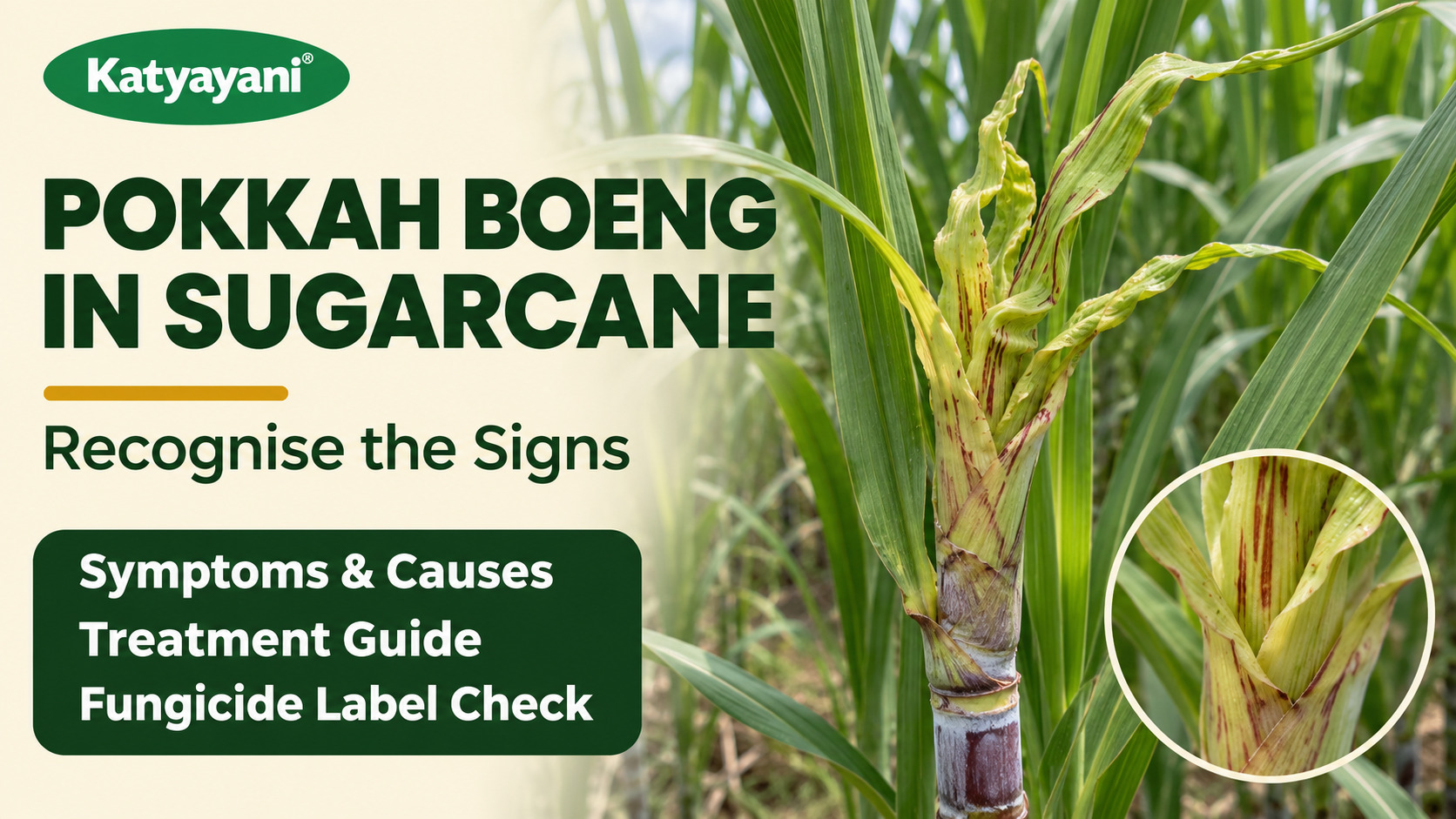
Pokkah boeng is a fungal disease of sugarcane. The name is a Javanese term for a malformed or distorted top, says TNAU. You see it first on the young top leaves, which turn pale, wrinkle, twist and stay short. In bad cases the growing point rots and the top of the plant dies.
TNAU calls pokkah boeng a re-emerging disease. That means growers had stopped worrying about it and now it is back.
A small example. A grower in July walks his two-month-old ratoon and sees a few clumps with crinkled, pale tops. The leaves look as if someone has pinched them. A week later one clump has a dead centre that pulls out easily. That walk is how most fields are first caught, so it pays to walk the rows every week in the weeks after rain and warm weather.
Pokkah boeng is one of several sugarcane diseases. For red rot, smut, wilt and the others, read our guide on sugarcane diseases and pests. This post stays with pokkah boeng, so it can go deeper than that guide.
What are the stages of pokkah boeng, and how do the symptoms look?
TNAU describes three stages: the chlorotic phase, the top rot phase and the knife-cut phase. A plant can show only the first stage and then recover, or it can move through all three. Other signs are shortened internodes and buds that sprout early, before the cane is mature.
| Stage | What you see in the field (TNAU) | What it tells you |
|---|---|---|
| Chlorotic phase | Leaves are pale or yellowish, rough, wrinkled, twisted and shortened | Earliest warning. This is the stage to act on |
| Top rot phase | The growing point is killed and the entire top of the plant dies | Cane growth at that stalk stops. Remove the affected top |
| Knife-cut phase | The stem looks as if tissue has been removed with a sharp knife | Damage reaches the stalk. Remove the affected part |
| Other signs | Shortened internodes; bud sprouting before the crop matures | Shows a stressed, stunted stalk |
Source: TNAU Agritech Portal, pokkah boeng page. The same page lists these stages with field photographs, so a grower can compare a real leaf with the pictures. The ICAR-SBI Annual Report 2024 shows photographs of the same stages: chlorosis, necrosis, twisted leaf and knife cut (ICAR-SBI Annual Report 2024).
A dead top does not always mean pokkah boeng. Other problems can kill a growing point. If you are not sure, take a fresh affected top, with the leaves, to the Krishi Vigyan Kendra (KVK) or the cane development officer of your sugar mill, and let them confirm before you spend money on a spray.
What causes pokkah boeng, and how does it spread from plant to plant?
Pokkah boeng is caused by a group of Fusarium fungi, not a single species. TNAU names Fusarium sacchari, Fusarium proliferatum and Fusarium verticillioides. It spreads mostly through the air. Infected setts, irrigation water, splashed rain and soil carry it as well, and the fungus can live for 12 months in plant debris.
| Question | Answer from the source | Source |
|---|---|---|
| Which fungi cause it? | A Fusarium species complex: F. sacchari, F. proliferatum, F. verticillioides and others | TNAU |
| Main way it spreads | Air-borne; spread by air currents | TNAU |
| Other ways it spreads | Infected setts, irrigation water, splashed rain, soil | TNAU |
| How long it survives | Up to 12 months in plant debris under natural conditions | TNAU |
ICAR-SBI adds a note of care. Its annual report says earlier work at the institute reported F. sacchari as the cause of both wilt and pokkah boeng, but the role of the other Fusarium species needs more study. In a small trial, five Fusarium species were put on eight varieties, and not every species produced wilt symptoms 60 days later, so the species do not all behave the same way (ICAR-SBI Annual Report 2024).
What this means for you: the fungus is already in the air and in old plant material around many cane fields. You cannot keep it out. What you can control is how many weak spots it finds, which means clean setts, careful water and weather-aware scouting.
Which weather and crop stage make pokkah boeng worse?
TNAU says warm and moist weather favours pokkah boeng, and summer showers with cloudy skies help it too. Three to seven month old plant crop is the most exposed, and a ratoon crop can be hit when it is only one month old.
| Factor | What the source says | Source |
|---|---|---|
| Weather | Warm, moist conditions; summer showers with cloudy weather | TNAU |
| Plant crop age at most risk | Three to seven months old | TNAU |
| Ratoon crop age at risk | Affected already at one month old | TNAU |
| Crown mealybug season in Tamil Nadu | April to July (summer months) | TNAU |
Months differ across the country, so do not copy the April to July window to Punjab or Bihar. TNAU gives it for the crown mealybug in Tamil Nadu. For your own district, watch the weather. After a warm, cloudy, showery spell, scout your three to seven month old cane first.
No official source gives a rainfall or humidity number that triggers the disease, so none is written here.
Why is pokkah boeng a growing worry for cane growers?
Official reports from the last two years show it is spreading in new places. ICAR-SBI wrote in its 2024 annual report that reports of crown mealybug and pokkah boeng in some Tamil Nadu districts were on the rise, and it held a workshop on 12 November 2024. TNAU forecasts in April and August 2026 still list it.
- Tamil Nadu. The ICAR-SBI report lists pokkah boeng and crown mealybug, caused by changing climate, among the notable issues in cane growing in Tamil Nadu and Karnataka. TNAU forecasts for April 2026 and August 2026 both record crown mealybug, pokkah boeng and internode borer in Cuddalore, Villupuram and Kallakurichi districts.
- Haryana and Uttar Pradesh. The ICAR-SBI Regional Centre at Karnal surveyed the reserved areas of ten sugar mills in Haryana and Uttar Pradesh (Karnal, Yamunanagar, Bhadson, Shahabad, Assandh, Mawana, Naglamal, Khaikheri, Liberheri and Barkatpur) and noted pokkah boeng up to 35 percent in cultivated varieties (ICAR-SBI Annual Report 2024).
No official figure for the cane yield or sugar loss caused by pokkah boeng was available, so none is written here. Do not accept a loss number from a dealer or an app unless it names a source and a year. The honest summary is this: the disease is real, it is rising in several areas, and early action costs less than late action.
What does the crown mealybug have to do with pokkah boeng?
TNAU says the severity of pokkah boeng goes up when the crown mealybug, Phenacoccus saccharifolii, is present. The insect sits in the crown, where the new leaves come out, and black ants look after it. It leaves a sticky honeydew, and a black sooty mould grows on that. That is why TNAU's advice treats the two together.
- Where the insect lives. TNAU says P. saccharifolii colonises the crown region of the crop, and it is associated with the black ant Camponotus compressus.
- What you see. Heavy honeydew and sooty mould (Capnodium) on the leaves.
- When. The mealybug peak coincides with the summer months of April to July (TNAU, Tamil Nadu).
- What ICAR-SBI studied. The 2024 annual report lists a study on the biology, ecology and management of the crown mealybug in association with pokkah boeng. The female lives 36 to 42 days and the male 21 to 25 days.
Because ants protect the mealybug, TNAU asks growers to watch the movement of ants in the field. Its April 2026 forecast says that when ant movement is noticed, spray imidacloprid 17.8 SL at 3 ml per 10 litres, or chlorantraniliprole 18.5 SC at 4 ml per 10 litres, or clothianidin 50 WDG at 5 g per 10 litres, or flonicamid 50 WG at 3 g per 10 litres, in the three border rows alone (TNAU forecast, April 2026). The forecast lists one more option which is not repeated here.
A caution on labels. The CIB&RC insecticide list upto 30.09.2026 (CIB&RC insecticides list) was searched for the word mealybug. The rows that name mealybug are for cotton, grapes, tea, groundnut and similar crops. The sugarcane rows are for pests such as termite, early shoot borer, top borer, white grub and aphids. Crown mealybug is not named on any sugarcane row. So take the TNAU insecticide advice to your agriculture officer and match it with the label of the product you buy.
How can I treat pokkah boeng in sugarcane, step by step?
The newest official advice is the TNAU pest forecast for April 2026. In short: dip the setts before planting, watch the ants, detrash, and spray the crown with propiconazole plus imidacloprid and a sticker from three months after planting. Remove the stalks that show top rot or knife-cut. Repeat at 20-day gaps as TNAU says.
- Confirm the problem. Look for the three stages above. If the top is dead and you doubt the cause, ask a KVK or the mill cane officer to look at it.
- Remove the badly hit parts. TNAU says to remove plant parts showing top rot and knife-cut symptoms. Take them out of the field. The fungus can live for 12 months in plant debris (TNAU), so leaving them lying between the rows is a poor idea. That last point is our reading of the TNAU statement, not a separate rule.
- Detrash before you spray. TNAU says to detrash first. The April 2026 forecast adds that the spray should be directed to the central whorl of the cane for better control.
- Spray the crown. For crown mealybug and pokkah boeng, TNAU (April 2026) says to spray propiconazole 25 EC at 1 ml, imidacloprid 17.8 SL at 0.3 ml, a sticking agent at 1 ml, in 1 litre of water. Start three months after planting and repeat three times at 20-day intervals.
- Watch the ants. If ants are moving in the field, spray the border rows with an insecticide from the TNAU list given in the section on crown mealybug.
- Feed the crop. TNAU advises the recommended dose of fertilisers and micronutrients after every ratoon and at earthing up, and a TNAU sugarcane booster spray of 1 kg, 1.5 kg and 2 kg at 45, 60 and 75 days after planting or ratooning (April 2026 forecast).
- Check again after 20 days. If new symptoms still show, TNAU's older portal page suggests propiconazole 25 EC at 1 ml per litre with flonicamid 50 WG at 0.3 g per litre, or with clothianidin 50 WDG at 0.5 g per litre, at 20-day intervals (TNAU portal page).
For a 15 litre knapsack tank, the April 2026 mix works out to 15 ml propiconazole 25 EC, 4.5 ml imidacloprid 17.8 SL and 15 ml sticker. These are calculated by multiplying TNAU's per-litre figures by 15; they are not printed in the forecast. If you want help with this sum, our dose per litre calculator guide shows the method.
Two warnings. First, this is TNAU advice for Tamil Nadu. Other state universities may give different advice. Second, read the label of the pack you hold. The label is the legal document, and a government list or portal page is a guide (CIB&RC page note).
What is the best fungicide for pokkah boeng, and what does the CIB&RC list say?
No fungicide is registered on the CIB&RC list for pokkah boeng. The Major Uses of Pesticides (Fungicides) list upto 30.09.2026 was searched and shows no pokkah boeng row. TNAU and ICAR-SBI both use propiconazole in their own advice. So the honest answer is: propiconazole is what the official institutes name, and you must confirm use with your agriculture officer.
| What was searched | What the CIB&RC fungicide list upto 30.09.2026 shows | What it means |
|---|---|---|
| The words pokkah boeng, top rot | No match | No fungicide row for this disease |
| Sugarcane rows in the list | Azoxystrobin 18.2% + Difenoconazole 11.4% SC: red rot, smut and rust, printed 0.1 percent or 1 ml per litre. A seed-treatment downy mildew entry also names sugarcane | Registered for other diseases, not for pokkah boeng |
| Propiconazole 25% EC | Rows for crops such as wheat, rice, groundnut, tea and soybean; no sugarcane row found | TNAU and ICAR-SBI use it on cane without a CIB&RC cane row |
| Carbendazim 50% WP and copper oxychloride 50% WP | Rows for other crops; no sugarcane row found | Not registered for sugarcane on this list |
Source: CIB&RC fungicides list, searched as text on 17 Nov 2026. The list says on its first page that it is compiled for guidance and not for legal purposes. Large PDF lists can hide a row, so ask your agriculture officer to check the pack and the Central Insecticides Board registration for the product you hold.
Our guide on how to read a pesticide label shows what to look for on a pack: the registration number, the crops, the dose and the waiting period.
How do the TNAU and ICAR-SBI doses compare, and which one should I follow?
They differ. TNAU gives propiconazole 25 EC at 1 ml per litre. ICAR-SBI sprayed it at 0.5 ml per litre in its own fields. Neither is a CIB&RC label dose for sugarcane. Follow the dose printed on the label of your product, and the advice of your state agriculture university or KVK, rather than mixing figures from two sources.
| Source and date | Plant crop or ratoon | What it says (as printed) |
|---|---|---|
| TNAU forecast, April 2026 | Plant crop | Sett dip in propiconazole 25 EC at 1 ml per litre for 30 minutes, then imidacloprid 17.8 SL at 0.3 ml per litre for 5 minutes |
| TNAU forecast, April 2026 | Standing crop | Spray propiconazole 25 EC 1 ml + imidacloprid 17.8 SL 0.3 ml + sticker 1 ml per litre of water, from three months after planting, three times at 20-day intervals |
| TNAU forecast, August 2026 | Ratoon crop | TNAU sugarcane booster at 1, 1.5 and 2 kg per acre at 45, 60 and 75 days after ratooning, plus propiconazole 25 EC at 200 ml per acre with imidacloprid 17.8 SL at 80 ml per acre after first symptoms; repeat with propiconazole 200 ml per acre and clothianidin 50 WG at 100 g per acre at 20 days; effective up to two ratoons |
| TNAU forecast, August 2026 | Plant crop | Sett treatment with propiconazole 25 EC at 100 ml per acre and imidacloprid 70 WS at 100 ml per acre for 20 minutes, then the booster at 45, 60 and 75 days after planting |
| ICAR-SBI Annual Report 2024 | Monitored varieties | All the monitored varieties recovered and put out new leaves free from symptoms after spraying propiconazole at 0.5 ml per litre |
| ICAR-SBI Annual Report 2024 | Nursery plots near an infested ratoon | Two rounds of propiconazole 25 EC at 0.5 ml per litre with thiamethoxam 75 SG at 0.3 g per litre |
Sources: TNAU April 2026 forecast, TNAU August 2026 forecast and ICAR-SBI Annual Report 2024. Notice two things. The August 2026 per-acre note shows imidacloprid 17.8 SL at 80 ml per acre in the ratoon line and 30 ml per acre in the plant-crop spray line of the same document, so the per-acre numbers do not agree with each other. The two undated TNAU portal pages (first page and second page) also differ, with imidacloprid 17.8 SL at 0.4 ml and 0.3 ml per litre. The dated April 2026 forecast shows 0.3 ml, so that is the figure used in this post.
A simple way to think about it: 200 ml per acre of propiconazole at 1 ml per litre would mean about 200 litres of spray liquid per acre. TNAU does not state the water volume, so this is our arithmetic and not a rule. Check with the KVK how much water your sprayer uses on an acre of cane at this stage. Our guide on choosing an agricultural sprayer explains why a sprayer that cannot reach the crown wastes the product.
How do I protect a new planting with sett treatment?
TNAU advises treating the setts of a plant crop as a preventive step. In the April 2026 forecast, setts go into propiconazole 25 EC at 1 ml per litre for 30 minutes, then imidacloprid 17.8 SL at 0.3 ml per litre for 5 minutes. The August 2026 forecast has a per-acre version.
Why do this? Because TNAU lists infected setts among the secondary ways pokkah boeng spreads, a sett can carry the problem into a clean field. ICAR-SBI is working on the same idea at scale. Its annual report describes demonstrating mechanised sett treatment with a mix of a fungicide, an insecticide and nutrients, to protect the crop from fungal diseases and early pests, particularly pokkah boeng and mealybug, and it supplied sett treatment devices to nursery units at sugar mills in Tamil Nadu.
At the institute itself, ICAR-SBI treated two-budded setts of breeding clones with azoxystrobin 50 ppm (0.2 ml), propiconazole 75 ppm (0.3 ml) and thiamethoxam 60 ppm (0.3 ml). Three months later the crop showed no pest or disease. At five months there was mild pokkah boeng, while nearby untreated plots had heavy incidence. This is an institute trial on breeding clones, so use it as a sign that sett treatment helps, not as a dose for a farm.
- Use setts from a clean field. TNAU names infected setts as a route of spread.
- Dip, then plant. Do not let treated setts sit in the sun for long. (This is common sense, not a figure from a source.)
- Keep a note of the product, dose and date for each plot so you can compare plots later.
What should I do in a ratoon crop?
A ratoon is at risk very early. TNAU says ratoon cane can be hit when it is one month old. The April 2026 forecast advises growers in endemic areas to discourage ratoon cropping after two ratoons, and to apply fertiliser and micronutrients after every ratoon at earthing up.
The August 2026 forecast has a ratoon module. Spray the TNAU sugarcane booster at 1, 1.5 and 2 kg per acre at 45, 60 and 75 days after ratooning. After the first signs of crown mealybug and pokkah boeng, add propiconazole 25 EC at 200 ml per acre with imidacloprid 17.8 SL at 80 ml per acre. If symptoms come back, spray propiconazole at 200 ml per acre with clothianidin 50 WG at 100 g per acre 20 days later. TNAU says this module is effective up to two ratoons.
ICAR-SBI saw why ratoons matter. In its nursery observations, pokkah boeng and mealybug in treated plots came from spread of the inoculum from a heavily infested ratoon crop nearby. Those plots were protected by two rounds of propiconazole and thiamethoxam. So a badly hit ratoon next to a clean planting is a risk to the planting.
Our post on micronutrient management in sugarcane covers the nutrient side of ratoon care, which TNAU lists as part of the pokkah boeng plan.
Which sugarcane varieties are more or less affected by pokkah boeng?
TNAU calls Co 86032 moderately tolerant and lists CoV 09356, CoV 94101, Co 11015, Co 06022 and 87 A 298 as highly susceptible. ICAR-SBI Karnal screened 51 zonal trial entries and found nine susceptible, including Co 0238. Variety reactions depend on place and year, so ask the mill which varieties it has seen hit locally.
| Source | Variety information | Note |
|---|---|---|
| TNAU portal page | Moderately tolerant: Co 86032. Moderately susceptible: CoC 13339 (shown on one version of the page). Highly susceptible: CoV 09356, CoV 94101, Co 11015, Co 06022, 87 A 298 | Tamil Nadu advice; page undated |
| ICAR-SBI Karnal, Annual Report 2024 | Of 51 zonal varietal trial entries screened in natural conditions, four were moderately susceptible and nine susceptible: Co 0238, CoPb 21211, CoH 21261, CoPb 21184, CoH 21262, CoPb 20211, CoH 20261, CoPb 20181 and CoS 8436. The rest were resistant or moderately resistant | North-west zone, natural infection |
| ICAR-SBI Coimbatore, Annual Report 2024 | Pokkah boeng seen on many monitored varieties from mild to severe, among them Co 12009, Co 10026, Co 13013, Co 0212, Co 09004, Co 11015, Co 18009, Co 0238, Co 0118, Co 15023, Co 05011, Co 06022, Co 06030, Co 92005 and Co 86032 | All recovered after spraying propiconazole 0.5 ml per litre |
These are research and survey notes, not a list of recommended varieties for your district. Notice that Co 86032 appears in both the TNAU tolerant row and the SBI monitored list, which shows that even a tolerant variety can show symptoms. Co 11015 is called highly susceptible by TNAU and also appears in the SBI list. Check your own variety against the table before the rains.
How to use this: if your variety is in the susceptible rows, scout it first and more often. Do not rip out a good-yielding variety only on this table. ICAR-SBI trial entries such as CoPb 21211 are new codes that may not be sold yet.
What can I do in the field without a spray?
Several steps need no extra spray. Remove cane showing top rot or knife cut, detrash, watch ants, feed the crop with the recommended fertiliser and micronutrients, limit ratoons to two in endemic areas, and use clean setts. TNAU lists these as the physical and cultural parts of its plan, and they cost mostly labour.
| Step | Source | Why it helps |
|---|---|---|
| Remove top-rot and knife-cut parts | TNAU | Takes out the source of spores |
| Detrash before spraying | TNAU, April 2026 forecast | The spray reaches the crown and central whorl |
| Watch ant movement | TNAU | Ants look after crown mealybug |
| Fertiliser and micronutrients after every ratoon and at earthing up | TNAU | Part of the TNAU integrated plan |
| Fewer than three ratoons in endemic areas | TNAU, April 2026 forecast | Reduces the carry-over in old stubble |
| Use clean setts | TNAU | Infected setts are a route of spread |
| Pick a less affected variety for a new field | TNAU, ICAR-SBI | Variety reactions differ |
For the spray method itself, our post on fungicide application methods explains the difference between spray, dust, granule and seed treatment, and why a target-aimed spray beats a general one.
What mistakes make pokkah boeng worse?
The common mistakes are spraying late, spraying without detrashing, leaving cut tops in the field, mixing doses from different sources, and using the same spray again and again. Most come from hurry. A weekly walk of the field and one clean written plan prevent most of them.
- Waiting for the top to die. The chlorotic stage is the time to act, not the knife-cut stage.
- Spraying a thick canopy. TNAU says to detrash before spraying, and to aim at the central whorl.
- Ignoring the ants. The mealybug and the ants come as a pair, says TNAU.
- Leaving removed tops in the field. The fungus lives in plant debris for 12 months (TNAU).
- Adding a second insecticide to the tank on a hunch. Check our tank mix compatibility guide and do a jar test first.
- Mixing numbers from TNAU, ICAR-SBI and a video. They differ. Pick one source and the label.
- Keeping a fourth ratoon in a hot spot. TNAU advises against ratoons beyond two in endemic areas.
- Believing a loss number with no source. None of the official pages opened gives one.
When should I call an expert, and what should I carry?
Call the KVK, the sugar mill cane development officer or your state agriculture university if more than a few clumps show top rot, if the cane next to a treated plot is hit, if you cannot name the cause, or if the label does not list sugarcane. Carry a fresh top, photographs and your spray record.
- Carry: a fresh top with leaves wrapped in paper, three photographs (whole clump, top, cut stalk), the variety name, planting date, the date of the last rain and the sprays you gave.
- Ask: which fungicide and insecticide on your pack list sugarcane, what dose per litre and per acre they advise for your sprayer, and how long to wait before cutting.
- Also ask about crown mealybug. TNAU ties the two together, so ask the expert to look for honeydew, sooty mould and ants.
A sugar mill field officer sees more fields in a week than a farmer sees in a year. Use that. If the mill has seen pokkah boeng on your variety this season, it will say so.
What is new or changed for pokkah boeng in 2025-26?
Three dated things stand out. The CIB&RC lists upto 30 September 2026 still show no pokkah boeng row. TNAU forecasts for April and August 2026 give fresh advice. ICAR-SBI reported its workshop and survey results in the 2024 annual report.
| Date | What | Source |
|---|---|---|
| 12 Nov 2024 | ICAR-SBI Workshop on Management of Crown Mealybug and Pokkah boeng in Sugarcane, with the Society for Sugarcane Research and Development, for cane staff from eleven Tamil Nadu districts | ICAR-SBI Annual Report 2024 (uploaded Sep 2025) |
| Apr 2026 | TNAU forecast records pokkah boeng, crown mealybug and internode borer in Cuddalore, Villupuram and Kallakurichi; gives sett dip and crown spray advice | TNAU CPPS forecast |
| Aug 2026 | TNAU forecast repeats the three-district record and adds ratoon and plant-crop modules in per-acre figures | TNAU CPPS forecast |
| 30 Sep 2026 | CIB&RC Major Uses of Pesticides, fungicides and insecticides: no pokkah boeng use found | CIB&RC / PPQS |
What did not change: the official advice is still a mix of removing affected parts, a preventive sett dip and a crown spray with propiconazole and an insecticide. The institutes named in this post also list extension leaflets on the topic: ICAR-SBI Extension Publication No. 359 (Tamil, 2024) and No. 368 (English, 2024, four pages). These titles are in the annual report, and the leaflets were not available, so none of their text is used here. Ask your KVK for a copy.
The newest official data year in this post is 2026. No 2025 or 2026 pokkah boeng advisory from the Uttar Pradesh cane department, Haryana, Maharashtra or Karnataka was available, so for those states the latest official data available is the ICAR-SBI Annual Report 2024.
Conclusion
Pokkah boeng starts with pale, twisted top leaves and can end with a rotten top. TNAU and ICAR-SBI advise removing the affected parts, treating setts, watching ants and crown mealybug, and spraying the crown with propiconazole and an insecticide, but the CIB&RC list has no pokkah boeng row, so confirm the product and dose locally. Walk your cane every week, act at the first pale leaf, and keep a written record.



Leave a Comment