
 19 min read
West Bengal is the largest cabbage state in the latest official table opened: 2,288.5 thousand tonnes of 9,037.3 thousand tonnes nationally in 2017-18 (DA&FW, Horticultural Statistics at a Glance 2018). Cabbage needs about 15 to 21 C, takes 60 to 120 days in the field after 4 to 6 weeks in the nursery, and gives 25 to 30 tonnes per hectare for early types and 40 to 60 for late types (NHB), which is about 10 to 12 and 16 to 24 tonnes per acre (our arithmetic). The all-India average was 22.68 tonnes per hectare in 2017-18, about 9.2 tonnes per acre. No official cost-per-acre figure for cabbage could be opened, so the post gives a worksheet instead of a profit number.
What is cabbage farming in India and how does the crop grow?
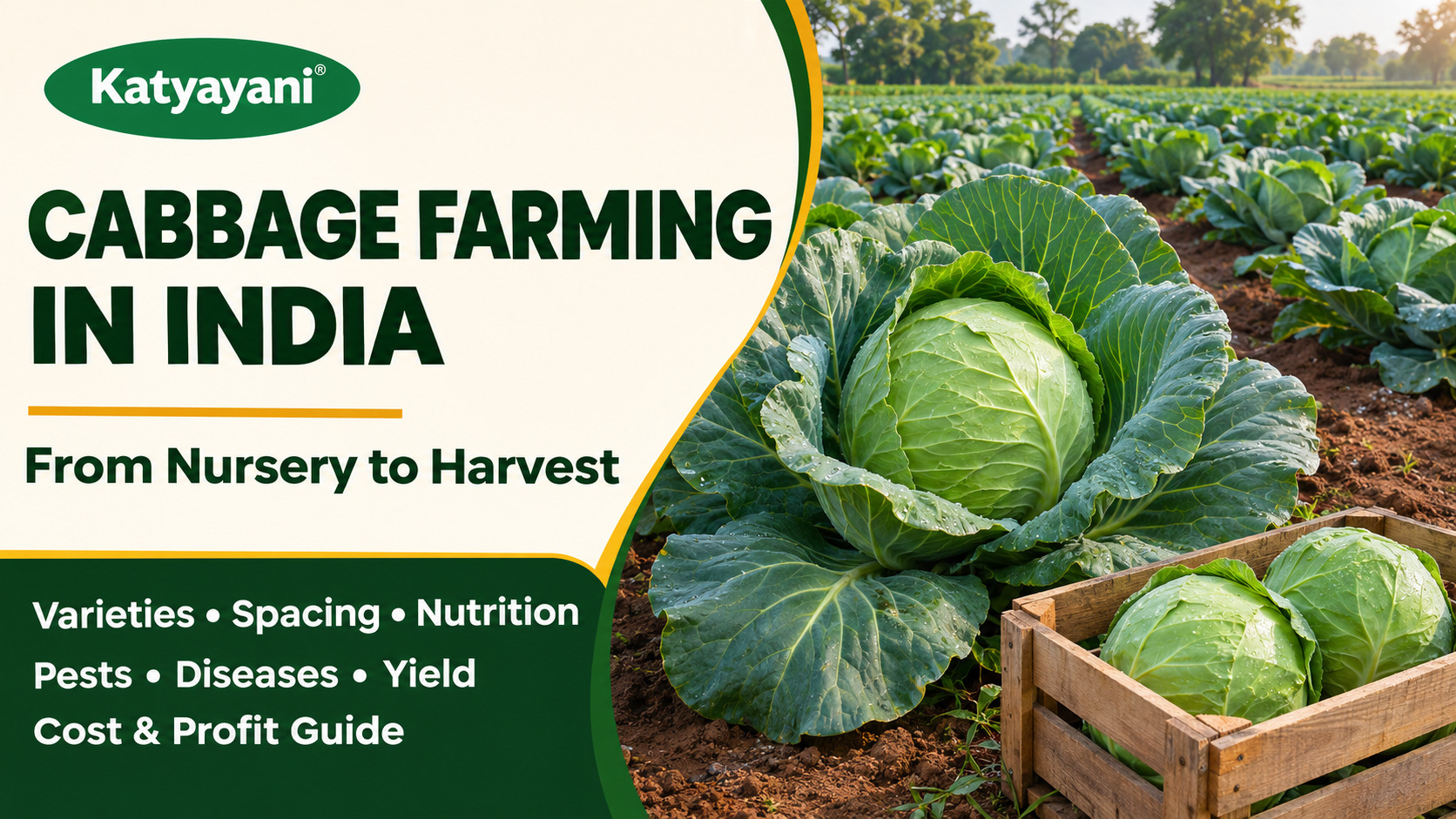
Cabbage (Brassica oleracea var. capitata) is a cool-season vegetable grown for its tight head of leaves. The grower raises seedlings in a nursery, moves them to the field, feeds and waters them for two to four months and cuts the heads when they are firm. It is a cool and moist climate crop.
The National Horticulture Board (NHB) describes the plant as a small, leafy biennial with a short, thick stem. The leaves wrap over each other into a round mass called the head, and the outer leaves are larger than the inner ones. Plants flower after winter, which is why a cabbage grown for the market is cut long before it flowers (NHB, Cabbage varieties).
Think of one plant as a factory that builds a head in three steps. First it grows leaves for about a month. Then it starts to fold the new leaves inward, which growers call head initiation. Last, the head fills and gets firm. Water stress at the second and third step is what ruins the crop. NHB says to avoid water stress from the time of head formation to the head maturity period (NHB, Cabbage manuring and fertilization).
Cabbage belongs to the same family as cauliflower, mustard and radish. That matters later, because the pests and the diseases are shared, and a field that grew one of them last year is not a clean field for cabbage. If you are also planning cauliflower, read the cauliflower cultivation package of practices next. The steps are close, but the sowing windows and the heading habit differ.
Which state is the largest producer of cabbage in India?
West Bengal is the largest cabbage producer in the latest official state table that could be opened, which is for 2017-18. It grew 2,288.5 thousand tonnes, about a quarter of the national 9,037.3 thousand tonnes. Odisha was second with 1,058.8 thousand tonnes. The source is DA&FW Horticultural Statistics at a Glance 2018.
The table below is copied from the DA&FW state-wise table for 2017-18. Area is in thousand hectares and production in thousand tonnes. Productivity is the production divided by area as the table prints it, in tonnes per hectare. The share column is our arithmetic.
| Rank by production | State | Area, 2017-18 (thousand ha) | Production, 2017-18 (thousand tonnes) | Productivity (t/ha) | Share of India (percent, our arithmetic) |
|---|---|---|---|---|---|
| 1 | West Bengal | 79.46 | 2,288.50 | 28.80 | 25.3 |
| 2 | Odisha | 37.74 | 1,058.78 | 28.05 | 11.7 |
| 3 | Madhya Pradesh | 29.89 | 686.91 | 22.98 | 7.6 |
| 4 | Bihar | 37.94 | 673.44 | 17.75 | 7.5 |
| 5 | Assam | 33.24 | 640.13 | 19.26 | 7.1 |
| 6 | Gujarat | 27.85 | 629.48 | 22.60 | 7.0 |
| 7 | Chhattisgarh | 21.84 | 414.19 | 18.96 | 4.6 |
| 8 | Haryana | 21.21 | 342.45 | 16.15 | 3.8 |
| 9 | Jharkhand | 19.06 | 326.22 | 17.11 | 3.6 |
| 10 | Uttar Pradesh | 9.06 | 302.97 | 33.46 | 3.4 |
| India total | 398.51 | 9,037.34 | 22.68 | 100 |
Three things stand out. West Bengal and Odisha together made about 37 percent of the country (3,347.3 of 9,037.3 thousand tonnes, our arithmetic). Bihar and Assam have a large area but a lower yield per hectare than West Bengal. Among the smaller producers, the same table shows Tamil Nadu at 66.07 tonnes per hectare on 3.03 thousand hectares, Himachal Pradesh at 34.32 and Uttar Pradesh at 33.46. Those high yields come from small areas, so do not read them as what a normal field gives.
One caution on the ranking. An NHB crop page lists Uttar Pradesh first among the major cabbage states, but that page carries no date, and the DA&FW table shows Uttar Pradesh tenth in 2017-18. This guide follows the dated table. The latest official data available to this guide for state-wise cabbage is 2017-18. Newer yearly estimates exist in government releases, but a readable official copy could not be opened on 17 Nov 2026, so none is printed (DA&FW, Horticultural Statistics at a Glance 2018).
How have India's cabbage area, production and yield changed over the years?
India grew cabbage on about 372 thousand hectares in 2011-12 and 399 thousand in 2017-18 in the DA&FW series. Production rose from 7,949 to 9,037 thousand tonnes in the same years. Average yield stayed in a narrow band of 22 to 23 tonnes per hectare, so most of the growth came from more area.
| Year | Area (thousand ha) | Production (thousand tonnes) | Productivity (t/ha) | Productivity per acre (t, our arithmetic) |
|---|---|---|---|---|
| 2011-12 | 372.4 | 7,949.0 | 22.9 | 9.3 |
| 2013-14 | 385.6 | 8,534.2 | 22.2 | 9.0 |
| 2015-16 | 393.84 | 8,805.95 | 22.36 | 9.0 |
| 2016-17 | 394.80 | 8,807.46 | 22.31 | 9.0 |
| 2017-18 | 398.51 | 9,037.34 | 22.68 | 9.2 |
Source for all rows: DA&FW, Horticultural Statistics at a Glance 2018 (the 2011-12 and 2013-14 rows come from the all-India table for brinjal, cabbage and cauliflower; the later rows from the state-wise cabbage table). Divide any tonnes-per-hectare figure by 2.471 to get tonnes per acre. A grower who gets 9 tonnes per acre is at the national average. A grower at 12 tonnes per acre is near the top of the early-variety range given by NHB.
Which soil, climate and season suit cabbage?
Cabbage grows best at 15 to 21 C in a cool, moist climate and in soil with a pH of 6.0 to 6.5 (NHB). TNAU gives a wider pH range of 5.5 to 6.5. The crop is grown as a winter crop in the plains, and in the hills it is sown in several windows from January to October.
NHB says cabbage grows on sandy to heavy soils that are rich in organic matter. Early crops do better on light soil, and late crops do better on heavier soil because it holds moisture. On heavy soil the plants grow more slowly but the heads keep better. NHB also warns that plants in saline soils are prone to disease (NHB, Cabbage soil and climate). Before you plant, get the soil tested. If you do not know how to read the result, the guide on how to read a soil health card explains it in simple steps.
| Point | What the source says | Source |
|---|---|---|
| Best temperature for growth and heading | 15 to 21 C | NHB |
| Soil pH | 6.0 to 6.5 (NHB); 5.5 to 6.5 (TNAU) | NHB; TNAU Agritech, Jan 2016 |
| Soil type | Sandy to clay; early crop on light soil, late crop on heavier soil | NHB; TNAU |
| Plains, sowing window | August to November (TNAU); July to November for early crops (NHB); first week of September to last week of November (Assam) | TNAU; NHB; AAU 2021 |
| Hills, sowing window | January to February, July to August, September to October (TNAU, Nilgiris); April to August for early crops (NHB) | TNAU; NHB |
| Saline soil | Plants are prone to disease; plant in furrows (NHB) | NHB |
A simple way to use the table: count back from the cool months. If your nights fall to the teens in late November, sow the nursery in late August to September, so that planting falls in October and the heads fill in the cool weather. NHB notes that diamondback moth is worst in comparatively high temperatures, so a late sowing also meets more pest pressure.
How many months does cabbage take to grow?
Cabbage takes about 3.5 to 5 months from sowing the seed to cutting the head. The seedling stage lasts 4 to 6 weeks (NHB), and heads are ready 60 to 120 days after transplanting depending on the variety. TNAU gives 120 days for the plains and 150 days for the hills.
| Stage | Time | Source |
|---|---|---|
| Nursery (seed to seedling) | 4 to 6 weeks; TNAU protray seedlings 25 days; 40 to 45 days in an open bed | NHB; TNAU |
| Field, early types (Golden Acre, Pride of India) | 60 to 65 and 70 to 80 days after transplanting | NHB variety table |
| Field, mid-season types | 80 to 90 days; one Nilgiris type 105 to 110 days | NHB variety table |
| Field, late types | 75 to 80 days (Copenhagen Market) and 100 to 105 days (Late Large Drum Head) | NHB variety table |
| Harvest window quoted for the crop | 90 to 120 days after planting | NHB, Harvesting |
| Plains crop, TNAU | Yield of 25 to 35 t/ha in 120 days | TNAU, Jan 2016 |
| Hill crop, TNAU | Yield of 70 to 80 t/ha in 150 days | TNAU, Jan 2016 |
Add the two parts to answer the question for your own variety. A 60 to 65 day variety with a 4-week nursery is about 3 months from seed. A 100 to 105 day variety with a 6-week nursery is about 5 months (our arithmetic, adding NHB nursery and field days). That is why early and late types are sown on different dates and why a farmer with one acre often splits it into two plots a fortnight apart, so that all the heads do not come at once.
Which cabbage variety should I choose?
Choose by maturity group and by the disease you fear. NHB lists 11 varieties, from Golden Acre (60 to 65 days) to Pusa Drumhead (large late heads of 3 to 5 kg). Pusa Mukta and K-1 are tolerant to black rot. Assam university lists Pusa Mukta as resistant to black rot. Match the variety to your sowing window.
| Variety (NHB name) | Maturity group and days after transplanting | Head weight | Average yield (t/ha) and note |
|---|---|---|---|
| Golden Acre | Early; 60 to 65 days | 1 to 1.5 kg | 20 to 24; heads crack if harvest is late |
| Pride of India | Early; 70 to 80 days | 1 to 1.5 kg | 20 to 28 |
| Copenhagen Market | Late; 75 to 80 days | 2.5 to 3 kg | Popular in West Bengal; yield not stated |
| Pusa Mukta | Not stated; flattish round heads | 1.5 to 2 kg | 25 to 30; tolerant to black rot |
| Pusa Synthetic | Not stated; medium heads | Not stated | 35 to 46; high yielding |
| Midseason Market | Mid season; 80 to 90 days | 2 to 4 kg | Yield not stated |
| September Early | Mid season; 105 to 110 days; popular in the Nilgiris | 4 to 6 kg | 40 to 50; susceptible to black rot; can stay in the field without cracking |
| Pusa Drumhead | Late season; needs a long winter | 3 to 5 kg | 50 to 54; tolerant to black leg |
| Early Drum Head | Early | 2 to 3 kg | 20 to 30 |
| Late Large Drum Head | Late; 100 to 105 days | Not stated | 20 to 30 |
| K-1 | Not stated; inner leaves white | Not stated | 20 to 30; tolerant to black rot |
Source: NHB, Cabbage: Varieties (undated). The Assam package of 2021 gives a second set of numbers for the same names: Golden Acre 60 to 70 days and 280 q/ha, Pride of India 60 to 70 days and 220 q/ha, Pusa Mukta 65 days and 250 q/ha with black rot resistance, and Drum Head 80 to 100 days and 450 q/ha (Assam Agricultural University package, 2021). The two sources differ because of local conditions, which is a reminder that a variety table is a starting point, not a promise. TNAU names Quisto for the hills and Golden Acre and Maha Rani for the plains, and says for F1 hybrids to use a paired-row system (page updated Jan 2016).
How do I raise cabbage seedlings in the nursery?
Sow the seed thinly on a raised bed, treat the seed first, keep the bed covered and moist until the seedlings come up, and move the seedlings after 4 to 6 weeks. NHB says seedlings older than that give poor growth and yield. TNAU gives 40 to 45 days for an open bed and 25 days in protrays.
Here is the NHB method in steps, with the numbers it gives (NHB, Cabbage propagation). The rabi onion nursery guide uses the same bed logic, so read it if you have never made a raised bed.
- Make raised beds 3 m long and 0.6 m wide, 10 to 15 cm high. Keep about 70 cm between beds for weeding and watering. Raised beds stop waterlogging in heavy soil (NHB, Propagation).
- Mix well-rotted FYM at 2 to 3 kg per square metre into the bed (NHB).
- Treat the seed. NHB names Trichoderma viride or thiram as seed treatments against damping-off. TNAU says to treat hybrid seed in hot water at 50 C for 30 minutes (page updated Jan 2016).
- Sow thinly in lines 5 to 7 cm apart, 1 to 2 cm deep. Cover with a thin layer of fine soil and water lightly with a can (NHB).
- Cover the bed with dry straw or grass to hold moisture. Remove the cover as soon as the sprouts show (NHB).
- Thin out crowded seedlings. NHB says over-crowding invites damping-off and wirestem.
- Harden the seedlings before moving them. TNAU says to hold back irrigation for 4 to 6 days before planting.
- Transplant within 4 to 6 weeks of sowing (NHB).
Seed quantity differs by source. NHB says 300 to 500 g of seed raises seedlings for one hectare, which is about 120 to 200 g per acre. TNAU gives 650 g per hectare for open-pollinated seed (about 263 g per acre) and 250 g per hectare for hybrid seed in protrays (about 101 g per acre). The Assam package gives 400 g per hectare for early varieties and 300 g for late varieties, about 162 g and 121 g per acre. All per-acre figures are our arithmetic. TNAU also says a nursery of about 100 square metres supplies one hectare.
How do I prepare the field and transplant cabbage?
Plough four to five times to a fine tilth, level the field with a plank and plant on ridges, furrows or a flat bed depending on rain and soil (NHB, Cabbage planting). Transplant in the morning or late evening and water at once. Spacing depends on maturity: 45 x 45 cm for early types and 60 x 60 cm or more for late types.
NHB says ridges suit early planting where rain falls at planting time, furrows suit saline soil and flat beds suit dry areas. Before planting, NHB dips seedling roots in a carbendazim solution, which it gives as Bavistin at 2 g per litre. Always take a dose from the label of the carbendazim product you hold, and wear gloves. TNAU adds a warning to avoid land infected with club root.
| Maturity group (NHB) | Spacing (cm) | Plants per hectare (our arithmetic) | Plants per acre (our arithmetic) |
|---|---|---|---|
| Early | 45 x 45 | 49,383 | 19,984 |
| Early (alternative) | 60 x 30 | 55,556 | 22,483 |
| Mid season | 60 x 45 | 37,037 | 14,988 |
| Late | 60 x 60 | 27,778 | 11,241 |
| Late (wide) | 75 x 60 | 22,222 | 8,993 |
| TNAU, plains | 45 x 30 | 74,074 | 29,977 |
| TNAU, hills | 40 x 40 | 62,500 | 25,293 |
| TNAU, F1 hybrid, paired rows | 60 x 45 x 45 | 28,333 (TNAU figure) | 11,466 |
How the plant count was worked out: 10,000 square metres per hectare divided by the area per plant (for 45 x 45 cm, 0.2025 square metres), and 4,046.9 square metres per acre for the acre column. These are the plants that fit the plot at that spacing before you subtract gaps and bunds, so keep about 5 to 10 percent extra seedlings for gap filling (this reserve is our suggestion, not a source figure). Wider spacing means a bigger head. Closer spacing means more heads that are smaller. NHB says planting distance varies by variety, season and soil.
How much manure and fertiliser does cabbage need per acre?
NHB recommends 15 to 20 tonnes of well-rotted FYM per hectare, with 80 to 120 kg N, 60 to 100 kg P2O5 and 60 to 120 kg K2O. Per acre that is about 6 to 8 tonnes FYM, 32 to 49 kg N, 24 to 40 kg P2O5 and 24 to 49 kg K2O (our arithmetic). Half the nitrogen and all the P and K go in at transplanting.
| Source | FYM per acre (t) | N per acre (kg) | P2O5 per acre (kg) | K2O per acre (kg) | Other |
|---|---|---|---|---|---|
| NHB, Manuring and Fertilization | 6.1 to 8.1 (15 to 20 t/ha) | 32.4 to 48.6 (80 to 120 kg/ha) | 24.3 to 40.5 (60 to 100 kg/ha) | 24.3 to 48.6 (60 to 120 kg/ha) | Half N plus all P and K at transplanting; rest of N at 6 weeks or at earthing up |
| AAU, Assam package 2021 | 4.0 (10 t/ha) | 48.6 (120 kg/ha) | 24.3 (60 kg/ha) | 24.3 (60 kg/ha) | Borax 8 kg/ha, about 3.2 kg per acre |
| TNAU, plains (Jan 2016) | 8.1 (20 t/ha) | 20.2 basal plus 20.2 after one month (50 + 50 kg/ha) | 50.6 (125 kg/ha, as the page prints it) | 10.1 (25 kg/ha) | 2 kg/ha Azospirillum basal; earth up with the second N |
| TNAU, hills (Jan 2016) | 12.1 (30 t/ha) | 36.4 basal plus 18.2 later (90 + 45 kg/ha) | 36.4 basal plus 18.2 later | 36.4 basal plus 18.2 later | Second split 30 to 45 days after planting |
| TNAU, F1 hybrid by fertigation | Not stated | 80.9 (200 kg/ha) | 50.6 (125 kg/ha) | 60.7 (150 kg/ha) | Applied once in three days through the crop period |
Per-acre columns are our arithmetic (kg per hectare divided by 2.471). The three packages differ a lot in phosphorus and potassium, because soils and yield targets differ. The honest way to settle your own dose is a soil test, then a dose from your state university or your block office. A dose that suits West Bengal alluvial soil is not automatically right for a red soil in Karnataka. Two common problems are too much nitrogen late in the crop, which makes loose heads that crack, and a soil pH that locks up the nutrient you just paid for. The guide on soil pH and nutrient lock explains the second one.
For the shop-side view, the fertiliser for cabbage vegetative growth collection lists products by use. Follow the label dose of the product you buy. Drip growers can find the TNAU F1 hybrid fertigation schedule (200:125:150 kg N, P2O5, K2O per hectare, page updated Jan 2016) on the TNAU page.
How often should I water cabbage, and does drip help?
Water just after transplanting, then every 10 to 15 days depending on season and soil (NHB). Do not let the soil dry out from head formation to maturity. Stop heavy watering near harvest, because extra water at that stage splits the heads. TNAU says to give a continuous supply of moisture.
A common mistake is a long gap followed by a flood. A dry spell slows the head, then one heavy watering swells the inside faster than the outer leaves can stretch, and the head cracks. The Assam package says the same thing in plain words: keep the soil moisture even, otherwise splitting may occur.
Mulch helps hold moisture and cuts weed growth. The guide on the benefits of mulching covers the types and depth. Keep mulch off the stem base.
How do I control weeds and when should I earth up?
Keep the field clean for the first two months. NHB says 2 to 3 hand weedings and 1 to 2 hoeings are normal, with earthing up about 30 days after transplanting. The Assam package says two weedings, at 20 and 40 days. TNAU warns against deep hoeing because cabbage roots feed near the surface.
Earthing up means pulling soil around the base of each plant. NHB says it supports the plant so that it does not topple while the head forms. It also happens to be the time to give the second dose of nitrogen, which the TNAU plains schedule and the NHB schedule both place at about one month to six weeks after planting. So one field trip does weeding, earthing up and top dressing together. That saves labour.
Weeding plan from the sources: first weeding at about 20 days with a shallow hoe, earthing up with the top dressing at about 30 days, second weeding at about 40 days. NHB lists only old herbicide names that are not a current label list, so none is printed here.
Which pests attack cabbage and how are they managed?
Diamondback moth, aphids, cutworm, leaf webber, cabbage borer and the cabbage butterfly are the pests named by NHB (NHB, Cabbage pests) and TNAU (TNAU Agritech, Cabbage). Diamondback moth is the worst in warm weather. Start with traps, clean seedlings and early scouting, and spray only when the count says so. TNAU gives an action level of 2 larvae per plant for diamondback moth.
How each pest shows up (NHB pest page). Diamondback moth caterpillars nibble the leaf surface, then punch holes, and a bad attack leaves a net. The leaf webber knots leaves together. The cabbage borer mines the leaf and bores the stem. Cabbage butterfly caterpillars feed in groups and burrow into the head. Aphids sit under the leaf and suck sap. Cutworm is a soil caterpillar that cuts seedlings at the base.
Non-chemical steps in the sources. NHB and TNAU both describe mustard as a trap crop for diamondback moth: NHB says to sow mustard 15 days before and again 25 days after planting cabbage, and TNAU says to grow it as an intercrop in a 20 to 1 ratio. The moth prefers mustard, so the pest collects there, and you treat the mustard rows. TNAU also gives pheromone traps at 12 per hectare, yellow sticky traps at 12 per hectare for aphids, and release of the parasite Diadegma semiclausum at 50,000 per hectare, 60 days after planting. Hand-pick the egg masses and caterpillars of the cabbage butterfly (NHB). The guide on biopesticides explains what Bt and neem products do and where they fall short.
Spray doses from TNAU are shown below. The page is dated January 2016 and product registrations change, so match the product to a current label and to the crop and pest it names before you buy. The per-tank column is our arithmetic for a 15 litre knapsack and uses the figure for one litre as TNAU gives it.
| Pest (TNAU) | Product and strength as TNAU prints it | Dose per litre as printed | Per 15 litre tank (our arithmetic) |
|---|---|---|---|
| Diamondback moth | Bacillus thuringiensis var. kurstaki 5 percent WP | 1.0 g per litre | 15 g |
| Diamondback moth | Azadirachtin 0.03 percent WSP (300 ppm) | 5.0 g per litre | 75 g |
| Diamondback moth | Chlorantraniliprole 18.5 percent SC | 1.0 ml per 10 litres | 1.5 ml |
| Diamondback moth | Emamectin benzoate 5 percent SG | 4 g per 10 litres | 6 g |
| Diamondback moth | Spinosad 2.5 percent SC | 1.2 ml per litre | 18 ml |
| Diamondback moth | Indoxacarb 14.5 percent SC | 3.5 ml per 10 litres | 5.25 ml |
| Diamondback moth | Cartap hydrochloride (primordial stage) | 1 g per litre | 15 g |
| Aphids | Azadirachtin 0.03 percent WSP (300 ppm) | 5.0 g per litre | 75 g |
TNAU says to use Bt or cartap at the primordial stage (2 larvae per plant) and neem seed kernel extract at 5 percent after that. Rotate chemical groups from one spray to the next, because the same molecule again and again makes diamondback moth resistant. Keep to the waiting period before harvest (pre-harvest interval guide). To convert a label dose to your sprayer, see dose per litre for a 15 litre tank.
For the shop-side view of the diamondback moth range, the insecticide for cabbage diamond back moth collection lists the products by use. For aphids, see the insecticide for cabbage aphids collection. These pages are for finding products named for the pest. The dose on the product page and label is the one to follow.
Which diseases hit cabbage and how are they managed?
Black rot, club root, downy mildew, damping-off, wirestem, black leg and leaf spots are the diseases named by NHB and TNAU (NHB, Cabbage diseases). Black rot and club root are the two that can wreck a whole field. Both are best handled before planting, through clean seed, raised beds and crop rotation.
| Disease | How it shows up (NHB) | What helps (NHB and TNAU) |
|---|---|---|
| Black rot (Xanthomonas campestris pv. campestris) | V-shaped yellow to brown wedges at leaf edges; black veins; small poor heads. Common in warm, wet weather | Tolerant varieties; seed dip in streptocycline 100 ppm for 30 minutes (TNAU); two sprays of copper oxychloride 2 g per litre plus streptomycin 100 ppm after planting and at head formation (TNAU); raised beds; no crucifers for the last 2 years (NHB) |
| Club root (Plasmodiophora brassicae) | Swollen, club-like roots; plants wilt in heat and recover at night; stunted yellow leaves. Cool, wet, acid soil favours it | Clean beds and tools; long rotation of 6 years or more (NHB); lime to lift soil pH above 7.0, mixed in six weeks before planting (NHB); TNAU: Pseudomonas fluorescens seed treatment 10 g per kg, seedling dip 5 g per litre, soil application 2.5 kg per hectare with 50 kg FYM; or carbendazim seedling dip 2 g per litre for 20 minutes and soil drench 1 g per litre; keep crucifers out for three years (TNAU) |
| Downy mildew (Peronospora parasitica) | Light green-yellow patches above, grey-white mould below; serious in the nursery; fog, drizzle and heavy dew favour it | Destroy weed hosts; avoid high humidity from over-watering; ask your state university for a current label fungicide |
| Damping-off and wirestem | Seedlings collapse at the soil line; wirestem has a thin, sunken, brown stem base | Well-drained raised beds; no crowding; no excess water; seed treatment with Trichoderma viride or thiram (NHB); TNAU nursery bed drench with copper oxychloride 2.5 g per litre |
| Black leg (Phoma) | Pale spots on leaves turning ash grey with black dots; stem lesions at ground level; plants fall over | Disease-free seed; hot-water seed treatment 50 C for 30 minutes; no crucifers for 2 years (NHB); Pusa Drumhead is listed as tolerant (NHB variety table) |
| Leaf spots and blight (Alternaria) | Dark yellow spots that grow into rings with a yellow halo | Crop rotation, clean seed; TNAU: mancozeb 2 g per litre or carbendazim 1 g per litre |
| Sclerotinia rot (white mould) | Water-soaked patches with white cotton growth, then black sclerotia; damp weather | Avoid planting where white mould has occurred; plant rows along the wind; avoid cuts on heads at harvest; rotate with cereals (NHB) |
One point about club root deserves its own line. NHB says lime will not stop an outbreak if the spore load in the soil is already high, and TNAU says to avoid land infected with club root. If your field has the disease, the choices are a long break from all cabbage-family crops, a clean new plot or growing something else this year. A spray alone does not fix it. The guide on crop rotation shows how to plan the gap.
Winter fog and dew raise downy mildew and several leaf diseases. The guides on fog, dew and crop disease in winter and when to spray in winter explain the weather and the timing. For black rot, the shop-side list is the fungicide for cabbage black rot collection. As with insects, follow the label dose of the product you actually buy, and do not use the TNAU figures as a prescription for a different product.
How much cabbage can I get from one acre?
Early varieties give 25 to 30 tonnes per hectare and late types 40 to 60 tonnes (NHB), which is about 10 to 12 and 16 to 24 tonnes per acre. The all-India average in 2017-18 was 22.68 tonnes per hectare, about 9.2 tonnes per acre (DA&FW). Your field result depends on the variety, the season and the care.
| Source | Crop type | Yield (t/ha) | Yield per acre (t, our arithmetic) |
|---|---|---|---|
| NHB, Harvesting | Early varieties | 25 to 30 | 10.1 to 12.1 |
| NHB, Harvesting | Late types | 40 to 60 | 16.2 to 24.3 |
| TNAU, Jan 2016 | Plains, 120 days | 25 to 35 | 10.1 to 14.2 |
| TNAU, Jan 2016 | Hills, 150 days | 70 to 80 | 28.3 to 32.4 |
| AAU, Assam package 2021 | Recommended practice, 200 to 250 q/ha | 20 to 25 | 8.1 to 10.1 |
| DA&FW, 2017-18 | All-India average | 22.68 | 9.2 |
| DA&FW, 2017-18 | West Bengal average | 28.80 | 11.7 |
| DA&FW, 2017-18 | Bihar average | 17.75 | 7.2 |
The spread is wide on purpose. A head of 1 kg from a close-spaced early crop and a head of 4 kg from a wide late crop can both be good crops. Do a quick check on your own plot: plants per acre (see the spacing table) multiplied by the average head weight in kg gives kg per acre. For example, the formula for 60 x 45 cm spacing is 14,988 plants multiplied by your average head weight, less the heads you lose to disease and splitting. Take 10 sample heads at harvest and weigh them to get the average.
How do I work out the cost and profit of cabbage farming?
No official cost-per-acre figure for cabbage could be opened, so this guide gives a method rather than a rupee profit. Profit equals the money from sold heads minus total cost. The Assam package of 2021 states a benefit-cost ratio of 3.0 for its recommended practice, which means Rs 3 returned for each Rs 1 spent in that study.
The formula is simple. Revenue = marketable yield in kg per acre x the rate you actually get per kg. Cost = all the lines in the worksheet below. Profit = Revenue minus Cost. Break-even yield = Cost divided by your selling rate per kg. If your break-even yield is above what your field gives in a normal year, the crop does not pay at that rate. We print no selling rate, because mandi rates change daily and by market. Read the day rate on Agmarknet or e-NAM for your nearest mandi and write the date next to it.
| Cost line | What goes in | Quantity guide per acre from this guide | Your cost (Rs) |
|---|---|---|---|
| Seed or seedlings | Seed packet or bought seedlings, plus nursery cost | Seed about 100 to 260 g depending on type; plants 8,990 to 29,980 by spacing | Fill in |
| Land preparation | Ploughing 4 to 5 times, levelling, ridges | NHB: four to five ploughings and planking | Fill in |
| Fertiliser | N, P, K and any borax, by bill | N 32 to 81 kg, P2O5 24 to 51 kg, K2O 10 to 61 kg | Fill in |
| Plant protection | Traps, biopesticides, sprays, hired sprayer | Pheromone traps 12 per ha (about 5 per acre); more as scouting says | Fill in |
| Labour | Transplanting, 2 to 3 weedings, earthing up, spraying, harvesting | NHB: 2 to 3 hand weedings, 1 to 2 hoeings | Fill in |
| Harvest, grading, packing, transport | Knives, baskets or crates, freight, market fee | NHB: pack in bamboo or wooden baskets | Fill in |
| Total cost per acre | Add all lines above | Fill in | |
| Marketable yield per acre (kg) | Weighed, after removing cracked and damaged heads | Use your own record | Fill in |
| Revenue per acre | Yield x rate you actually got, with the date and market | Fill in | |
| Profit per acre | Revenue minus total cost | Fill in |
Two habits make the worksheet honest. First, count your own family labour at a fair daily rate, or the profit looks bigger than it is. Second, count only marketable heads. Cracked, loose or worm-eaten heads sell for little or nothing. A mixed grower can also compare cabbage with another winter crop using the same sheet. The cost and process posts on tomato, brinjal and radish (mooli) use the same plain method, so the lines are easy to compare.
When and how should I harvest and store cabbage?
Cut the head when it is firm and mature, 90 to 120 days after planting (NHB, Cabbage harvesting). Do not wait. A delay of even a few days can split the heads and raise field disease. Cut with a knife, leave two to four wrapper leaves and keep the cut heads in shade. Do not snap or twist the head off.
| Step | What NHB says | Number |
|---|---|---|
| Grading | Remove damaged or diseased wrapper leaves; discard insect-damaged and defective heads | |
| Cold storage, early harvested crop | Store at 0 C | 98 percent relative humidity, 3 to 6 weeks |
| Cold storage, late harvested crop | Store at 0 C | 95 percent relative humidity, 3 to 6 weeks |
| Controlled atmosphere, late cabbage | Store at 0 C with low oxygen and raised carbon dioxide | 2.5 to 3 percent O2 and 5 percent CO2, 7 to 8 months |
Source: NHB, Cabbage: Post Harvest Technology (undated). Most growers do not have cold storage, so the practical rule is simple: cut in the cool of the morning, keep heads in shade, send them to market quickly and handle them gently. NHB says the heads usually go straight to nearby markets after grading (NHB, Cabbage post harvest technology). The cut and the trimming also tell you how many heads you sell, which links back to the worksheet.
What mistakes cut cabbage yield and how do I avoid them?
The costly mistakes are old seedlings, uneven watering, planting in a field that grew crucifers last year, late harvest and one-molecule spraying. Each has a number in the sources: seedlings older than 4 to 6 weeks, a gap of 2 to 6 years for rotation, and a few days of delay at harvest.
| Mistake | What goes wrong | Fix from the sources |
|---|---|---|
| Seedlings older than 6 weeks | Poor growth and yield (NHB) | Transplant within 4 to 6 weeks of sowing |
| Planting after mustard, cauliflower or cabbage | Black rot, black leg and club root carry over (NHB) | Keep crucifers out for 2 years against black rot and black leg, 3 years in the TNAU club root advice, and 6 years or more in NHB for club root |
| Dry spell then flood | Heads split (NHB, AAU) | Water every 10 to 15 days and keep moisture even |
| Deep hoeing | Cuts surface roots (TNAU) | Hoe shallow and earth up instead |
| Thick nursery sowing | Damping-off and wirestem (NHB) | Sow in lines 5 to 7 cm apart and thin |
| Late harvest | Split heads and more field disease (NHB) | Cut when firm; harvest in rounds |
| Same chemical every spray | Resistance builds in diamondback moth | Rotate groups; use traps and Bt early; read the label |
| Wet foliage at night in fog and dew | Downy mildew (NHB) | Water in the morning; do not over-irrigate |
| Planting in saline or acid wet soil | More disease (NHB) | Test the soil; use furrows in saline soil; lime for club root risk |
If only one thing is changed this season, make it the seedling and the soil. A clean nursery and a field without a recent cabbage-family crop solve more problems than any spray, and they cost nothing in chemicals.
What changes for hills, protected nurseries and other special cases?
Hills, saline soil and hybrid seed need small changes. In the hills TNAU gives three sowing windows, closer spacing of 40 x 40 cm, larger FYM and a yield of 70 to 80 tonnes per hectare in 150 days. In saline soil NHB advises planting in furrows. Hybrids suit protray nurseries and paired-row spacing.
In hills TNAU gives three sowing windows, 40 x 40 cm spacing, 30 t/ha FYM and a yield of 70 to 80 t/ha in 150 days. In saline soil NHB advises furrows, on dry land flat beds, and for early planting in rain, ridges. Hybrids suit protray nurseries (TNAU, Jan 2016). For insurance, ask the block office whether cabbage is notified for the season in your state.
What is new in 2025-26 for cabbage farming in India?
Nothing in the official sources opened here shows a dated change to cabbage package of practices in 2025-26. The newest dated cultivation text is the Assam package of practices of 2021. The latest official state-wise cabbage table opened is for 2017-18. This guide does not invent a change that no source states.
The NHB crop pages are undated, the TNAU page was updated in Jan 2016 and the DA&FW book is the 2018 edition. The steps in this guide are old and stable. What changes each year is the list of registered pesticides, state subsidy and the market, so ask your state agriculture university or district horticulture officer for the current advisory and read the label every time.
Conclusion
Cabbage farming in India is a cool-season, 3.5 to 5 month crop with a clear order of work: raise clean seedlings for 4 to 6 weeks, plant at 45 x 45 to 60 x 60 cm, feed with manure and N, P and K, water evenly, watch for diamondback moth and aphids, keep black rot and club root out through clean seed, raised beds and rotation, and cut heads when firm. The latest official state table opened (DA&FW, 2017-18) puts West Bengal first at 2,288.5 thousand tonnes and the all-India average at 22.68 tonnes per hectare, about 9.2 tonnes per acre. NHB gives 25 to 30 t/ha for early types and 40 to 60 for late types. No official cost-per-acre figure was found, so use the worksheet with your own bills and your own selling rate to work out profit.


Leave a Comment