Loading…
Explore organic and bio-input products from Katyayani Organics to support plant growth, improve soil health, and promote sustainable farming. Find the right solutions for your crops.
25 articles
 18 min
Organic farming in India means growing crops without synthetic fertiliser, synthetic pesticide, synthetic growth regulators or genetically engineered seed, and being able to prove it. To sell produce as organic you need certification under NPOP (third-party, mainly for export) or PGS-India (group peer review for the home market). The conversion period is at least 2 years for annual crops and 3 years for perennials under NPOP, and 24 and 36 months under PGS-India. ICAR network trials found the mean yield fell 6.7 percent in year 1 and 4.8 percent in year 2 against inorganic management, then matched it by year 3. Sikkim is the state the Prime Minister has called fully organic. PIB (4 Aug 2026) says PKVY gives Rs 31,500 per hectare over 3 years. No official source ranks crops by profit, so work out your own numbers before you convert.
 15 min
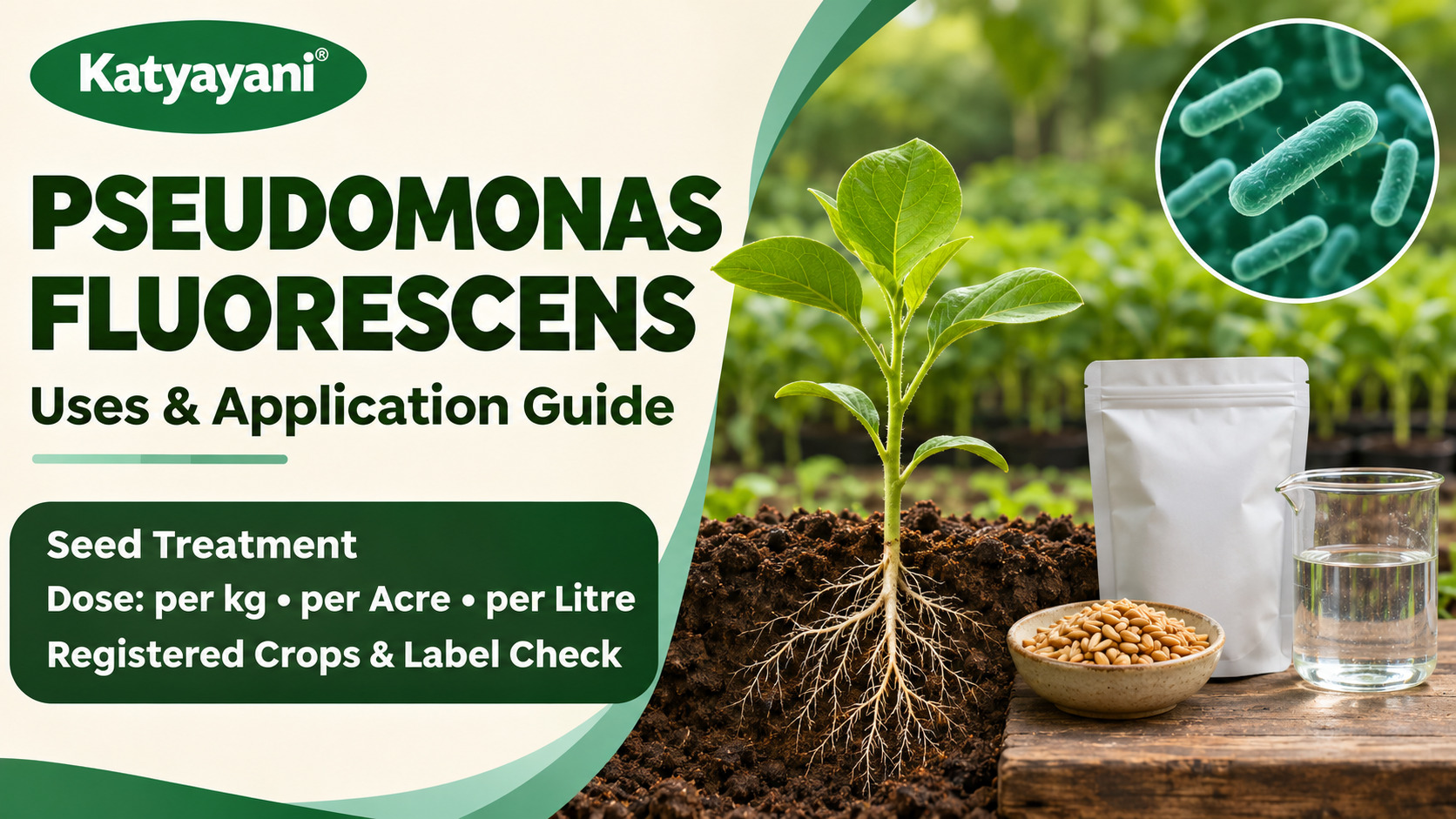
Pseudomonas fluorescens is a living bacterium sold as a bio-fungicide. The CIB&RC list (updated upto 30.09.2026) shows it for wheat, tomato, paddy, groundnut, chilli seedlings, cotton, brinjal, carrot and okra. Seed treatment is 4.5 ml or 5 to 20 g per kg of seed depending on the product. Soil dose is 1 to 5 kg per hectare, usually mixed with farmyard manure (about 0.4 to 2 kg per acre). Spray doses printed are 5 or 6 g per litre of water (wheat, tomato) and 1.87 to 6 L per hectare for liquids. It is a preventive tool. TNAU says biocontrol agents and fungicides are incompatible. Read the strength, strain and dose on your own pack.
 17 min
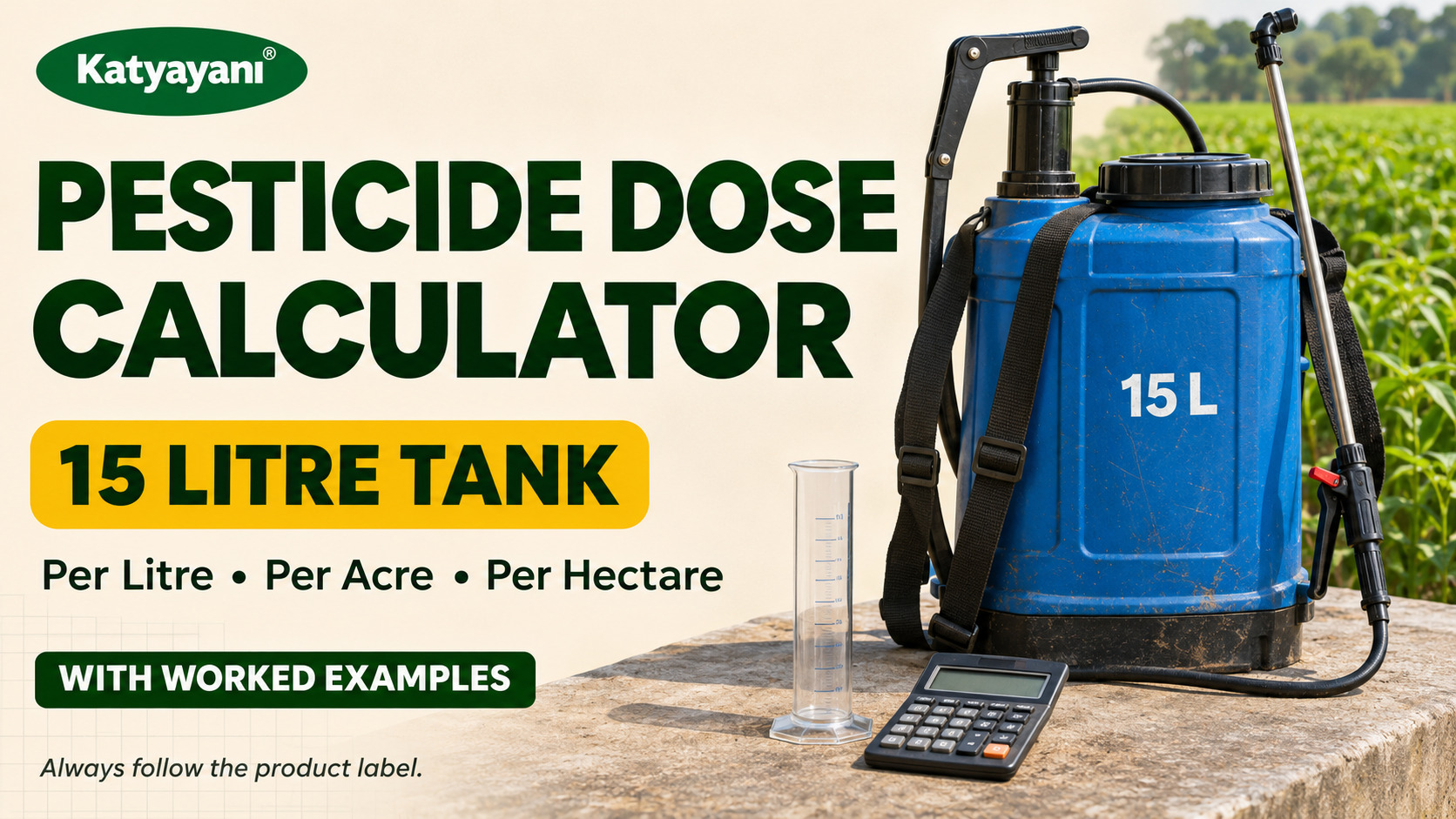
Dose per litre = dose per hectare (or per acre) divided by water per hectare (or per acre). Dose per tank = dose per litre times tank size. Example from a CIB&RC bio-insecticide row: 1,000 to 1,500 ml per hectare in 500 litres of water is 2 to 3 ml per litre, which is 30 to 45 ml in a 15 litre tank (our arithmetic). Water per acre is not fixed: NIPHM lists high volume as 300 to 500 litres per hectare and low volume as 50 to 150. Find your own by spraying plain water on a marked plot, then use the label dose for that area. The label on your pack always wins.
 15 min
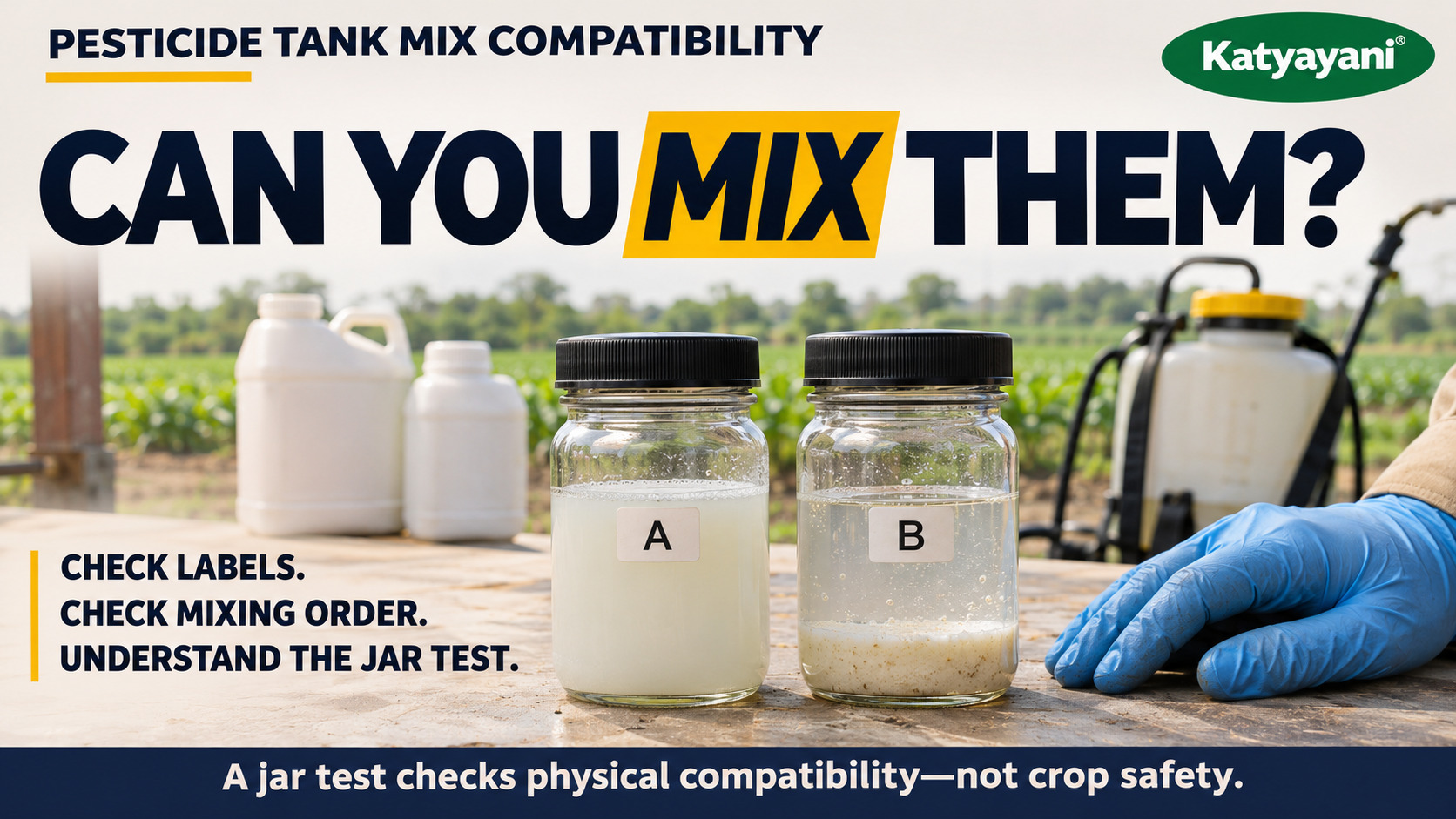
A pesticide tank mix is two or more products sprayed together from one tank. Read every label first, because the label can forbid a partner. Fill the tank half with clean water, add products one at a time (dry powders and granules first, then liquids and emulsifiable concentrates, spreaders last), and stir between each. Test any new combination in a jar before you fill the tank: same water, same proportions, stand 15 to 30 minutes, and reject it if you see layers, lumps, gel, heat or settled solids. A jar test shows physical problems only. It cannot show that one product has weakened the other.
 17 min
For most winter sprays, wait until the dew is gone, spray in a light breeze in the late morning to afternoon, and keep a rain-free gap of at least 24 hours for contact products and 1 to 2 hours for systemic ones (Purdue). Do not spray in high wind, high temperature or rain (TNAU). Stay away from calm, clear evenings, when inversions trap fine drift (Government of Ontario, NDSU). For insecticides on flowering crops such as mustard, ICAR-CRIDA bulletins say evening or afternoon and never when bees are foraging. Cold slows herbicide uptake below 60 F (Nebraska), and sulphur loses vapour action at 15 C and below (AWRI).
 15 min
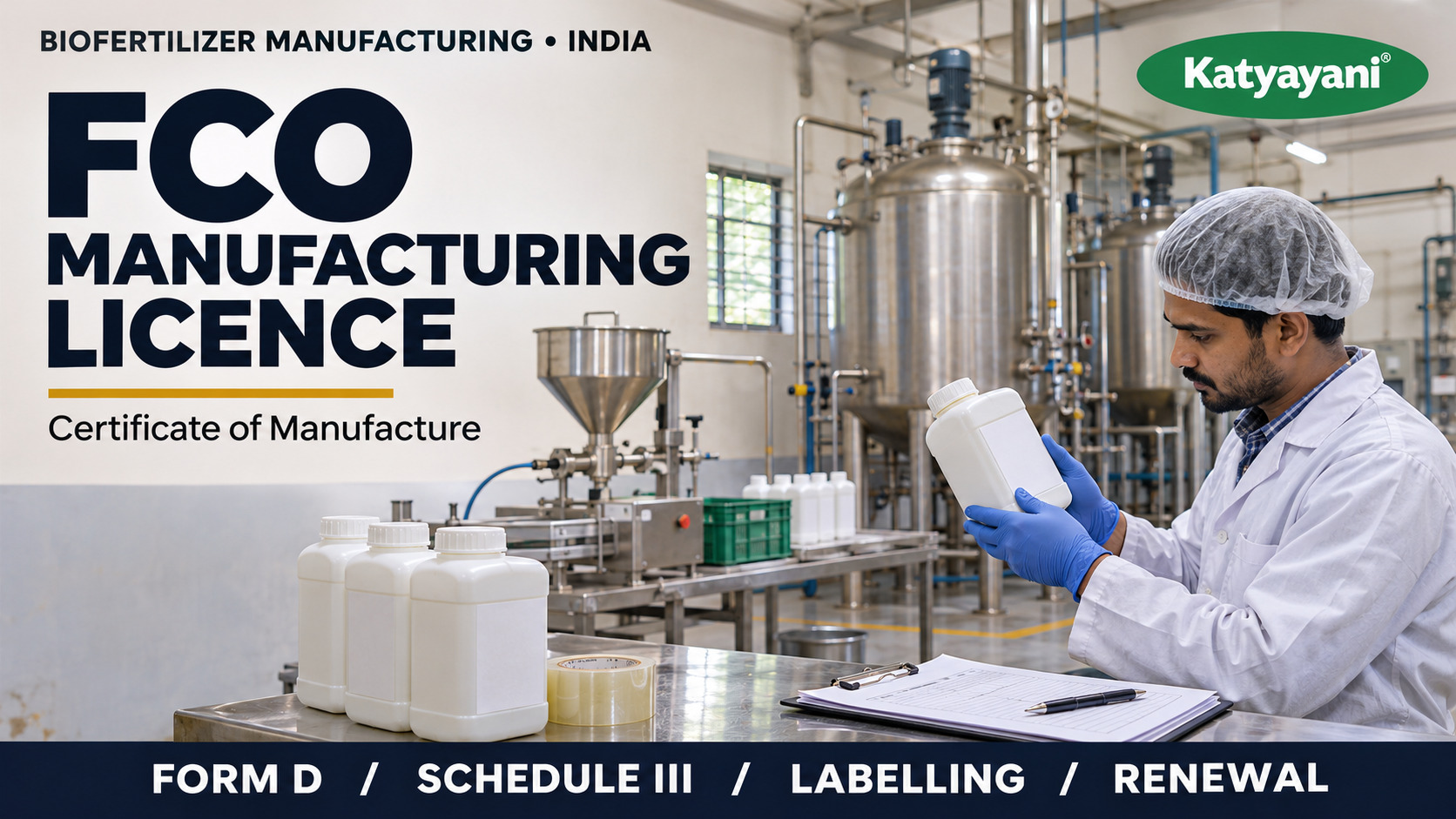
To make biofertilizer for sale in India you need a certificate of manufacture under the Fertiliser Control Order (FCO), 1985. You apply in Form D to the State registering authority with the fee that State fixes. The authority must send you its order within 45 days. A granted certificate comes in Form F and is valid for three years. Your product must meet Schedule III, for example at least 5 x 10^7 CFU per gram of carrier, and from 1 April 2026 carrier packs must weigh 200 g to 1 kg.
 15 min
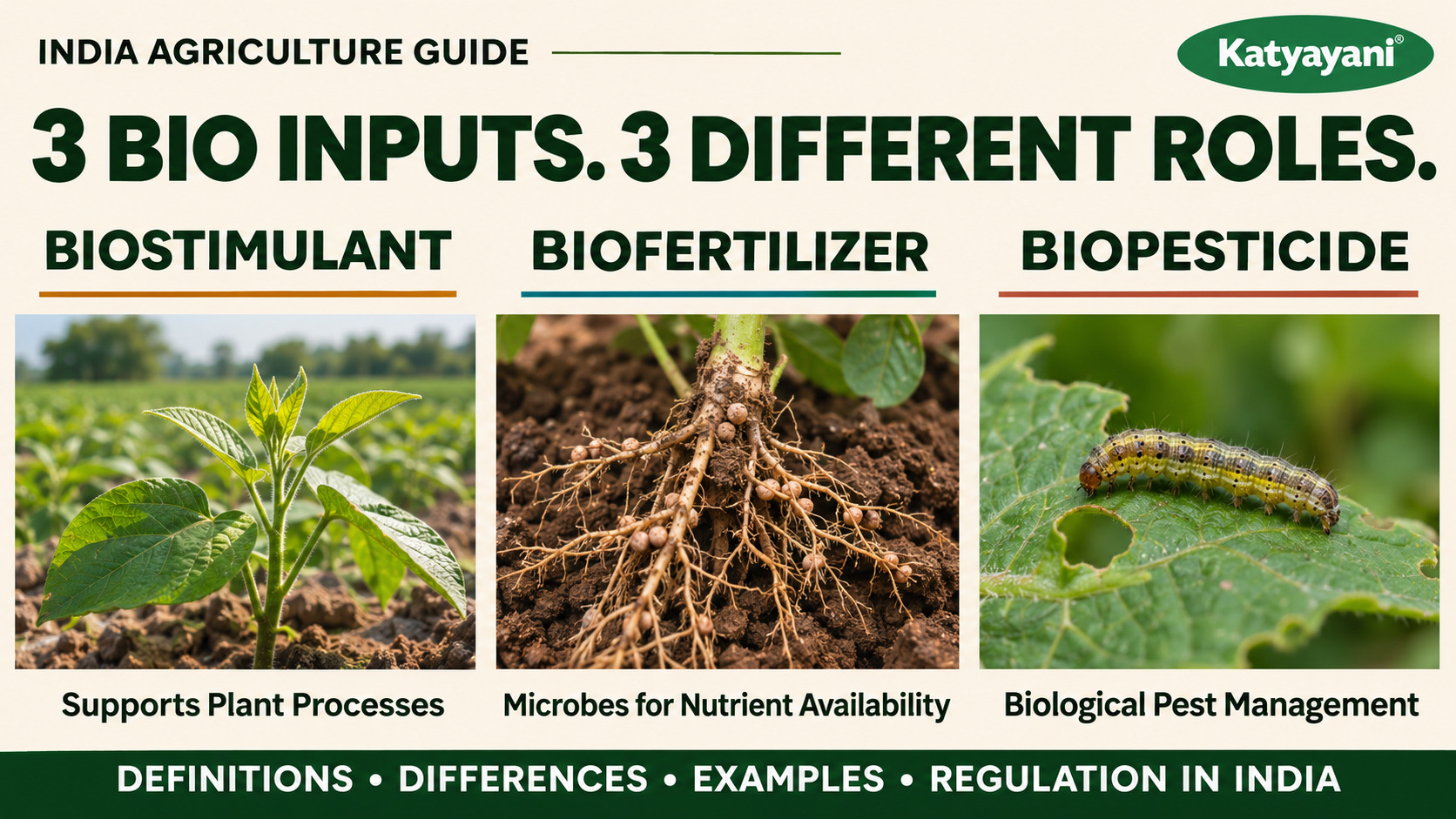
A biofertilizer is a product with living microbes that help the crop get nitrogen, phosphorus, potash or zinc. A biostimulant is a substance or microbe whose main job is to stimulate the plant's own processes, such as nutrient uptake, growth and stress tolerance, whatever its nutrient content. A biopesticide uses living organisms or natural substances to control pests and diseases. In India the first two are covered by the Fertiliser Control Order, 1985. Biopesticides are covered by the Insecticides Act, 1968, and need CIB&RC registration.
 15 min
The pre-harvest interval (PHI) is the minimum number of days that must pass between your last pesticide spray and the day you harvest. In India the same idea is printed as the "waiting period" in the CIB&RC lists. The number is set for each product on each crop, so the same chemical can be 3 days on one crop and 28 days on another. Count from the date of the last spray, use the longest PHI if you mixed products, and never shorten it because it rained. The re-entry interval is different: it controls when people may walk into the field, not when the crop may be picked.
 17 min
No single repellent protects a field. ICAR network projects get results by stacking layers: a border net or fence, a smell or border-crop barrier for boar, reflective ribbons or sound for birds, and a noise or solar fence for monkeys. ICAR-AINPVPM reports wild pig damage of 15 to 32 percent and a net border with a 1:4.3 cost-benefit ratio. Many of these animals are protected by law, so use deterrents, never poison, snares or blades, and report losses under the PMFBY wild animal add-on where your state has notified it.
 15 min
Anthracnose and pod blight is a seed-borne and residue-borne fungal disease of soybean caused by Colletotrichum truncatum. It likes warm, humid, wet weather. You see brown blotches on stems and petioles, curled leaves with dark veins, and black-specked pods that carry few, small or shrivelled seeds. It can start from the seedling stage and builds up through flowering and pod fill. Indian studies measured up to 64.8 percent yield loss at a high disease index (JNKVV Jabalpur trial), and each 1 percent rise in severity cost about 115 kg per hectare in one ICAR-IISR trial. Prevention carries most of the weight: clean seed, a seed treatment backed by your state recommendation, a moderately resistant variety, a sowing date that dodges peak wet weather at pod fill, rotation with a non-legume and clearing of residue. Spray only if scouting shows the disease and use a product whose label covers soybean and anthracnose.
 16 min
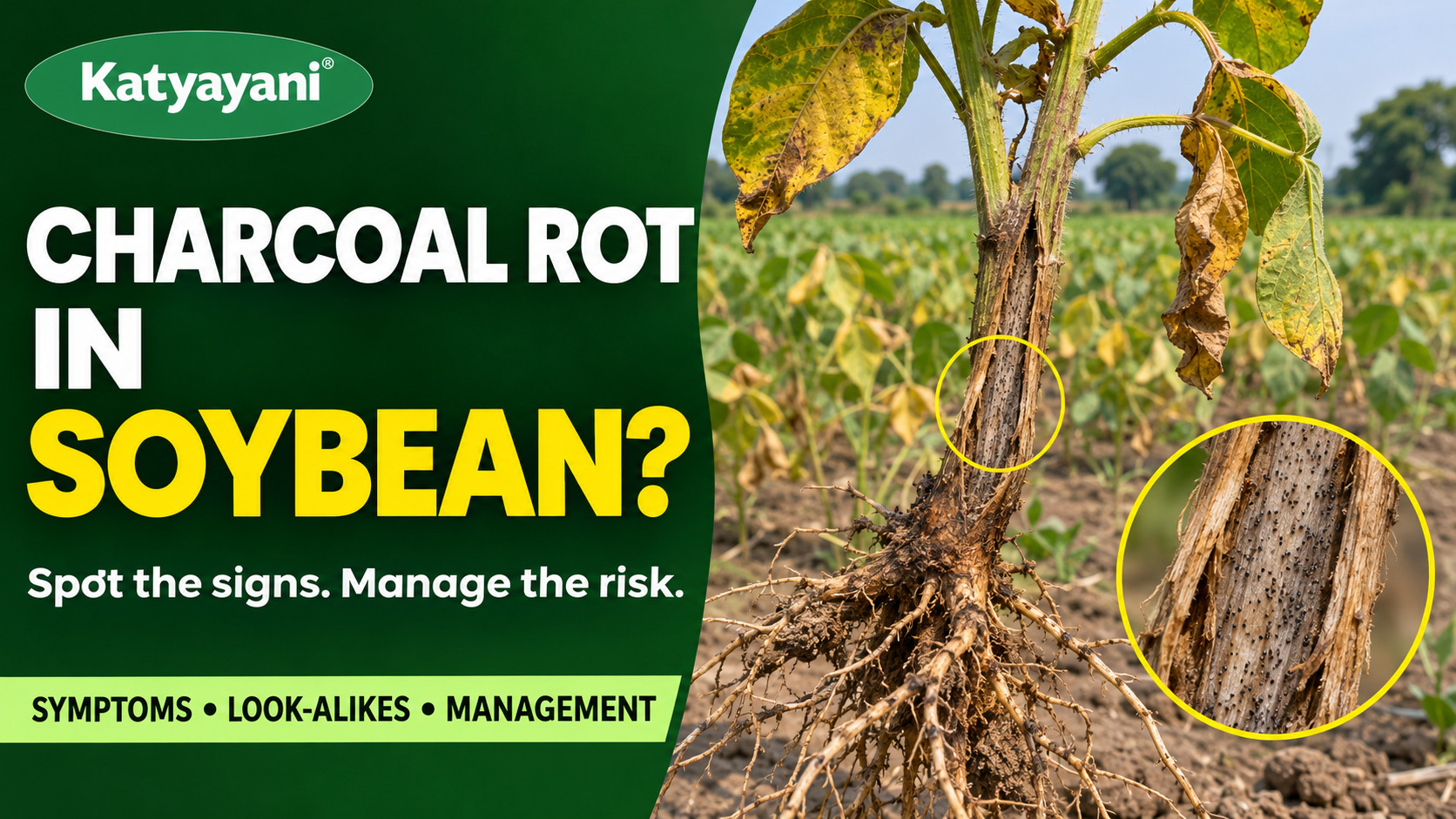
Charcoal rot is a soil-borne fungal disease (Macrophomina phaseolina) that infects soybean roots early but shows up only when heat and drought stress hit around flowering and pod fill. Plants in the driest or most compacted patches wilt and die early with leaves still hanging, and splitting the taproot shows silver-grey tissue with tiny black specks (microsclerotia). The fungus lives in soil and residue for years and can ride on seed. Nothing in the sources rescues a wilted plant, so the work is done before and at sowing: clean seed, a seed treatment backed by your state recommendation, rotation with cereals, a well-drained and not over-dense crop, and moisture protection during dry spells. Confirm the cause by splitting the stem before you spray anything.
 17 min
Marigold responds well when manure and biofertilizers replace part of the chemical fertiliser, not when they are added on top of a full dose. Most Indian sources put well-rotted FYM at 25 to 30 tonnes per hectare (roughly 10 to 12 tonnes per acre), mixed in at the last ploughing. TNAU gives Azospirillum and phosphobacteria at 2 kg per hectare each, mixed with FYM. Trials from Saharanpur, Faizabad and Raipur found the best flower yield with about 50 to 75 percent of the chemical dose plus vermicompost or FYM and Azotobacter, Azospirillum or PSB. Keep biofertilizers away from fungicides, and use Trichoderma as a preventive soil treatment, not a cure.
