
 14 min read
Gibberellic acid (GA3) is a plant growth regulator. CIB&RC registers it under the Insecticides Act, so you need a pesticide sale licence to stock it. The official formulation list of 31 March 2026 shows six GA3 forms: 0.001% L, 0.1% GR, 0.186% SP, 0.45% SL, 40% WSG and a 90% technical. Before a bulk order, check the form, strength, crop and label, and ask for the batch papers.
What is gibberellic acid (GA3) and what does it do on a farm?
Gibberellic acid, written GA3, is a plant growth regulator. In India, CIB&RC approves it crop by crop. Examples are better fibre quality in cotton, and more growth, vigour, yield and quality in tomato.
The European Food Safety Authority looked at GA3 in 2024. It assessed one use: spraying seedless grapes in Southern Europe to stretch the cluster, thin berries and size berries (EFSA peer review, 2024).
This post is for the person who buys GA3 for resale, so it gives no crop doses. For the plant science, read our guide to plant growth regulators and biostimulants. Here we cover the bill, the label and the shelf.
Which law covers GA3 in India?
The law treats GA3 as a pesticide. CIB&RC, the Central Insecticides Board and Registration Committee, registers it under the Insecticides Act, 1968. So licence, label, storage and expiry all follow the Insecticides Act and the Insecticides Rules.
The Fertiliser (Control) Amendment Order of 23 February 2021 (S.O. 882(E)) defined a biostimulant. It says a biostimulant "does not include pesticides or plant growth regulators which are regulated under the Insecticide Act, 1968" (Gazette of India copy). So GA3 is not a biostimulant under that Order. To see the difference in practice, read our guide on biostimulant, biofertiliser and biopesticide.
The CIB&RC list of pesticides registered under section 9(3), as on 31 March 2026, has Gibberellic Acid as entry 180 (CIB&RC list). Our post on CIB&RC registration explains section 9(3) and 9(3B).
Which licence and records does a dealer need to sell GA3?
You need a licence under the Insecticides Act to sell, stock or exhibit any insecticide. Section 13 of the Act provides for the licence, and section 18(2) bars sale without one. GA3 is registered under the Act, so the licence applies to it.
Section 18(2) says no person shall sell, stock or exhibit for sale or distribute any insecticide except under a licence (Insecticides Act, 1968). Steps and papers differ by state. See how to get a pesticide and fertiliser dealer licence, state by state.
Rule 15 of the Insecticides Rules sets the records. Every sale of an insecticide is made by a bill or cash memo, so write the product, strength, batch number and quantity on each bill. Sales to licensed manufacturers, stockists, distributors, dealers, retailers or bulk consumers go into a register, insecticide by insecticide, in Form XIII. Keep one page per product and one line per sale.
A monthly return of sales to actual consumers goes to the licensing officer in Form XIV, within 15 days of the month end. Close your month on the 5th and fill the return then. Rule 16 bars stocking or showing for sale any insecticide that is not packed and labelled as the rules need, so sell only labelled packs. These points come from the Insecticides Rules, 1971. Your state office may ask for extra forms, so check the local format.
Which GA3 forms and strengths are registered in India?
The CIB&RC formulation list updated on 31 March 2026 shows six GA3 entries and one mixed product. They are 0.001% L, 0.1% GR, 0.186% SP, 0.45% SL, 40% WSG and a 90% technical. The mixed product is GA3 with 6-benzyladenine. The Major Uses document up to 30 September 2026 also lists a 20% tablet.
| Form on the CIB&RC list | What the letters mean | Where it is listed |
|---|---|---|
| Gibberellic Acid 0.001% L | L is liquid | Formulation list, 31.03.2026; Major Uses, 30.09.2026 |
| Gibberellic Acid 0.1% GR | GR is granule | Formulation list, 31.03.2026; Major Uses, 30.09.2026 |
| Gibberellic Acid 0.186% SP | SP is soluble powder | Formulation list, 31.03.2026; Major Uses, 30.09.2026 |
| Gibberellic Acid 0.45% SL | SL is soluble liquid | Formulation list, 31.03.2026; Major Uses, 30.09.2026 |
| Gibberellic Acid 40% WSG | WSG is water-soluble granule | Formulation list, 31.03.2026; Major Uses, 30.09.2026 |
| Gibberellic Acid Technical 90% w/w | Technical grade | Formulation list, 31.03.2026; Major Uses, 30.09.2026 |
| Gibberellic Acid 20% Tablet | Tablet | Major Uses, 30.09.2026 only. Not in the 31.03.2026 formulation list |
| Gibberellic acid 1.8% + 6-Benzyladenine 1.8% L | Mixed product, liquid | Formulation list (combination of pesticides), 31.03.2026; Major Uses, 30.09.2026 |
The sources are the CIB&RC formulation list, 31.03.2026 and Major Uses of Pesticides, PGR, 30.09.2026. The tablet shows up only in the later document, because new approvals are added after a list is printed. If a supplier offers a form that is on neither list, do not buy it until you see the registration.
For what SP, SL, WSG and GR mean in a spray tank, see pesticide formulation types.
Why does GA3 strength range from 0.001% to 40%?
The percent on the label is the share of pure GA3 in the pack. A 40% granule holds 400 grams of GA3 in every kilogram. A 0.001% liquid holds about 10 milligrams in every kilogram. These are not the same product at different prices. Each pack has its own label dose.
The arithmetic is simple. One percent is 10,000 ppm, and one ppm is one milligram per kilogram. So you can turn any label strength into grams of GA3 per kilogram of product.
| Label strength | In ppm (about) | GA3 in 1 kg of product | Form |
|---|---|---|---|
| 0.001% | 10 ppm | 0.01 g | Liquid |
| 0.1% | 1,000 ppm | 1 g | Granule |
| 0.186% | 1,860 ppm | 1.86 g | Soluble powder |
| 0.45% | 4,500 ppm | 4.5 g | Soluble liquid |
| 20% | 200,000 ppm | 200 g | Tablet |
| 40% | 400,000 ppm | 400 g | Water-soluble granule |
| 90% | 900,000 ppm | 900 g | Technical |
Use the table to see the size of the gap. The dose always comes from the label of the pack in your hand.
Never treat a 25 gram pack of 40% granules and a 1 litre bottle of 0.001% liquid as swaps without the label dose. A farmer who swaps them by eye can overdose by a very large factor. Your counter staff must read the label dose every time.
Which crops is each GA3 form approved for?
The CIB&RC Major Uses document gives each GA3 form its own short crop list. Grapes, rice, cotton, wheat, maize, tomato and apple are on it. The table leaves out the technical, which is not a farm pack. Stock the form that matches what your customers grow. A crop that is not listed for that form is not an approved use.
| GA3 form | Crops listed in Major Uses (up to 30.09.2026) |
|---|---|
| 0.001% L | Paddy, sugarcane, cotton, groundnut, banana, tomato, potato, cabbage, cauliflower, onion, grapes, brinjal, bhindi, tea, mulberry |
| 0.1% GR | Rice |
| 0.186% SP | Cotton (to improve fibre quality) |
| 40% WSG | Grapes, rice, wheat, maize |
| 0.45% SL | Apple |
| 20% Tablet | Tomato |
| GA3 1.8% + 6-Benzyladenine 1.8% L | Apple |
The 20% tablet on tomato has a waiting period of 7 days between the last spray and harvest. Our post on pre-harvest interval explains waiting periods. Pass on the one printed on the pack you sell.
The document calls itself "compiled on the basis of available information for guidance and not for legal purposes." So use the label on the pack as your guide for the farmer.
Two Katyayani pages match this table. The Accel Gro Plus 40% WSG page names grapes and rice. The Accel Gro 0.186% SP page names cotton. Both agree with the crop lists above.
How do I check that a GA3 product is registered?
Match three things: the registration number on the label, the form and strength on the CIB&RC list, and the label crop against the Major Uses document. If one does not match, hold the order and write to the supplier. Section 18 of the Act bars the sale of an unregistered insecticide.
- Read the registration number on a sample pack. Rule 19 says the label must carry it.
- Find the form and strength in the CIB&RC formulation list. The spelling may differ a little, so look for the same strength and form letters.
- Open the Major Uses document and see if the label crop is approved for that form.
- Ask the supplier for a copy of the registration certificate. The brand name and registrant name must match the pack.
- Check the manufacturer name on the label. If the manufacturer is not the registrant, rule 19 says the label must state how the two are linked.
- Keep a photo of the label and the certificate in the purchase file.
Section 18(1) of the Insecticides Act says no person shall sell, stock or exhibit for sale any insecticide that is not registered (Insecticides Act, 1968). To tell real stock from fake, see how to identify fake pesticides and fertilisers.
What must be printed on a GA3 label?
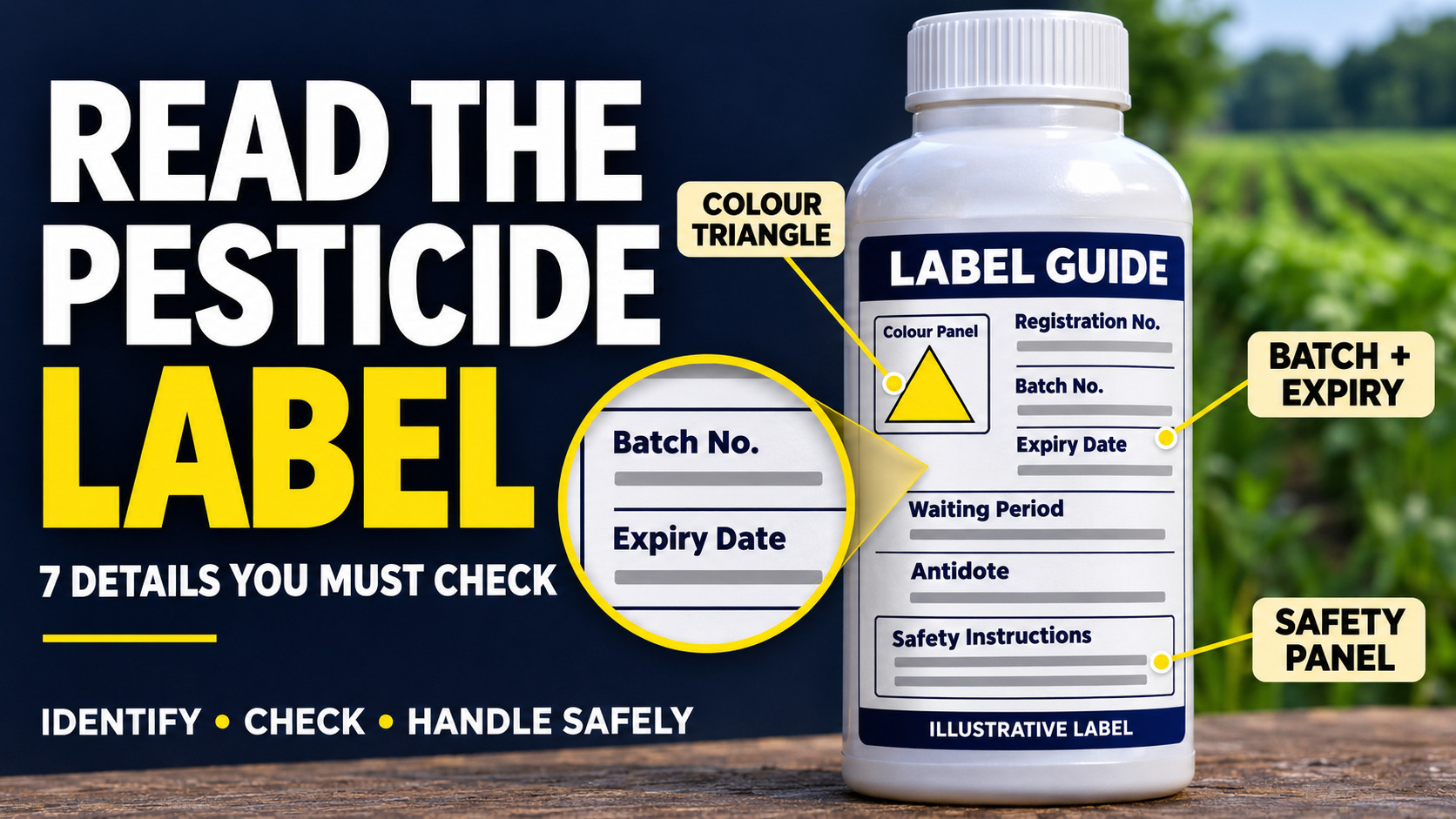
Rule 19 of the Insecticides Rules, 1971 lists the items. They include the maker name, the brand name, the registration number, the active ingredient and its percent, the net content, the batch number, the expiry date and an antidote statement. The label must be in Hindi, English and one or two regional languages.
| Rule 19 item | What to look for on the pack |
|---|---|
| Name of manufacturer | Name and address. If the registrant is a different firm, the link is stated |
| Name of insecticide | The brand name or trade mark |
| Registration number | A number is printed. It should match the certificate |
| Active and other ingredients with percent | Gibberellic acid with the percent, using the common name |
| Net content | In metric units, not counting the wrapper |
| Batch number | Printed, readable, same on the pack and on the bill |
| Expiry date | The date up to which the product keeps its efficiency and safety |
| Antidote statement | Present |
| Diamond-shaped toxicity square | At least one-sixteenth of the label face, with the signal word and colour band for its category |
| Languages | Hindi, English and one or two regional languages |
The rule also bars unwarranted safety claims. Words such as "safe", "non-poisonous", "non-injurious" or "harmless" must not be on the label (Insecticides Rules, 1971, rule 19). If you see them, be suspicious of the pack. Our guide to reading a pesticide label walks through a real one.
Which label claims should make me refuse a GA3 pack?
Refuse a pack if the label makes a false or misleading claim, refers to registration in any way other than the registration number, or leaves out required items. The Insecticides Act calls such a product misbranded, and section 29 sets punishment for selling or stocking a misbranded insecticide on some of these grounds.
Section 3(k) of the Act lists when an insecticide is deemed misbranded. It includes a label with a false or misleading statement, an imitation of another insecticide, a product not packed or labelled as required, one that is not registered, and a label that refers to registration in any way other than the registration number (Insecticides Act, 1968).
| What you see on the pack | Why it is a warning sign |
|---|---|
| "Works on all crops" with no crop list | The approval is crop by crop in the Major Uses document |
| "Government approved" or "CIB&RC certified" printed as a slogan with no number | The Act allows only the registration number, not other references to registration |
| A brand name very close to a well-known product | Imitation is a ground for misbranding |
| No batch number or expiry date | Rule 19 needs both |
| Strength not printed, or printed as "high power" | Rule 19 needs the active ingredient and its percent |
| Label only in one language | Rule 19 needs Hindi, English and a regional language |
If you find such a pack in your own stock, set it aside and tell your supplier in writing. For the pictograms and signal words used in the wider world, see our walk-through of GHS labelling for agrochemicals.
Why should a dealer not buy technical-grade GA3?
CIB&RC lists "Gibberellic Acid Technical 90% w/w" as its own registered item, apart from the farm formulations. Rule 15 of the Insecticides Rules keeps separate stock registers for technical grade and for formulated insecticides. Rule 16 bars stocking or showing for sale any insecticide that is not packed and labelled as the rules need.
Our post on technical grade vs formulation grade covers the difference. If you buy for resale to farmers, stock formulated packs with a full label.
The EFSA review adds a quality point. It says "a FAO specification does not exist" for GA3. EFSA proposed a reference specification with a minimum purity of 850 g/kg and a limit of 200 micrograms per kg for fumonisin B1 and B2 together. These are EU limits, not Indian limits. For how such sheets work for other products, see FAO and WHO specifications.
What papers should I ask a GA3 supplier for?
Ask for the registration certificate, the manufacturer licence, the batch test report and an invoice that shows batch number and expiry. Rule 19 puts the batch number and expiry date on the label, so the papers must match the pack. If a paper does not match, hold the order.
| Paper | Why you ask for it | What to check |
|---|---|---|
| CIB&RC registration certificate | Shows the product is registered | Brand, strength, form and registrant match the pack |
| Manufacturer licence for the unit | Section 17(2) of the Act bars making an insecticide without a licence | Name and address match the label |
| Batch test report | Shows the GA3 content of that batch | Batch number matches the pack |
| Invoice with batch and expiry | Your record if a complaint comes | Batch, quantity and expiry written on the bill |
| Written return terms for near-expiry stock | Protects you from dead stock | Agreed before the order |
Keep each set of papers with the stock register. Our guide to choosing a bulk pesticide supplier adds more checks for FPO buyers.
How do I compare two GA3 quotes fairly?
Compare the price of one gram of pure GA3, not the price of the pack. Multiply the pack weight in grams by the strength and divide by 100. That gives grams of GA3 in the pack. Then divide the pack price by those grams. This works for powders and granules.
| Step | Example pack A (made-up) | Example pack B (made-up) |
|---|---|---|
| Pack size and strength | 25 g of 40% WSG | 1 kg of 0.186% SP |
| Grams of GA3 in the pack | 25 x 40 / 100 = 10 g | 1,000 x 0.186 / 100 = 1.86 g |
| Price per gram of GA3 | Pack price divided by 10 | Pack price divided by 1.86 |
| Does it suit the crop? | Grapes, rice, wheat, maize (list above) | Cotton (list above) |
These sizes are made up to show the method. They are not offers. A cheaper gram of GA3 is no use if the pack is for a crop your customers do not grow, so the last row matters as much as the first three. For the margin side, see our guide to wholesale and retail margins.
How should I store GA3 in the shop and the godown?
Keep it in a dry, well-lit, well-ventilated room, away from food, feed and other goods. The Insecticides Rules want insecticides in separate rooms or locked almirahs, in premises that are well built, dry, well-lit and ventilated. Never store them in the same building as food or animal feed.
- Rule 36 says the packages must be stored in separate rooms or premises, or in separate almirahs under lock and key, depending on quantity and nature.
- Rule 10C bars storing or selling any insecticide in the same building where food for people or animals is made, stored or sold.
- Rule 35 says insecticides must not touch foodstuffs or animal feed in transit or in store.
- FAO notes that high temperature, humidity and strong sunlight shorten shelf-life, and that dust and wettable powder formulations tend to cake together.
- FAO says shelf-life falls fast once a pack is opened, so use opened packs first.
These rules are from the Insecticides Rules, 1971, and the shelf-life points are from the FAO pesticide storage guide. No official page gives a GA3-specific storage temperature, so follow any storage advice on the label. For counter and shelf set-up, see shelf display and counter advice for agri shops.
How do I handle shelf life, expiry and returns?
Check the expiry date when you buy, and sell the oldest batch first. FAO says most pesticides have an indicated shelf-life of at least two years from manufacture, and advises never to order more than one year of stock. Under rule 10A, expired stock must be set apart, stamped and disposed of.
Rule 10A of the Insecticides Rules says that, right after the date of expiry, stock must be segregated and stamped "not for sale". It is kept in a separate demarcated place with a "date-expired insecticide" notice, and then disposed of in an environment-friendly way. It must not be used for remanufacture. FAO describes lab checks for expired stock, but Indian rule 10A requires segregation and disposal, so follow rule 10A.
FAO also gives signs of deterioration. Caking in a powder is one. Sedimentation or gelling in a liquid is another. Do not sell such stock. Return it to the supplier with the batch number, and keep the bottle for the supplier visit. Note the date you open a pack and use opened packs first. Order in small lots through the season.
Agree in writing with your supplier what happens to stock that expires on your shelf. Our post on dealer licence renewal also shows what an inspector may ask to see in your stock register.
When in the crop season is GA3 used, so I know when to stock?
Each approved use on the CIB&RC list has its own timing. Grape sprays fall around pruning and flowering. Cotton sprays fall at squaring and ball formation. Rice sprays fall a few weeks after transplanting. Have the right pack on the shelf two to three weeks before the first window.
| Crop and form | Timing shown in the CIB&RC list (up to 30.09.2026) |
|---|---|
| Grapes, 40% WSG | Pre-bloom elongation, fruit-set thinning, and berry enlargement at 6 to 7 mm berry size |
| Grapes, 0.001% L | First spray 30 to 35 days after pruning, second at the match-head stage |
| Rice, 40% WSG | 20 to 25 days after transplanting, and at panicle emergence |
| Wheat, 40% WSG | 20 to 25 days after sowing |
| Maize, 40% WSG | Knee-high stage, 25 to 30 days after sowing |
| Cotton, 0.001% L | First spray 40 to 45 days after planting, second at ball formation |
| Cotton, 0.186% SP | One spray at square formation or early flowering, to improve fibre quality |
| Onion, 0.001% L | 25 to 30 days after planting |
| Tomato, 20% tablet | To improve growth, vigour, yield and quality, with a 7 day waiting period |
These timings are as printed in the Major Uses document. The doses sit in the same document, but the table in the PDF is hard to read. So give out only the dose printed on the pack.
What should the counter staff tell the farmer when selling GA3?
Staff should read four things from the pack: the crop it is approved for, the dose, the time of spray and the waiting period. They should also tell the farmer to wear protective clothing, gloves, goggles and boots. Rule 39 lists this clothing for people who handle insecticides.
- Ask the farmer which crop and which growth stage the product is for.
- Check that the crop is on the label of the pack you are about to sell.
- Read the label dose and the time of spray aloud. Do not give a dose from memory.
- Tell the farmer the waiting period before harvest, if the label shows one.
- Tell the farmer to wear protective clothing, rubber gloves, goggles and boots. Rule 39 lists these.
- Ask the farmer to follow the label before mixing GA3 with any other product. Our guide to tank mix compatibility explains the risk.
- Give a bill that shows the batch number and keep a copy.
If the farmer wants a dose per tank instead of per acre, our per-litre dose calculator for a 15 litre tank shows the method. Use it only with the label dose.
What mistakes do dealers make when buying GA3?
Most mistakes are easy to avoid. Dealers compare pack prices instead of the cost per gram of GA3. They buy a form that no local crop uses, or a full year of stock at once, so it sits, cakes and expires. They skip batch papers, so there is no trace if a complaint comes. They accept packs with safety claims on the label, which rule 19 bars. They store GA3 near food or feed, which breaks rule 10C. They sell expired stock, which breaks rule 10A. And they tell a farmer a dose from memory, which risks an overdose, especially with 40% granules.
Our guide on plant growth promoters and which to stock helps you decide the range.
How should I plan the first order?
Start with the form that fits your biggest local crop, buy a small lot, and record how fast it sells. Add a second form only after you see demand. Staff should read the label dose out and not guess.
- List the crops grown within your sales area that appear in the crop table.
- Pick the form that is approved for the most of those crops.
- Check registration, label and expiry on a sample before the full order.
- Order a small first lot. FAO says never to order more than one year of need.
- Write down batch number, expiry and the date each pack is received.
- Review sales at the end of the season and adjust the next order.
Conclusion
Buy GA3 as a regulated pesticide. Match the form and strength to the CIB&RC list, match the crop to the Major Uses document, read the rule 19 label items, keep the batch papers, and store and rotate the stock by the rules.

Leave a Comment