
 15 min read
A herbicide is a weed killer, and the law treats it like any other pesticide. Every herbicide you sell must be registered with CIB&RC, labelled under rule 19 and stored under rules 10A, 10C and 36. Check the banned list first: the 31 October 2026 list shows paraquat dichloride as banned. Then match the molecule and its mode of action to the crop, read the waiting period on the label, and buy in small lots.
Is a herbicide a pesticide in the eyes of the law?
Yes. The Insecticides Act, 1968 defines "insecticide" to include other substances, such as fungicides and weedicides, that the Central Government adds to the Schedule. So herbicides fall under the same law. A herbicide must be registered, you must hold a sale licence, and the label and storage rules apply.
Section 3(e) of the Act says this, and section 18 bars the sale of any insecticide that is not registered (Insecticides Act, 1968). So if a supplier tells you a weed killer needs "no registration", he is wrong. For the licence itself, see how to get a pesticide and fertiliser dealer licence.
This post is for the shop owner or buyer. To choose a sprayer and nozzle for herbicide work, read how to choose a sprayer for herbicide, fungicide and insecticide. For what to stock by crop and quantity, see the rabi stock list for dealers.
How many herbicides are registered in India, and where do I find the list?
The CIB&RC formulation list updated on 31 March 2026 has a section for single-molecule herbicides, numbered 296 to 409, and a section for herbicide mixtures, numbered 1038 to 1150. That is 114 single entries and 112 mixtures, because number 1104 is not used. You will find the lists on the ppqs.gov.in site under CIB&RC.
Two more CIB&RC documents help you. The Major Uses of Pesticides, Herbicides (up to 30.09.2026) gives the approved crop, weeds, dose, water volume and waiting period for each herbicide. The list of banned, refused and restricted pesticides was updated on 31.10.2026. Here are the sources: CIB&RC formulation list, Major Uses, Herbicides and the banned and restricted list.
The Major Uses document says it is compiled "for guidance and not for legal purposes", so the registered label has the final word. To see how registration works, read CIB&RC registration, section 9(3) and 9(3B).
Which herbicides are banned or restricted, and what is the status of paraquat?
Check the banned list before you place any order. The CIB&RC list updated on 31 October 2026 shows Paraquat Dichloride as banned, with the order number S.O. 5234(E) dated 22 September 2026. The order is on the CIB&RC site as an enclosure to a public notice (CIB&RC public notice, 7 October 2026). The same list also names alachlor and linuron as banned, and sets crop limits on oxyfluorfen and trifluralin.
| Herbicide | Status on the CIB&RC list (31.10.2026) |
|---|---|
| Paraquat Dichloride | Banned. Entry cites S.O. 5234(E) dated 22.09.2026 |
| Paraquat Dimethyl Sulphate | Banned |
| Alachlor | Banned (S.O. 3951(E), 8 August 2018) |
| Linuron | Banned (S.O. 3951(E), 8 August 2018) |
| Oxyfluorfen | Banned for use on potato and groundnut (S.O. 4294(E), 3 October 2023) |
| Trifluralin | All uses except use in wheat banned from 8 August 2018. The label must carry a caution that it is toxic to aquatic organisms and must not be used near water bodies, aquaculture or fish culture areas |
Older lists can still show a banned molecule. The 31 March 2026 formulation list still has paraquat entries, and the Major Uses document up to 30 September 2026 still lists paraquat uses. Both were compiled before the 22 September 2026 order was entered on the banned list. The banned list is the one to follow.
The order, as printed in the Gazette of India (Extraordinary No. 5027, 23 September 2026), does four things. It prohibits the registration of Paraquat Dichloride from the date of publication. It cancels the registration certificate. It tells the Registration Committee to call back the certificates. It says State Governments shall take such steps under the Act and Rules as they think fit to carry out the order. It gives no period to clear old stock, and it names no sale period.
A pesticide with no registration cannot be sold under section 18 of the Act. So stop buying and stocking new paraquat or paraquat mixtures, and do not sell what you hold. Write to your State agriculture or pesticide licensing officer about old stock and wait for the reply. Keep your purchase and stock records. For other compliance risks in dealer shops, see dealer compliance in the fake fertiliser crackdown.
How are herbicides grouped, and why does it matter to a dealer?
Herbicides are grouped by how they kill the weed, which is called the mode of action. It matters because a farmer who sprays the same mode again and again can breed a resistant weed. So stock more than one mode of action for each main crop.
The ICAR journal Indian Farming (volume 76, issue 9, 2026) says Phalaris minor in wheat has become resistant to many commercial herbicides. It advises rotating, sequencing or mixing herbicides with different modes of action to slow resistance, and telling farmers about the alternatives (Indian Farming, 2026). A ready-mix of two actives is one way to do the mixing.
Keep a record of what each customer bought. Then you can ask, "What did you use last season?" and offer a product with a different mode of action. The active ingredient on the label tells you the molecule. If you are not sure of its mode of action, ask your supplier or your district agriculture office before you recommend a swap.
Which herbicides suit wheat?
ICAR-IIWBR, Karnal, names clodinafop and pinoxaden for narrow-leaf weeds in wheat. For broad-leaf weeds it names 2,4-D, metsulfuron and carfentrazone. For a mixed field it names sulfosulfuron, sulfosulfuron with metsulfuron, or mesosulfuron with iodosulfuron. These come from the 1 to 15 February 2025 advisory for late-sown wheat.
| Weed problem in wheat | Options named by ICAR-IIWBR (Feb 2025 advisory) |
|---|---|
| Narrow-leaf weeds (grasses) | Clodinafop 15 WP, or pinoxaden 5 EC |
| Broad-leaf weeds | 2,4-D, metsulfuron 20 WP, or carfentrazone 40 DF |
| Both narrow and broad-leaf weeds | Sulfosulfuron 75 WG, or sulfosulfuron + metsulfuron 80 WG, or mesosulfuron + iodosulfuron 3.6% WDG |
| Multiple herbicide resistant Phalaris minor | Ready-mix clodinafop + metribuzin 12+42% WP, or pyroxasulfone 85 WG |
The advisory says to spray the mixed-weed options (sulfosulfuron and the mesosulfuron mix) before the first irrigation or 10 to 15 days after it, in 120 to 150 litres of water per acre (ICAR-IIWBR advisory, Feb 2025). The Katyayani MSM page lists the same wheat weeds that the Major Uses document names for metsulfuron, such as Chenopodium album and Melilotus. See the MSM metsulfuron methyl 20% WP page. For the crop itself, see wheat sowing time and seed rate.
Timing matters as much as the molecule. Each label names a spray time, such as days after sowing or a leaf stage of the weeds. If a farmer comes late, do not sell him a double dose. Check the weed stage against the label first, because using more than the label dose is not an approved use.
The advisory is dated February 2025, so ask your district office or KVK whether a newer one is out for this season.
Which herbicides suit rice?
The Andhra Pradesh section of the ICAR Kharif Agro-Advisories 2025 names pyrazosulfuron-ethyl, pretilachlor and butachlor within 3 to 5 days of sowing or planting. At about 20 days after transplanting, it names cyhalofop-P-butyl for grass weeds, and bispyribac-sodium or a triafamone with ethoxysulfuron mix for heavy weed growth.
| Rice stage (ICAR Kharif Agro-Advisories 2025, Andhra Pradesh section) | Molecules named |
|---|---|
| Wet direct-seeded rice, within 3 to 5 days of sowing | Pyrazosulfuron-ethyl 10% WP, or pretilachlor with safener 37% EW |
| Transplanted rice, within 3 to 5 days of planting | Pyrazosulfuron-ethyl 10% WP, or butachlor 50% EC, or pretilachlor 50% EC |
| Heavy mix of grass, sedge and broad-leaf weeds | Bensulfuron methyl 0.6% + pretilachlor 6% granules |
| About 20 days after transplanting, grass weeds | Cyhalofop-P-butyl 10% EC |
| High weed pressure later | Bispyribac sodium 10%, or triafamone + ethoxysulfuron 30% WG |
The advisory names these for fields with shallow standing water. The Katyayani page says "Garuda is for rice only" and lists nursery, transplanted and direct-seeded rice. See the Garuda bispyribac sodium 10% SC page. For direct-seeded rice, our post on Punjab DSR covers the scheme side.
The CIB&RC Major Uses document lists the weeds each rice product targets. Pretilachlor and butachlor list Echinochloa and Cyperus species. Penoxsulam 21.7% SC shows a waiting period of 60 days on its transplanted rice entry. Ask your supplier for the exact label of the pack you buy.
Which herbicides suit maize, soybean, chickpea and cotton?
For maize, the Andhra Pradesh section of the ICAR advisory names atrazine within two to three days of sowing, then tembotrione or topramezone with atrazine at 15 to 18 days after sowing. For soybean, the CIB&RC list shows imazethapyr. For chickpea and cotton, ICAR names pendimethalin right after sowing, and cotton gets a later post-emergence spray.
| Crop | Molecules named | Source |
|---|---|---|
| Maize | Atrazine 2 to 3 days after sowing; tembotrione 34.4% SC or topramezone 33.6% SC, each with atrazine 50% WP, at 15 to 18 days after sowing; halosulfuron methyl if Cyperus is heavy | ICAR Kharif Agro-Advisories 2025 (Andhra Pradesh) |
| Soybean | Imazethapyr 10% SL at the 1-2 leaf stage of weeds or 7 to 14 days after sowing, with an adjuvant as shown on the label | CIB&RC Major Uses, 30.09.2026 |
| Chickpea | Pendimethalin immediately after sowing or the next day, to check weeds for the first 20 to 25 days | ICAR Kharif Agro-Advisories 2025 (Andhra Pradesh) |
| Cotton | Pendimethalin immediately after sowing; then quizalofop-p-ethyl + pyrithiobac sodium at 25 to 30 days after sowing | ICAR Kharif Agro-Advisories 2025 (Andhra Pradesh) |
All four molecule sets come from the ICAR advisory or the Major Uses document. For chickpea and cotton, the advice also includes manual or mechanical weeding. The ICAR advice is for Andhra Pradesh, so ask your district office or KVK what suits your state. For small farms, see our guide to manual weeders. For the crop itself, read chickpea farming in India.
What do pre-emergence and post-emergence mean on a label?
Pre-emergence means the herbicide is sprayed on the soil before the weeds come up, often within days of sowing. Post-emergence means it is sprayed on weeds that are already growing, often at a set leaf stage. A post-emergence product used too late may control poorly.
The tables above show both. Pendimethalin right after sowing in chickpea and cotton is pre-emergence. Quizalofop-p-ethyl with pyrithiobac sodium at 25 to 30 days after sowing in cotton is post-emergence. Labels also use DAS for days after sowing, as in tembotrione or topramezone with atrazine at 15 to 18 DAS in maize. DAT means days after transplanting, as in cyhalofop-P-butyl at about 20 DAT in rice. Some labels give the leaf stage of the weeds instead, as with imazethapyr at the 1-2 leaf stage in soybean.
Before any herbicide sale, ask three things. What is the crop? How many days since sowing or planting? Which weeds are in the field: grass, sedge or broad-leaf? The answers tell you whether the farmer needs a pre-emergence product, a post-emergence product or only hand weeding.
The timing is part of the registered use. A product used outside its crop or stage is not an approved use, so the label, and not a salesman, must decide the spray window.
What is the waiting period for herbicides, and why does it matter?
The waiting period, also called PHI, is the minimum gap between the last spray and harvest. The CIB&RC Major Uses document lists it for each approved use. Read it out to the farmer when you sell.
| Herbicide and crop (Major Uses, 30.09.2026) | Weeds listed (examples) | Waiting period column |
|---|---|---|
| Clodinafop-propargyl 15% WP, wheat | Phalaris minor | 110 days |
| Pinoxaden 5.1% EC, wheat | Phalaris minor, Avena ludoviciana | 90 days |
| Metsulfuron methyl 20% WG, wheat | Chenopodium album, Melilotus species, Lathyrus aphaca | 76 days |
| Penoxsulam 21.7% SC, rice (transplanted) | Echinochloa, Cyperus, Ludwigia, Monochoria | 60 days |
| Imazethapyr 10% SL, soybean | Echinochloa colonum, Euphorbia hirta, Commelina benghalensis | 72 days |
The numbers differ a lot from product to product. The same molecule can also show a different number for a different formulation. For example, clodinafop-propargyl 15% DF on wheat shows 70 days, while the 15% WP shows 110. Read the waiting period every time.
The Major Uses document is for guidance only, so match each number with the label on the pack. Our post on pre-harvest interval for pesticides explains PHI in more detail.
How do I tell resistance from a bad product?
If a herbicide fails in one field but works in the next, the cause may be a resistant weed or a spraying error, not a bad pack. Indian Farming says Phalaris minor in wheat has become resistant to many herbicides. ICAR-IIWBR names a separate ready-mix and pyroxasulfone for resistant Phalaris minor. Ask the farmer what was sprayed, when and how.
- Ask for the product, the batch number and the date of spray.
- Ask the weed stage at spray time and compare it with the label.
- Ask about water volume and nozzle. IIWBR names 120 to 150 litres per acre for wheat sprays.
- Ask if the same product was used in earlier seasons. Indian Farming links resistance to repeated use of the same herbicides.
- If the same product worked in neighbouring fields, take the batch number and report it to your supplier.
- Suggest a product with a different mode of action next season.
Indian Farming (2026) adds that stopping weed seeds from returning to the soil should be part of weed control, and that cultural and physical methods should go with herbicide use (ICAR Indian Farming). The IIWBR advisory names the resistant Phalaris minor option as a ready mix of clodinafop and metribuzin, or pyroxasulfone (ICAR-IIWBR advisory). Never quote a dose from memory. Use the label, and use our per-litre dose calculator for a 15 litre tank to convert it to the tank.
What should I know about ready-mix herbicides?
A ready-mix holds two or more active ingredients in one pack. The CIB&RC list has a separate section for them, serial numbers 1038 to 1150. Each mix is its own entry, so check the exact mix and the crop. The Major Uses document lists approved crops entry by entry.
Many mixes on the list match the advisories above. For wheat it has clodinafop propargyl with metribuzin in more than one strength, for example 9% with 20% as a WP and 12% with 42% as a WG. It also has sulfosulfuron 75% with metsulfuron methyl 5% WG. For maize it has tembotrione 9% with atrazine 45% WG. The ICAR-IIWBR advisory names a 12+42% WP mix for resistant Phalaris minor, but the list shows the 12% and 42% pair as a WG. So the strength and form on your pack may not match the advisory word for word.
Ask four things about any mix. What are the two actives and their modes of action? Indian Farming (2026) lists mixtures of herbicides with different modes of action as one way to lower resistance pressure. Is the mix approved for this crop? Does it contain a banned molecule? Mixes of paraquat are on the older lists, and the banned list now shows paraquat dichloride as banned. Is the strength and form the one the farmer needs? Tell him to follow the label dose for that exact pack.
Do not tank-mix a ready-mix with another product unless the label says so. If a farmer asks you to mix two separate products, the label must allow it. Our guide on tank mix compatibility shows how to check.
Which herbicide formulation should I stock?
The CIB&RC list shows herbicides in many forms, such as EC, SC, SL, WP, WG, WDG, DF, OD, EW, CS and granules. One molecule may come in several forms. Pick the form your customers can mix and spray easily, and check how it holds in the shop. Liquids can separate, and powders can cake.
The letters mean different things in the tank. Our guide to pesticide formulation types explains EC, SC, WP and WG. FAO notes that dusts and wettable powders cake in humid or compacted storage, and that liquids can show sediment, gel or flakes when they go bad (FAO shelf-life guide). So buy small lots of powders in humid areas.
| Form in the CIB&RC list | Example herbicide entry | What to watch in the shop |
|---|---|---|
| EC (emulsifiable concentrate) | Butachlor 50% EC, pretilachlor 50% EC | Check seams for leaks. FAO notes ECs can corrode container seams |
| SL (soluble liquid) | Glyphosate SL entries, 2,4-D amine 58% SL | Look for sediment or flakes |
| SC (suspension concentrate) | Bispyribac sodium 10% SC, tembotrione SC | Shake before sale. Sediment that will not mix is a warning sign |
| WP and WG (powder and granule) | Metsulfuron methyl 20% WP, clodinafop 15% WP | Keep dry. Caked powder should not be sold |
| GR (granule) | Butachlor 5% GR, pendimethalin 5% G | Keep sealed and dry |
What should I check on a herbicide label and bill?
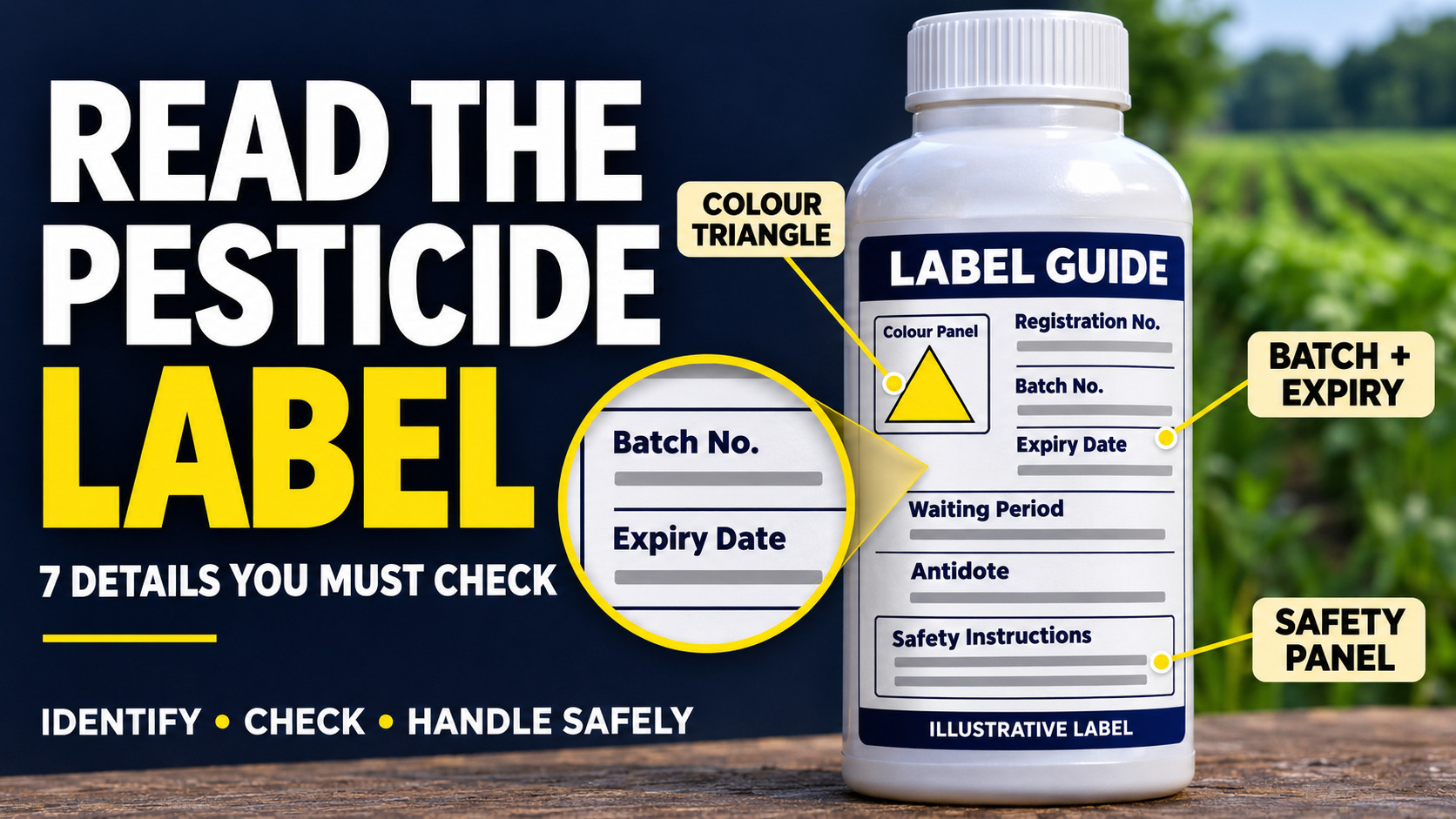
Check the registration number, the active ingredient and percent, the crop and weeds named, the batch number, the expiry date and the toxicity square. Rule 19 requires these on the label. Rule 15 says every sale of an insecticide must be by bill or cash memo.
- Registration number printed on the label (rule 19).
- The active, percent and form match an entry on the CIB&RC list.
- Active ingredient and percent, which tell you the group and the real strength.
- Crop and weed list. Use outside the label is not an approved use.
- Batch number and expiry date (rule 19).
- Toxicity square with signal word and colour band, at least one-sixteenth of the label face.
- Hindi, English and a regional language (rule 19).
- No claims such as "safe" or "harmless". Rule 19 bars them.
- A pack packed and labelled by the rules. Rule 16 bars stocking any pack that is not.
- A bill or cash memo for every sale (rule 15).
These come from the Insecticides Rules, 1971. For a step-by-step label read, see how to read a pesticide label. To spot fake packs, see how to identify fake pesticides and fertilisers.
How do I choose between two brands of the same herbicide?
Compare the active ingredient and its percent, the form, the registration number, the crop list and the expiry date. Then compare the cost of covering one acre at the label dose. Two packs of the same molecule can differ in strength, so the price per pack alone tells you very little.
- Write down the active ingredient, percent and form from each label.
- Check that both formulations (active, percent and form) appear on the CIB&RC list.
- Check that your main crop and weeds are named on both labels.
- Read the label dose per acre for each pack and work out how many acres one pack covers.
- Divide the pack price by the acres covered. That is the cost per acre for each brand.
- Check the expiry date and the batch number. A pack with less than a season of life left is a poor buy.
- For what to ask a supplier before a bulk order, see our GA3 buying guide.
Do not choose only on the lowest cost per acre. A pack with the wrong crop on the label costs more in the end. For the sales side, see our post on wholesale and retail margins.
How should I store herbicides and deal with expired stock?
Store herbicides in a dry, well-lit, ventilated room or a locked cupboard, apart from food and feed. Rule 10C bars storing insecticides in the same building as food or feed. Rule 10A says that after the expiry date, stock must be set apart, stamped "not for sale" and disposed of in an environment-friendly way.
- Rule 36: store in separate rooms or locked cupboards, away from other articles, in premises that are well built, dry, well-lit and ventilated.
- Rule 10C: no storing or selling insecticides in the same building where food or feed is made, stored or sold.
- Rule 10A: keep expired stock in a separate marked place with a "date-expired insecticide" notice. Do not use it for remanufacture.
- FAO: shelf-life is shorter at high temperatures, and powders cake in heat, humidity and strong sunlight. Do not order more than one year of need.
- FAO: shelf-life falls fast once a container is opened, so use opened packs as quickly as you can.
The rules are from the Insecticides Rules, 1971, and the shelf-life points are from the FAO page. For shelf layout and the counter, see shelf display and counter advice for agri shops.
How much herbicide stock should I buy before the season?
Work from the area under each crop in your sales area and the number of acres one pack covers at the label dose. Buy a small first lot, then reorder as sales show. FAO advises ordering no more than one year of need. Weed sprays fall in short windows, so stock should arrive before sowing.
Here is the method with made-up numbers. Say your area has 2,000 acres of wheat, and last season 60 percent of fields used a herbicide. That is 1,200 acres to cover. Read the label dose to see how many acres one pack covers, then divide 1,200 by that number to get the packs needed. Order only part of them first, in small lots. Use your own records, not these numbers.
Our weed control range page shows the Katyayani herbicides, so you can compare molecules before you ask for a quote.
What should counter staff tell a farmer who buys a herbicide?
Staff should read the crop, stage, dose and waiting period from the pack, ask which weeds are in the field, and advise protective clothing. Rule 39 describes it: overalls and hat, rubber gloves, goggles and boots. They should also tell the farmer to keep a separate sprayer for herbicides if possible.
- Ask the crop, its age and the weeds present.
- Check the crop and stage on the label match.
- Read the dose and water volume from the label.
- Tell the farmer the waiting period.
- Say that overalls, a hat, rubber gloves, goggles and boots are needed while handling and spraying (rule 39).
- Advise not to spray in strong wind. Our sprayer guide covers drift and nozzles.
- Advise a separate sprayer for herbicides if the farmer can, and wash it well. The live sprayer post calls this practical advice.
- Do not mix products in the tank unless the label allows.
- Give a bill or cash memo (rule 15).
What mistakes do dealers make when buying herbicides?
The common mistakes are stocking a banned molecule, buying only one mode of action for a crop, buying too early, ignoring the waiting period, and selling without reading the label. Each is easy to avoid with the checks above.
Two more are worth a word. Ordering more than one year of stock leads to expiry and caking. Storing herbicides near seed, fertiliser or food breaks rule 10C, and selling past the expiry date breaks rule 10A, so keep a separate locked shelf and set expired packs aside.
If you hold paraquat or its mixtures, stop buying, write to your State licensing officer about old stock, and keep your records.
Conclusion
Start with the banned list. Then match molecule and mode of action to the crop, read the label and waiting period, store by rules 10A, 10C and 36, and buy in small lots.

Leave a Comment