
 12 min read
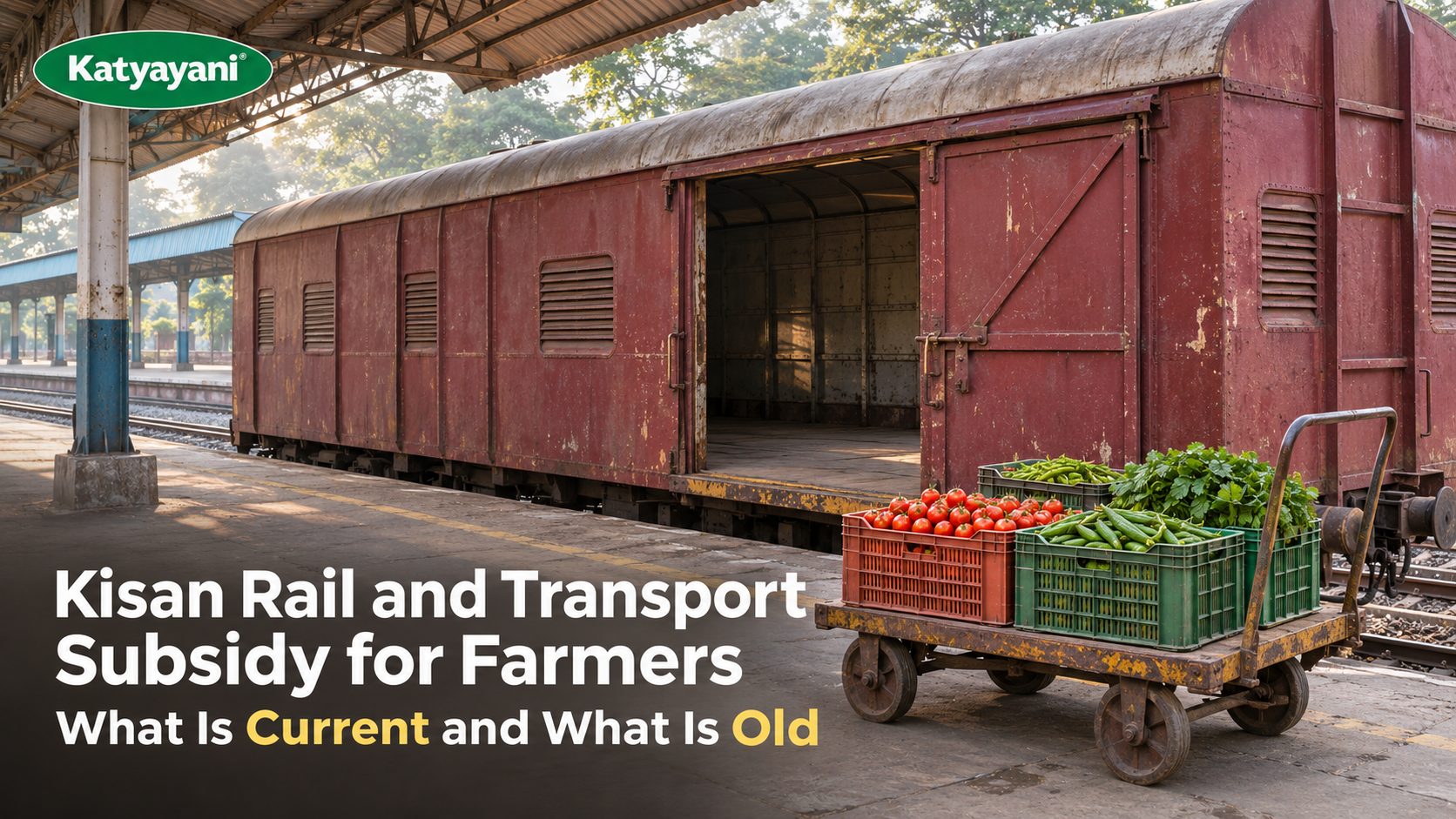
Kisan Rail is a Railways service for moving perishables such as fruit and vegetables. PIB (20 Feb 2024) says 2,364 services ran up to 15 Nov 2023 and that the 50% freight subsidy on fruits and vegetables continued only till 31 March 2022. After that, PIB says 45% subsidy was given by the Ministry of Railways. No PIB paper cited here shows a Kisan Rail freight subsidy for 2025-26 or 2026-27. Ask Railways for the discount in force before you book.
What is Kisan Rail?
Kisan Rail is a Railways service that carries fruit, vegetables and other perishable farm produce to far markets. It began in August 2020. PIB (20 Feb 2024) says 2,364 services ran up to 15 November 2023, carrying about 7.93 lakh tonnes of perishables.
The New India Samachar issue of May 2022 says the idea is simple: get produce to a far market fast and cheap, before it spoils. The Ministry of Agriculture and Farmers Welfare picks the rail circuits after talks with state departments, local bodies, agencies and mandis. Coaches are given on demand. The same issue counts 2,190 trips by 25 March 2022.
Kisan Rail is a transport service, not a loan. Any subsidy PIB describes is a subsidy on transportation. For the sale at the other end, see e-NAM registration and selling.
Is there still a 50% subsidy on Kisan Rail?
No, PIB shows it as ended. PIB (20 Feb 2024) says the 50% subsidy on moving fruits and vegetables by Kisan Rail continued till 31 March 2022, and that after this the Ministry of Railways gave a 45% subsidy. The PIB papers cited here show no Kisan Rail freight subsidy for 2025-26 or 2026-27.
So the line "50% subsidy on Kisan Rail" was true in the first phase, but the PIB factsheet of 20 February 2024 shows it changed. Do not plan a shipment on the 50% figure. Ask Railways what discount, if any, applies on the day you book.
| Period | Subsidy on fruit and vegetable freight | Who gave it (as PIB says) |
|---|---|---|
| Up to 31 March 2022 | 50% | Ministry of Food Processing Industries under Operation Greens (New India Samachar, May 2022) |
| After 31 March 2022 | 45% | Ministry of Railways (PIB, 20 Feb 2024) |
| 2025-26 and 2026-27 | Not shown in the PIB papers cited here | Ask Railways |
PIB (20 Feb 2024) does not say until what date the 45% ran. Treat it as a past rate until Railways confirms it in writing. If an agent tells you "the subsidy is still 50%", ask for the official order. A real order has a date and a number.
Who paid the 50% subsidy, and under which scheme?
The Ministry of Food Processing Industries (MoFPI) paid it under Operation Greens. The New India Samachar issue of May 2022 calls it a 50 percent subsidy on transportation of fruits and vegetables in Kisan Rail.
Note the wording. Both PIB papers describe a subsidy on transportation. Neither describes a cash grant to the farmer. Ask Railways how any discount is applied before you book, and keep the booking receipt.
What is Operation Greens, and what does it cover?
Operation Greens is a MoFPI scheme for tomato, onion and potato (TOP) crops. A PIB note says NAFED is the nodal agency for price stabilisation. MoFPI provides 50% of the subsidy on two items: transport of TOP crops from production to storage, and hiring of storage for TOP crops.
The PIB note on Operation Greens lists five aims. They are better value for TOP farmers through production clusters and their FPOs, steady prices, fewer post-harvest losses, more food processing, and a market-intelligence network with real-time data on demand, supply and prices. There is a short-term plan for price stabilisation and a long-term plan for value-chain projects.
| Part of Operation Greens | What the PIB note says |
|---|---|
| Crops | Tomato, onion, potato (TOP) |
| Nodal agency for price stabilisation | NAFED |
| Short-term support | MoFPI gives 50% of the subsidy on transport of TOP crops from production to storage, and on hiring storage |
| Market information | A web portal and dashboard to watch prices of TOP crops |
| Long-term projects | FPO formation, quality production, post-harvest facilities, agri-logistics, marketing and consumption points |
That note names only tomato, onion and potato. The New India Samachar issue and the PIB factsheet speak of fruits and vegetables on Kisan Rail in general and do not list items. If you grow another crop, ask Railways whether it is covered.
If you sell onions, also read onion export duty and MEP and the red chilli price trend. Price and trade rules can change whether a far market is worth the trip.
What is Krishi UDAN, and is it only for air cargo?
Krishi UDAN is a Ministry of Civil Aviation scheme that helps move farm produce by air, mainly from the North East, hilly and tribal areas. PIB (20 Feb 2024) says it was launched in August 2020 and covers 58 airports, 25 of them in priority regions. The scheme envisages a waiver of landing and parking charges.
The PIB release of 27 October 2021 on Krishi UDAN 2.0 adds detail. It offers a full waiver of landing, parking, TNLC and RNFC charges for Indian freighters and P2C aircraft at selected Airports Authority of India airports. It names 53 airports for the first phase and says farmers, freight forwarders and airlines are likely to gain. The Ministry of Civil Aviation planned a 6-month pilot.
| Point | Krishi UDAN (as PIB says) |
|---|---|
| Ministry | Civil Aviation |
| Launched | August 2020 (PIB, 20 Feb 2024) |
| Airports | 58 airports: 25 in priority regions and 33 others (PIB, 20 Feb 2024) |
| What it waives | Landing, parking, TNLC and RNFC charges for Indian freighters and P2C aircraft at selected AAI airports (PIB, 27 Oct 2021) |
| Focus | North East, hilly and tribal regions (PIB, 27 Oct 2021) |
The release lists waivers of airport charges. It gives no rate per kilogram for farmers. If you plan to send produce by air, ask the airline or freight forwarder for the full rate.
Which routes did Krishi UDAN 2.0 name?
The PIB release of 27 October 2021 names seven focus routes, each with a product. It also plans airside transit and transshipment facilities at Bagdogra and Guwahati, and at Leh, Srinagar, Nagpur, Nashik, Ranchi and Raipur. These are plans in a 2021 release, not a current service list.
| Focus route | Product named by PIB |
|---|---|
| Amritsar to Dubai | Babycorn |
| Darbhanga to rest of India | Lichis |
| Sikkim to rest of India | Organic produce |
| Chennai, Vizag, Kolkata to Far East | Seafood |
| Agartala to Delhi and Dubai | Pineapple |
| Dibrugarh to Delhi and Dubai | Mandarin and oranges |
| Guwahati to Hong Kong | Pulses, fruits and vegetables |
The release also says the ministry would ask states to cut sales tax on aviation turbine fuel to 1% for freighters and P2C aircraft, as done for UDAN flights. It proposes linking E-KUSHAL with e-NAM. The release does not show whether each step happened, so check with the Ministry of Civil Aviation before you plan around it.
Kisan Rail, Operation Greens and Krishi UDAN: how do they differ?
Kisan Rail is a Railways service. Operation Greens is a food-processing scheme that paid part of the freight. Krishi UDAN is a civil aviation scheme that waives airport charges. Each has its own ministry and rules, so a benefit under one does not give you a benefit under another.
| Scheme | Ministry | What it does | Latest status confirmed |
|---|---|---|---|
| Kisan Rail | Railways | Runs special services for perishables | 2,364 services to 15 Nov 2023 (PIB, 20 Feb 2024) |
| Operation Greens transport subsidy | Food Processing Industries | 50% subsidy on transportation of fruits and vegetables by Kisan Rail (New India Samachar, May 2022) | 50% till 31 Mar 2022; then 45% by Railways (PIB, 20 Feb 2024) |
| Krishi UDAN | Civil Aviation | Waives landing, parking and other airport charges for agri-produce flights | 58 airports (PIB, 20 Feb 2024) |
How much could a subsidy change the freight cost?
A lot. Take an example with made-up numbers, not a Railways rate. Say full freight for your lot is Rs 40,000. A 50% subsidy cuts it to Rs 20,000. A 45% subsidy cuts it to Rs 22,000. With no subsidy you pay Rs 40,000. The gap between 50% and 45% alone is Rs 2,000 on this lot.
| Case (example only) | Full freight | You pay |
|---|---|---|
| No subsidy | Rs 40,000 | Rs 40,000 |
| 45% subsidy | Rs 40,000 | Rs 22,000 |
| 50% subsidy | Rs 40,000 | Rs 20,000 |
Now set this against the price you expect. If the extra price at the far market is smaller than your freight and other costs, the trip does not pay, subsidy or not. Check price gaps between markets on mandi price pages, and read what to do when mandi prices fall below MSP. Then work it out in six steps.
- Write the full freight charge Railways quotes for your lot.
- Subtract any discount shown in writing.
- Add loading, unloading, packing, crates, agent fee and local transport.
- Add a loss allowance, since perishables lose weight and quality.
- Divide by the quantity you will sell, to get cost per kilogram.
- Compare with the price gap between your local mandi and the far market.
What should I ask Railways before I plan a shipment?
Ask the Railways commercial office, and ask in writing. Do not rely on a trader's word. The list below is a set of questions, not a statement of what Railways offers.
| Ask this | Why it matters |
|---|---|
| Is a Kisan Rail or a similar service running on my route now? | Circuits are picked on demand and may change |
| What is the freight rate, and is any subsidy or discount in force today? | The 50% rate ended on 31 March 2022 |
| Is my crop on the list of produce that gets the discount? | Operation Greens named tomato, onion and potato |
| What is the minimum quantity or number of boxes? | Small lots may need a group |
| How long does the journey take, and where do I unload? | Perishables spoil with delay |
| Who is responsible if produce is damaged or delayed? | Know the cost of risk in advance |
| Can I get the rate and rules in writing? | It protects you in a dispute |
Many small farmers cannot fill a lot alone. An FPO or a farmer group can pool produce and book together. Read how an SHG differs from an FPO first. This is practical advice, not an official booking rule.
How can a farmer group book a lot together?
Pick one leader. Agree the quantity and grade each member will bring, and share the cost by weight. Collect the money before booking and keep written records. One person should deal with Railways and one should receive the produce at the far market. Write down every rupee so every member can see it.
Here is an example with made-up numbers. Four farmers send one lot and pay Rs 24,000 in total for freight, crates and local transport. They bring 400, 300, 200 and 100 kg, which is 1,000 kg in all. The cost is Rs 24 per kg. So the farmer with 400 kg pays Rs 9,600, the next pays Rs 7,200, then Rs 4,800 and Rs 2,400.
If produce is damaged on the way, agree in advance how the loss will be shared. Put it in a short written note that every member signs. A group that needs working capital for such work can read about the FPO credit guarantee scheme.
What other help can reduce post-harvest and transport cost?
Cold storage, warehouses, grading and packing sheds cut losses and give you time to pick a better day to sell. Our guides cover cold storage subsidy, AMI warehouse subsidy and the Agriculture Infrastructure Fund.
| Need | Where to look |
|---|---|
| Hold produce and sell later | e-NWR loan against a warehouse receipt |
| Build or rent cold storage | MIDH horticulture mission and the cold storage guide above |
| Reach buyers online instead of a far mandi | ONDC for farmers |
| Local direct-selling markets | Uzhavar Sandhai farmers' markets in Tamil Nadu |
| Know all support in one place | agriculture subsidy schemes |
Sometimes a nearer market, a small cold room or a direct buyer pays better than a long rail trip. Compare the options with real numbers.
What records should I keep for any transport scheme?
Keep the booking receipt, freight rate, weight, date, names of the buyer and agent, photos of the loading and the sale slip. These help you claim any benefit, settle a dispute and see your true profit.
- Booking receipt and the freight charge shown on it
- Written reply from Railways or the agriculture office about any discount
- Weight slip and number of boxes at loading and at unloading
- Photos of the packed lot and the vehicle
- Sale slip or bill from the buyer or mandi
- Bank entry that shows the payment you received
To see which schemes ask for which papers, start with the agri schemes calendar. Keeping your AgriStack Farmer ID papers ready also helps.
How do I spot a fake "Kisan Rail subsidy" offer?
Be careful with any message that asks for a fee to "register" for a Kisan Rail subsidy. The PIB papers cited here describe a subsidy on transportation. None mentions a registration fee or a cash payment to farmers. Check any offer with the Railways office or your agriculture office before you pay.
| Warning sign | What to do |
|---|---|
| Asks a fee to "register" for a Kisan Rail subsidy | Do not pay. Ask Railways for the official order |
| Promises a cash subsidy to your bank account for rail freight | The PIB papers describe a subsidy on transportation, not a cash grant. Ask in writing |
| Says the subsidy is "still 50%" without an order | Ask for the order number and date |
| Sends a link on WhatsApp to apply | Do not click. Visit the Railways office |
| Wants your OTP or bank PIN | Never share |
What should I do if a scheme page looks old?
Check the date on the page. If it is older than this year, treat it as history. Look for a newer PIB note, ministry order or Parliament reply. If you find none, ask the department in writing and keep the reply. Plan on the rate in force on the booking day.
The facts in this guide come from PIB documents dated October 2021, May 2022 and February 2024. They show how the support worked and that the 50% rate ended on 31 March 2022. They do not show what applies today.
Conclusion
The 50% Kisan Rail freight subsidy ran till 31 March 2022, and PIB says a 45% subsidy followed from the Ministry of Railways. Do not plan a trip on the old figure. Get the rate in writing, work out your cost per kilogram and compare with a nearer market.

Leave a Comment